
In brief
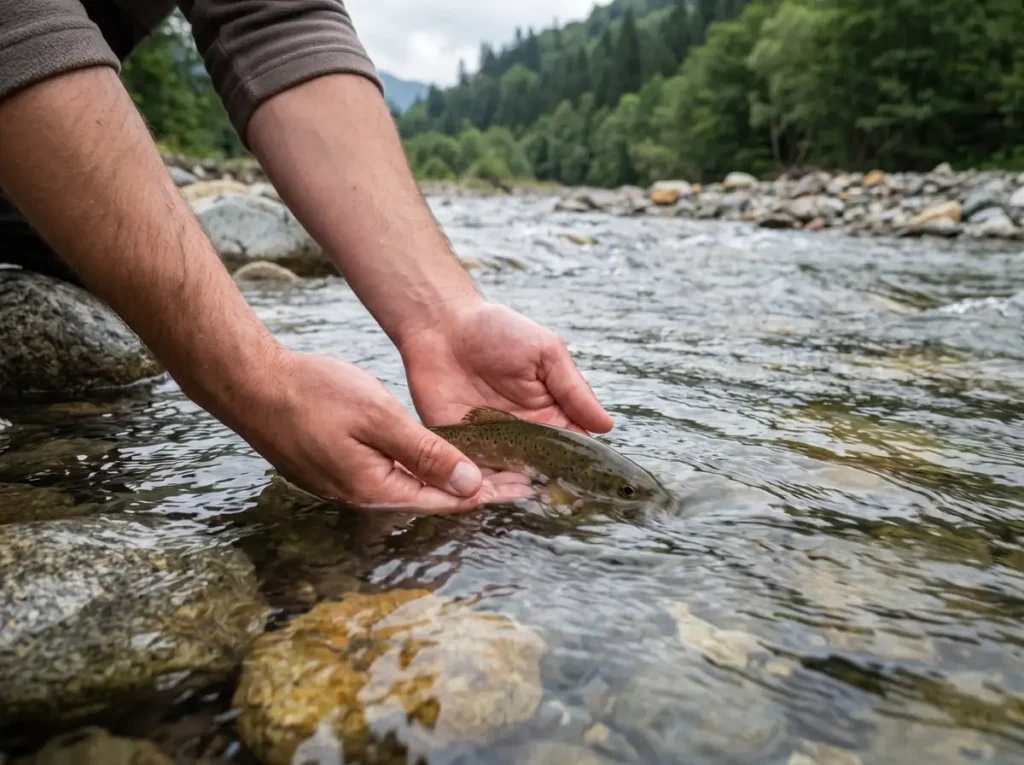
- The Ministry of the Environment has approved a derogation from the ban on capturing fish belonging to strictly protected species, for 1,000 specimens of Mediterranean barbel and 400 specimens of asprete, on the Vâlsan Valley and in the Făgăraș Mountains.
- The fish are caught, measured and released at the same location, unharmed. The derogation runs until 31 December 2026.
- The only beneficiary is the Centura Verde Foundation, through the „Aspretele Trăiește” project, and every action is reported within seven days to the county environmental directorate.
Published: Official Gazette of Romania (Monitorul Oficial) no. 691 of 20 August 2026
Issued: 17 August 2026
The asprete, a fish known only from the Vâlsan river and considered one of the rarest in the world, will be legally caught and measured until the end of the year. The Ministry of the Environment has approved a derogation for 400 specimens, with the obligation that each one be released alive, at the spot from which it was taken. Order of the Minister of the Environment, Waters and Forests no. 1.682 of 17 August 2026, published in the Official Gazette of Romania no. 691 of 20 August 2026, approves a derogation for the purpose of scientific research for two fish species. It is the second act this year through which the ministry steps in on the regime of a single protected species, after the one by which the turtle dove hunting period was cut to zero days. The general rules for recreational anglers have changed in the meantime: MADR Order no. 260/2026 moves the permit online and requires a catch record.
The derogation concerns Article 33(1) of Government Emergency Ordinance no. 57/2007, the text that prohibits, as a rule, the capture of specimens of strictly protected wild fauna species. The order has five articles and an annex containing the report template that the holder must fill in after each outing in the field.
The two species are treated differently in terms of numbers. For Barbus meridionalis, known as the Mediterranean barbel, 1,000 specimens are approved, adults and juveniles alike. For Romanichthys valsanicola, the asprete, or Romanian darter, 400 specimens are approved, again adults and juveniles. In both cases, the table in the order shows the same state of the specimens before and after collection: alive.
On 28 August 2026 the agriculture ministry also extended the list of places where commercially caught fish may be landed and sold: MADR Order no. 250/2026 adds nine entries, almost all of them on the Olt reservoirs.
What it changes in practice
The first effect is the exception from the ban itself. Without this order, capturing an asprete would have remained prohibited, whatever the scientific purpose. The derogation covers three distinct operations: capture, inventory and subsequent release, within three protected natural areas, Valea Vâlsanului (ROSCI0268), Munții Făgăraș (ROSCI0122) and the Valea Vâlsanului Nature Reserve (code 2125).
The second effect is the restriction to a single holder. The capture is carried out only by the Centura Verde Foundation, with specialist technical staff, for the objectives of conserving the asprete under the „Aspretele Trăiește” project. No other organisation and no individual can invoke this order.
The third effect is the obligation to release. The specimens are captured temporarily, for biometric measurements, and released at the same location, unharmed. This is not a harvesting authorisation, but one for controlled handling, and the expected result is a set of data, not a collection of specimens.
The fourth effect concerns the way the work is done in the field. The order prohibits machinery with a high degree of wear or with fuel and lubricant leaks, requires engines fitted with noise attenuators and casings, and imposes limits on activities that produce noise pollution. The holder must comply with the management plans and rules of the areas where it works and must keep records of the waste generated.
The fifth effect is liability for damage. If accidents or interventions occur that harm the conservation objectives or the integrity of the sites, the ecological restoration works are approved by the National Agency for Environment and Protected Areas and are carried out at the holder’s expense. An event that puts the environment at risk is reported immediately to the agency, to the National Environmental Guard and to the ministry.
The sixth effect is the reporting chain, with two deadlines. Within seven days of the capture, the holder sends the county environmental directorate a report for each action, following the template in the annex. The county directorate forwards, within a maximum of 30 days from the application of the derogation, a report on the results to the National Agency for Environment and Protected Areas and to the ministry.
What has changed compared with the previous situation
The underlying rule does not change. The ban in Article 33(1) of Government Emergency Ordinance no. 57/2007 remains in force for everyone. What changes is that, for a limited list of specimens, one named holder and one defined period, it does not apply.
The derogation has an expiry date. It is set from the date the order enters into force until 31 December 2026, so it covers a little over four months. After that date, the order can no longer be invoked, and carrying the monitoring further requires a new act.
The second change is that an additional authorisation appears, separate from the order. Under Article 2(11), for the capture itself the environmental permit for harvesting/capture has to be applied for and obtained. The order lifts the general ban, but it does not take the place of a permit.
The third new element is the documentation. The annex introduces a standard form, with the applicant, the species, the number of specimens, the stage of development, the state before and after collection, the place and date of collection, the means used and the destination of the specimens, plus the reason for the derogation ticked from a list of five options laid down by law.
Advantages and disadvantages
What it improves
- It allows the measurement of a species for which field data are hard to obtain precisely because it is strictly protected.
- It requires release at the same location and without harm, so it does not turn the research into a loss for the population being studied.
- The numbers are capped in the text of the order itself, 1,000 and 400 specimens, rather than left to the holder’s judgement.
- The reporting deadline is short, seven days from the capture, which keeps the authority informed almost in real time.
- It sets out who pays for the ecological restoration if damage occurs, and that is the holder of the activity.
What remains a problem
- The derogation expires on 31 December 2026, while monitoring a rare species needs continuity over several years.
- The order does not provide for the publication of the reports, so the results stay inside the internal circuit between the holder, the county directorate, the agency and the ministry.
- It does not say what happens if a specimen dies accidentally during handling, even though the table asks for the state after collection.
- The 30-day deadline for the county directorate’s report runs from the date the derogation is applied, a less precise wording than the seven days from the capture.
Practical advice
- If you fish on the Vâlsan, bear in mind that the order gives you no right whatsoever. The derogation is granted by name and applies exclusively to the Centura Verde Foundation, with specialist technical staff.
- If you work on a research project on protected species, use this order as a model application. It shows which documents underpin a derogation: the report of the specialist directorate and the opinion of the Romanian Academy.
- Do not confuse the derogation with the permit. Article 2(11) separately requires the environmental permit for harvesting/capture, and its absence is not covered by the order.
- Check the management plan of the protected natural area you enter. The order obliges the holder to observe the management plans, rules and measures of each area concerned.
- Prepare the form in the annex before going out into the field. The seven-day deadline runs from the capture, not from the end of the campaign.
- If you see teams working on the river with noisy machinery or with fuel leaks, report it to the National Environmental Guard. The order expressly prohibits such machinery.
Frequently asked questions
What is the asprete?
Are the captured fish killed?
Who may capture the specimens?
How long is the derogation valid?
Which protected areas are concerned?
What is reported, and within what time?
Original text of the legal act
The text below is reproduced in Romanian, the official form of publication.
The full text, as published in the Official Gazette of Romania
Official Gazette of Romania no. 691 of 20 August 2026 8 pages PDF, 76 KB the act starts on page 7
Open the official PDFDownload the PDF
The viewer is not shown on small screens. Use the buttons above to open or download the file.
This article is for informational purposes only and does not constitute legal advice. For specific situations, consult a licensed attorney or tax advisor.