
In brief
- A collection of 45 works by the sculptor Constantin Antonovici, 21 sculptures and 24 drawings, enters the public domain of the State and the administration of the Ministry of Culture.
- The collection was acquired in 2024 and is entered in the State inventory at 110,700 lei, which works out at under 2,500 lei per work.
- The handover is made under a protocol, within 30 days of entry into force, and the centralised inventory of State assets is amended accordingly.
Published: Official Gazette of Romania (Monitorul Oficial) no. 703 of 25 August 2026
In force from: 25 August 2026
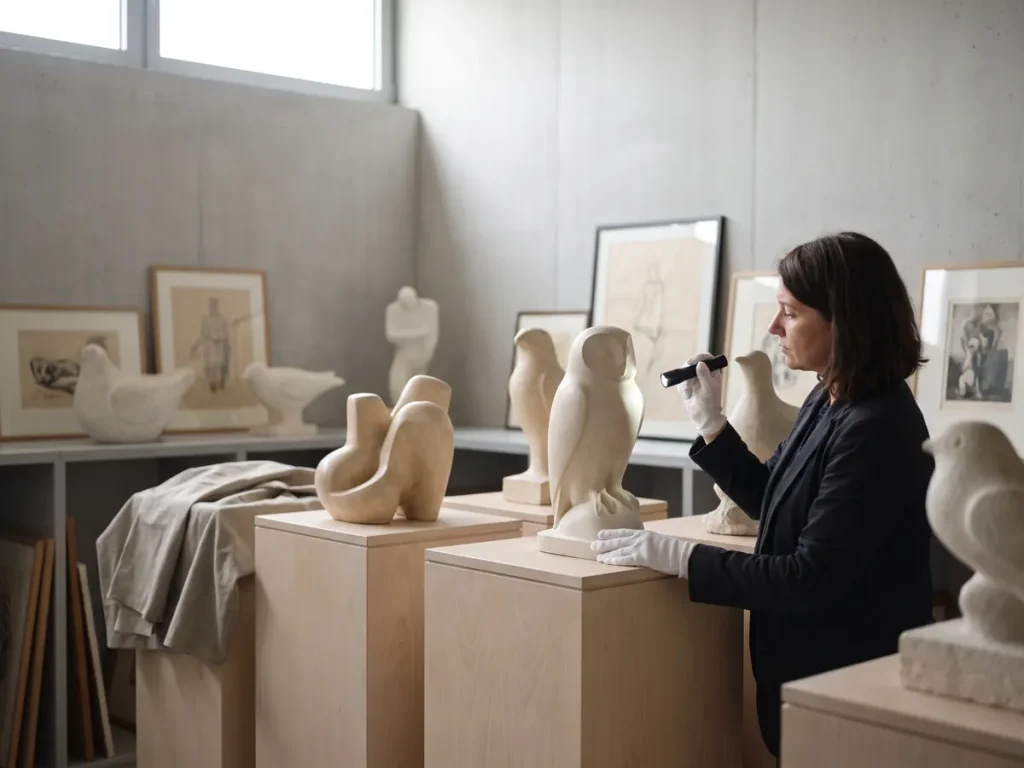
The plaster owls of Constantin Antonovici, an apprentice of Brâncuși, formally pass into the heritage of the Romanian State: 45 works, among them „Marele Brâncuși și coloana infinitului” (Brâncuși the Great and the Endless Column), valued in total at 110,700 lei. Government Decision no. 656/2026, published in Official Gazette of Romania no. 703 of 25 August 2026, enters the collection in the centralised inventory of assets in the public domain of the State and places it under the administration of the Ministry of Culture. It is the second time this summer that Parliament and the Government have acted on cultural memory, after the law that declared Aurel Munteanu a hero martyr.
Antonovici worked in Constantin Brâncuși’s studio in Paris and later in the United States. The owl is the motif that recurs most often in his work, and the collection now entering the heritage of the State contains it in seven sculptural variants and in four further drawings.
The collection was acquired in 2024, under Order of the Minister of Culture no. 2.944/2024, and its inventory value was recorded in the financial and accounting records in 2025. The address given in the annex is in Bucharest, District 3, Bulevardul Unirii no. 22.
The next day, four more assets in the public domain changed status, through Government Decisions no. 645, 646, 654 and 660/2026.
What it changes in practice
The first effect is legal. The collection enters the public domain of the State, which means that it becomes inalienable, immune from seizure and imprescriptible, under the Civil Code.
The second effect is administrative. The right of administration goes to the Ministry of Culture, with the express purpose of showcasing movable cultural heritage.
The third effect concerns the inventory. The number in the records of the Ministry of Finance has still to be allocated, and the classification code is 8.24.06.
The fourth effect is the deadline. Handover and takeover are carried out under a protocol concluded between the parties concerned, within 30 days of entry into force, that is by 24 September 2026.
The fifth effect is accounting. The Ministry of Culture, together with the Ministry of Finance, amends Annex no. 6 to Government Decision no. 1.705/2006, the annex that contains the centralised inventory of assets in the public domain of the State.
The sixth effect concerns what is in the collection. The 21 sculptures are worked in plaster, patinated plaster and wood, and the largest of them, „Bufniță uriașă” (Giant Owl), measures 247.65 centimetres. The 24 drawings and sketches are executed in pencil, conté, gouache, pastel and charcoal, some of them on tracing paper.
The seventh effect is documentary. The annex also records a note in the artist’s own hand on one of the works, on „Plângerea lui Iisus” (The Lamentation of Christ): „ATENȚIE! Piatră de marmorat” (CAUTION! Stone to be marbled). Heritage work under water got its own opening in September 2026: institutions without divers of their own may again apply for underwater research authorisations.
What has changed compared with the previous situation
The first change is one of legal status. Until now the collection was listed as an asset acquired by the ministry in 2024. From 25 August 2026 it is an asset in the public domain of the State, with the special protection the Civil Code gives to that category.
The second change concerns the records. The collection now appears in the centralised inventory of State assets, so it can be followed publicly, with an inventory number and a value.
The third change is one of responsibility. The Ministry of Culture does not merely hold the collection, it administers it for a purpose written into the decision, the showcasing of movable cultural heritage.
The fourth point concerns the value. The 45 works are entered at 110,700 lei in total, which means an average of about 2,460 lei per work. This is an accounting inventory value, not a market valuation.
What does not change is the location. The decision does not order the collection to be moved and does not name a particular museum to display it.
Advantages and disadvantages
What it improves
- The collection receives the legal protection of the public domain: it cannot be sold, seized in enforcement proceedings or acquired by adverse possession.
- The full list of the 45 works is public, with titles, materials and dimensions.
- The purpose is written into the act: showcasing movable cultural heritage, not merely storing it.
- The handover deadline is short, 30 days, so the procedure does not stay in limbo.
- The work of a Romanian sculptor who trained in Brâncuși’s studio enters the official records of the State.
What remains a problem
- The inventory value, 110,700 lei for 45 works, looks low for a single-artist collection and may affect insurance or restoration.
- The decision does not say where the collection will be displayed, nor whether the public will be able to see it.
- The Ministry of Finance inventory number has not been allocated yet, so public tracking of the asset begins later.
- The annex does not state the conservation condition of the works, although many of them are plaster, a fragile material.
- The act makes no provision for money for conservation, restoration or display.
Practical advice
- If you are researching the work of Constantin Antonovici, the annex to the decision is a useful inventory: titles, materials and dimensions for 45 works.
- For viewing, write to the Ministry of Culture. The decision gives it the administration, but does not name an exhibiting institution.
- If you are a museum or a cultural institution and want to borrow works, bear in mind that assets in the public domain may be given for use only under the conditions of the Administrative Code.
- The handover deadline expires 30 days after 25 August 2026. The protocol between the parties is the document that marks the actual transfer.
- To identify the asset in official records, use classification code 8.24.06 and the inventory number that the Ministry of Finance will allocate.
- If you follow State heritage, the decision amends Annex no. 6 to Government Decision no. 1.705/2006, the annex of the centralised inventory.
Frequently asked questions
Who was Constantin Antonovici?
How many works enter the heritage of the State?
How much is the collection worth?
Who administers it?
When does the handover take place?
Can the collection be sold?
Where can I find the full list of works?
Errors and inconsistencies in the published text
- Annex, the sculpture collection, position 5, „Vultur uriaș” (Giant Eagle): the work loses height once the base is added to it. The dimensions of the work are given as 167.86×91.44×11.43 cm, and in brackets 167.64×30.48×20.32 cm „cu bază”, with the base. Adding the base ought to increase the height, not cut it by 22 millimetres, still less to reduce the width from 91.44 to 30.48 cm. That this column uses the brackets for the dimension including the base can be seen from two other positions in the same list: at position 3, „Bufniță” (Owl), the figures are 76.835 cm and 83.82 cm with the base, and at position 7, also „Bufniță”, 66.04 cm and 73.66 cm with the base, so in both cases the value goes up. At position 5, either the bracketed figures are the dimensions of the base itself and the words „cu bază” are wrong, or one of the two sets of measurements has been transcribed incorrectly.
- Annex, the drawings and sketches collection, position 4: the title „Portretul lui Iisus (VEROVIINIQUE)”. The word in brackets exists neither in Romanian nor in French. For a work on this subject the expected form is „Veronique”, that is Veronica, the saint whose veil carries the face of Jesus, a theme that recurs in the religious drawings on the same list, alongside „Coborârea de pe cruce” (The Descent from the Cross), „Iisus ducând crucea” (Jesus Carrying the Cross) and „Plângerea lui Iisus” (The Lamentation of Christ). This is not a simple typographical slip: the annex is the act through which the work acquires its official name in the centralised inventory of assets in the public domain of the State, and it is under that name that it will be searched for, lent and identified from now on.
Editorial analysis
The act has a precise and useful effect: it takes 45 works by a sculptor who worked in Brâncuși’s studio out of the sphere of ordinarily administered assets and places them under the regime of the public domain. Their journey through the administration is worth following, though, because it can be read off the columns of the annex themselves. The collection was acquired in 2024, under Order of the Minister of Culture no. 2.944/2024. The inventory value was recorded in the financial and accounting records in 2025. The decision entering it in the centralised inventory of assets in the public domain of the State appears in August 2026, and the identification number of the Ministry of Finance has still not been allocated, the column saying only that it „se va atribui”, will be allocated. That is almost two years and three acts before an asset bought by the State becomes visible in the State’s own public register.
The most consistent decision in the act is also the most questionable: the 45 works enter the inventory as a single asset. The title of the annex says so in the singular, „datele de identificare ale bunului cultural mobil”, the identification details of the movable cultural asset, and the columns bear it out: one classification code, 8.24.06, one inventory number and one value, 110,700 lei for the lot. No work has a value of its own. „Bufniță uriașă” (Giant Owl), a plaster 2.47 metres tall, and a pencil drawing on tracing paper measuring 41.5×54.5 centimetres weigh exactly the same in the State’s records. The consequences are not theoretical: an insurance policy, a restoration tender or a loan to a museum all work from the value of the asset, and here the value exists only for the collection as a whole. For the same reason, any movement of a single piece touches the entire inventory position.
The second observation concerns the quality of the identification data, the only thing that remains once the works pass out of sight. For these objects the annex is the equivalent of an identity document, and it contains a corrupted name, a set of dimensions that contradicts itself and an incomplete address: „Țara: România, sectorul 3, Bulevardul Unirii nr. 22”, country Romania, District 3, Bulevardul Unirii no. 22, without naming the city, although the column is headed „Adresa”, address. There is no photograph, no individual identification code for any of the 45 works, and no mention of their classification in the national cultural heritage, that is, of the one procedure that would give each piece a file of its own. For assets easily confused with one another, such as seven plaster owls by the same artist, a description in words is thin protection.
Finally, Article 1 grants administration „cu destinația de punere în valoare a patrimoniului cultural mobil”, for the purpose of showcasing movable cultural heritage. The wording is not ornamental, because the right of administration is granted for a purpose and can be argued about on that basis. Except that the act provides no mechanism by which the purpose can be checked: no deadline, no reporting obligation, no exhibiting institution charged with the task. It stays a correctly drafted intention that nobody has any means of measuring.
What should be changed
- A value and an individual code for each work. The annex ought to give, for each of the 45 positions, its own inventory value and a unique identifier, even if the position in the centralised inventory remains a single one. In practice, one owl could be insured, restored or lent without a fresh decision being needed for the whole collection.
- An identification photograph attached to every position. For movable cultural assets an image does more than three dimensions in centimetres, and it can be published on the website of the Ministry of Culture, with a reference in the annex. In practice, a missing piece could be recognised, which with a description reading „ghips, 66×20,32×6,35 cm”, plaster, 66×20.32×6.35 cm, is impossible.
- A statement about classification in the national cultural heritage. The annex ought to show whether the works are classified in the Treasure or the Fund category and, if they are not, within what period the procedure is to be started. In practice, it would be known whether these 45 works enjoy the special regime of protection or only that of the public domain.
- The full address of the place where the collection is kept. The column ought to name the town and the institution that actually holds the space, not only the district and the street. In practice, the handover and takeover protocol due within 30 days would have an identifiable addressee, and the public would know where the collection is.
- A deadline and a form for the showcasing. The act could fix the period within which the Ministry of Culture designates the exhibiting institution and publishes a minimum plan, even if only a temporary display. In practice, the purpose written into Article 1 would become verifiable, and the collection would not stay in storage out of sheer inertia.
Original text of the legal act
The text below is reproduced in Romanian, the official form of publication.
The full text, as published in the Official Gazette of Romania
Official Gazette of Romania no. 703 of 25 August 2026 64 pages PDF, 486 KB the act starts on page 54
Open the official PDFDownload the PDF
The viewer is not shown on small screens. Use the buttons above to open or download the file.
This article is for informational purposes only and does not constitute legal advice. For specific situations, consult a licensed attorney or tax advisor.