
In brief
- A 31-page plan promises to cut the time it takes to permit an offshore wind farm from around 24 months to 12, through a digital one-stop shop, standard forms and a ban on asking for documents the State already holds.
- Almost all the deadlines, however, run from „the going live of the digital solution”, and the plan does not say what that solution is, who builds it or by when: 22 of the 31 deadlines hang on a moment the act puts no date on.
- The plan had to be approved by 31 December 2024, under Article 50 of Law no. 121/2024. It arrived 609 days later.
Published: Official Gazette of Romania (Monitorul Oficial) no. 734 and no. 734 bis of 1 September 2026
In force from: 1 September 2026
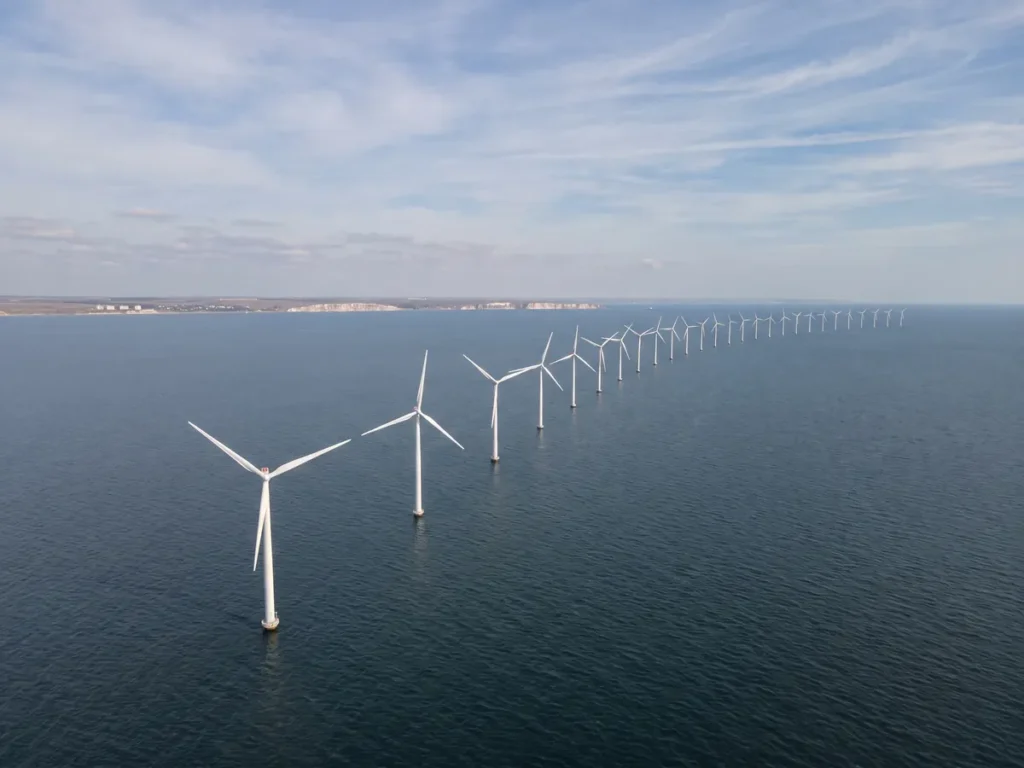
The State proposes to halve the time it takes to permit a wind farm in the Black Sea, but does not say when it starts counting. The joint order of the acting minister of energy, of the minister of economy, digitalisation, entrepreneurship and tourism and of the president of the Competent Authority for the Regulation of Offshore Operations in the Black Sea no. 945/1.349/1.607/2026, published in Official Gazette of Romania no. 734 of 1 September 2026, approves the Action Plan for the simplification and streamlining of the administrative procedures concerning offshore wind energy projects. The order itself has three articles and a single page; the substance sits in the 31-page annex, published separately, in Official Gazette of Romania no. 734 bis of the same day. It comes a day after the package of six acts which laid down the concrete rules on approval, construction and decommissioning, and on the same day, in the neighbouring edition no. 733, there also appeared the Methodology for granting the exploration permit, approved by Order of the minister of energy no. 951/2026.
It is the fourth action plan required by Law no. 121/2024 on offshore wind energy, and the last of them. The law set up four inter-institutional working groups and four plans: the one on ports, in Article 47, approved by Order no. 517/667/2026 and published on 4 August 2026; the one on vocational training, in Article 49, published on 31 July 2026; the one on local supply chains, in Article 48, published on 25 August 2026; and this one, required by Article 50, on administrative procedures. All four had the same legal deadline, 31 December 2024, and all four were published between 31 July and 1 September 2026.
What sets it apart from the other three is its subject. The earlier plans dealt with ports, people and factories. This one deals with the administration itself: the endorsements it asks for, the papers it asks for twice, the deadlines it does not keep and the powers that overlap. Its legal basis, Article 50 of Law no. 121/2024, refers to three specific articles of Government Emergency Ordinance no. 41/2016 on simplification measures: Article 2^1, which forbids institutions to ask for copies of documents issued by other public institutions, Article 2^2, which forbids them to ask for files and stationery, and Article 3^1, which requires free photocopying where paper copies are asked for.
The plan was drawn up by the working group set up by Joint Order no. 740/1.668/1.491/2025 and rests on Approval Report no. 153.397 of 19 August 2026 of the Ministry of Energy. The order was signed on 25 August 2026 by the acting minister of energy, Ilie-Gavril Bolojan, and by the representative of ACROO, and on 28 August 2026 by the representative of MEDAT.
What it changes in practice
The first thing to say is what it does not produce. The plan creates no new rights for the investor and does not by itself shorten any deadline. Point 7.3 says so expressly: the indicators „are indicative in nature and are used exclusively to monitor progress in implementing the measures laid down in the Plan, without constituting individual obligations as to result for the participating institutions”. The plan also says, twice, that the measures „do not alter the requirements or the level of rigour of environmental, safety and security assessments”.
What it does produce are organisational obligations for the administration, with four deadlines that can be checked against a calendar. Each responsible institution has to designate an implementation coordinator, a „focal point”, within 3 months of the approval of the plan, that is by 1 December 2026. The Ministry of Energy, together with the competent institutions, has to carry out a full administrative audit of the current procedures, listing every endorsement, every duration and every overlap, within 6 months, that is by 1 March 2027. Also within 6 months, the process of signing the inter-institutional cooperation protocol has to be started. And the Ministry of Energy „may draw up and publish” an annual report on the state of implementation, by 31 March of each year.
The second effect is the „once only” principle, now written into an act of the sector. The institutions involved in endorsing offshore projects must stop asking for copies of documents which already exist with other public bodies and must obtain them directly, through the interconnection of databases. The stated target is a reduction of at least 50% in the number of documents required of investors. Point 2.1^1 goes further: assessments already filed or carried out in another procedure are not asked for a second time, and clarifications are requested on specific points, „without repeating in full the documentation already filed”.
The third effect is the mutual recognition of assessments. Point 3.1^1 provides that technical, legal, environmental, safety and compliance assessments carried out by one authority are made available to the others and „will be recognised as such, without being repeated in full”. An inter-institutional guide is to establish which types of assessment are recognised, how long they remain valid and in which limited situations an assessment is repeated.
The fourth effect concerns the moment from which an administrative deadline runs, a question which in practice decides cases. Point 3.3 says that the procedural deadline begins „at the moment when the completeness of the documentation filed is confirmed” through the one-stop shop platform, and may be suspended in the event of justified clarifications or additions. It is the only rule of procedure in the whole plan that can be relied on directly.
The fifth effect is an unblocking mechanism. Point 4.3 sets up a „three-stage dispute resolution procedure”: analysis at technical level, mediation between the Ministry of Energy and MEDAT, then escalation to government level. The target is a proposed solution for at least 80% of the cases referred, within 30 days of referral, with fortnightly monitoring meetings and a public half-yearly report.
The sixth effect is transparency. The plan provides for a public electronic register of applications and endorsements, a „live SLA” monitoring panel with average times per stage and the rate of compliance with deadlines, a dashboard updated quarterly and online public consultation for projects with major impact. Legislative or procedural changes have to be reflected on the platform within 15 days of their entry into force, and public consultation reports are published within 30 days of the close of the session.
What has changed compared with the previous situation
The starting point is described by the plan itself, in Annex no. 2: documentation is filed separately with each institution, the same documents are asked for several times, there is no single mechanism for tracking progress, and deadlines differ and are hard to anticipate. The dependencies between procedures „are managed informally”.
The substantive novelty is the digital one-stop shop, abbreviated GUD throughout the text, where it appears 84 times. It is to allow a single application to be filed, distributed automatically to the competent institutions, with notifications on the status of each stage and exchange of data between authorities. The plan does not build it, however, and does not decide what it is. It says that the digital solution „will be established at the design and implementation stage”, and the formula „the possibility of using” existing digital infrastructures „will be examined as a priority” appears four times.
This is where the second novelty comes in, and it has nothing to do with energy. The existing infrastructure the plan is looking at is the Single Electronic Contact Point for Industrial Licences, PCUEL, run by the Industrial Licence Office under Government Emergency Ordinance no. 140/2022 on the single industrial licence. PCUEL appears 32 times in the plan, and OLI 28 times. In Annex no. 2, the single industrial licence has been added as the ninth procedure on the list of those applicable to offshore projects. The formula „where PCUEL is used” appears nine times, always conditionally.
The list of institutions bearing responsibility has changed as well. In Article 50, Law no. 121/2024 named the Ministry of Energy, the Ministry of Research, Innovation and Digitalisation and ACROPO. In the meantime the digitalisation ministry has been reorganised, its tasks have passed to MEDAT, and ACROPO has become ACROO. Annex no. 1 to the plan lists four institutions with named responsibilities, the Ministry of Energy, MEDAT, ACROO and OLI, plus a residual category, „other central public authorities and competent institutions”.
What has not changed, although it was on the table: „administrative silence”, the rule under which the absence of a reply within the deadline counts as approval. Point 3.3 does not introduce it; it says only that its application „will be examined” and that any application of it „will be the subject of a separate legal analysis and of the necessary legislative measures”.
Advantages and disadvantages
What it improves
- The „once only” principle is written out expressly for the offshore sector, with a numerical target: 50% fewer documents required of the investor.
- Assessments carried out by one authority are recognised by the others, without being repeated in full, and clarifications are requested on specific points.
- The moment from which the deadline runs is defined, the confirmation that the documentation is complete, and the plan also says when it is suspended.
- A public register of applications and endorsements, plus a „live SLA” panel with average times per stage, would make it visible where each file stands.
- Blockages between institutions are given a formal three-stage procedure, with 30 days for a proposed solution.
- The plan calls for the reuse of an existing platform rather than the building of a new one, which avoids yet another point of entry for the investor.
What remains a problem
- Of the 31 deadlines expressed with the words „within”, 22 run from the going live of the digital solution, a moment on which the plan puts no date.
- The indicators are declared indicative, „without constituting individual obligations as to result”, so nobody answers if the target is missed.
- There is no funding allocated. The institutions work „within the limits of their powers, of the resources available and of the approved budget framework”.
- Three of the 20 numbered measures have neither an indicator nor a designated responsible body, although point 8.1 promises that every measure will be tracked.
- „Administrative silence” remains merely something to be examined, so the lever that would actually penalise a missed deadline is absent.
- Article 2^2 and Article 3^1 of Emergency Ordinance no. 41/2016, which Article 50 of the law expressly targeted, are dealt with nowhere in the 31 pages.
Practical advice
- If you are preparing an offshore wind project, do not wait for the one-stop shop. The deadlines that produce effects now are those in Government Decision no. 687/2026 and in ACROO Orders no. 13-17/2026, published a day earlier, not the targets in this plan.
- Note the date of 1 December 2026. By then, each institution involved should have designated an implementation coordinator. Ask the institution you deal with for the name.
- The next checkable milestone is 1 March 2027, the 6-month deadline for the audit of procedures and for starting the signature of the inter-institutional protocol.
- When an institution asks you for a copy of an endorsement issued by another public institution, invoke Article 2^1 of Emergency Ordinance no. 41/2016 and point 2.1 of the plan. The ban has been in the law since 2016; the plan only restates it.
- If you are asked for files, ring binders or other stationery, Article 2^2 of the same ordinance forbids it, and the ban applies whether or not the plan mentions it.
- Ask in writing for confirmation that the documentation is complete. The deadline runs from that moment, under point 3.3, and a request for clarifications suspends it.
- A blockage between two institutions can be escalated. The plan provides for technical analysis, then mediation between the Ministry of Energy and MEDAT, then government level, with a proposed solution within 30 days of referral in 80% of cases.
- Keep an eye on the annual implementation report. Point 8.2 says that the Ministry of Energy „may draw up and publish” such a report by 31 March of each year. The verb is „may”, not „shall”, so its absence breaches nothing.
Frequently asked questions
What is this plan, in fact?
Does anything change for investors from 1 September 2026?
How long should it take to permit an offshore wind farm?
What is the digital one-stop shop and who builds it?
From when do the deadlines in the plan run?
Who is responsible for implementation?
How late was the plan?
Do the environmental, safety or defence requirements change?
What happens if the targets are not met?
Errors and inconsistencies in the published text
- Annex no. 2, the table at point 2, items 5 and 6 (Official Gazette of Romania no. 734 bis, pages 30 and 31). At item 5, „Aviz arheologic subacvatic”, the underwater archaeology endorsement, the text „legislația patrimoniului cultural”, cultural heritage legislation, is printed identically in eight successive columns, although it makes sense only in the first of them, the legal basis: it appears as the project stage, as the documentation required, as the dependencies on other procedures, as the estimated duration, as the target duration, as the type of simplification and as the observations. At item 6, „Aviz utilizare infrastructură portuară”, the endorsement for the use of port infrastructure, the text „solicitare utilizare infrastructură, date tehnice (actual); standardizare și integrare GUD (propus)” is printed identically in six successive columns, from the documentation required through to the observations. The plan declares Annex no. 2 to be its „operational instrument”, and the two items remain, as published, without dependencies, without a current duration, without a target duration and without a type of simplification. They are the only two of the nine procedures in the table for which it is impossible to establish what exactly is being simplified and against what progress is measured.
- Point 5.3, „Electronic archiving and traceability of documents” (Official Gazette of Romania no. 734 bis, page 18). The recommendation, the indicator and the responsible bodies attached to this measure concern something other than archiving. The recommendation calls for „the definition of a minimum set of necessary APIs (e.g. Trade Register, ANAF, Cadastre, ANRE, ACROO)” and for „periodic testing of interoperability”, the indicator is „at least 5 functional interconnections with public registers, after the testing and stabilisation phase of the platform, within 6 to 12 months of its going live”, and the responsible bodies are „each institution holding registers (API integration)”. The same sentence appears, word for word, in the body of measure 2.3, „Interoperability of databases” (page 9), and it is also the indicator of that measure. The result is that the measure on electronic archiving is left without an indicator of its own, and the same five interconnections tick off two different measures, although point 8.1 requires „100% of the measures laid down in the Plan” to be tracked through the monitoring mechanism.
Editorial analysis
The problem the plan describes is real, and it is described honestly. In four points, Annex no. 2 admits that the investor today files documentation separately with each institution, that the same documents are asked of him several times, that there is no single mechanism for tracking progress and that the dependencies between procedures „are managed informally”. An official document which writes that about its own administration is a good starting point. What follows the diagnosis, however, is a plan that postpones its own start.
The arithmetic of the deadlines says more than the text. The plan contains 31 deadlines expressed with the words „within”. Of these, 22 run from „the going live of the digital solution used to implement the GUD” or from the going live of the platform, and four run from the approval of the plan. The rest are tied to a procedural event: 30 days from the referral of a blockage, 30 days from the close of a consultation, 90 days from the completion of another, 15 days from the entry into force of a legislative change. In other words, almost three quarters of the plan’s deadlines start from a moment the plan puts no date on, for a digital solution which, on its own admission, „will be established at the design and implementation stage”. It is not even known whether it will be a new platform or an extension of PCUEL: the formula „where PCUEL is used” appears nine times, always in the conditional.
The second observation comes from counting the measures. Chapters 2 to 6 contain 20 numbered measures. Seventeen have an indicator, a deadline and responsible institutions. Three have none of them: point 2.1^1, on the reuse of documentation, point 3.1^1, on the elimination of double administrative assessment, and point 5.4, on interoperability and cyber security. These are precisely the measures on which the central promise depends, that nobody will ask you twice for the same document, and the only measure concerning the security of a system through which the technical documentation of billion-euro investments is supposed to pass. Meanwhile point 8.1 sets as an indicator „100% of the measures laid down in the Plan tracked through the monitoring mechanism”, a target which the plan’s own text makes impossible.
The third observation concerns the relationship between what the plan requires and what was required of it. Article 50 of Law no. 121/2024 does not speak of simplification in general: it refers specifically to three articles of Emergency Ordinance no. 41/2016. Article 2^1, the ban on asking for copies of documents issued by other public institutions, is thoroughly covered, through measure 2.1 and through the target of 50% fewer documents. Article 2^2, which forbids institutions to ask for files, ring binders and any other stationery item, and Article 3^1, which requires free photocopying where paper copies are asked for, appear nowhere in the 31 pages. The words „dosar cu șină”, „birotică”, „papetărie”, „fotocopiere” and „hârtie”, that is ring binder, office supplies, stationery, photocopying and paper, are absent from the text. It may be objected that Article 3^1 does not apply to acts issued by central authorities, so it would largely be without object. Except that the plan expressly involves local authorities and port authorities, to which it does apply.
The fourth observation becomes visible only when the plan is set beside the acts published in the same week. At item 2, Annex no. 2 notes that the methodology for the exploration permit „is to be approved through secondary legislation”, and that the duration of the procedure is „n/a / being defined”. The methodology had already been approved by Order of the minister of energy no. 951/2026 and appeared in Official Gazette of Romania no. 733, on the same 1 September 2026, two numbers away. Item 7 is clearer still: the plan records a current duration of 6 to 12 months for the offshore development approval and sets itself a target of „≤ 6 months”. The rules approved by Government Decision no. 687/2026, published a day earlier, provide that ACROO issues the development approval within 60 working days of the filing of the complete documentation, that is in about three months. The target the plan sets itself for more than a year from now is twice as long as the deadline already in force since 31 August 2026.
What should be changed
- A date for the digital solution, not a condition. If the plan fixed a firm deadline for the decision on the solution, say 6 months from approval, the 22 deadlines which today run from an undated moment would become calculable, and delay in choosing the platform would carry a visible cost instead of quietly postponing everything else.
- An indicator and a responsible body for points 2.1^1, 3.1^1 and 5.4. Without them, the three measures cannot be tracked through the mechanism in point 8.1, and the target of „100% of measures tracked” remains unachievable by construction. For 5.4 the omission is more serious than a matter of form: nobody is named as responsible for the security of the system.
- An indicator of its own for electronic archiving, at point 5.3. The rate of documents archived with a full access history, or the average time needed to retrieve an administrative file, would measure the actual measure. Today, the five interconnections with public registers tick off points 2.3 and 5.3 at the same time.
- Coverage of Article 2^2 and Article 3^1 of Emergency Ordinance no. 41/2016. These are two of the three texts for which the law called for this plan. A one-page measure, with an express ban addressed to the local and port authorities involved in endorsing offshore projects, would complete the mandate given by Article 50.
- Aligning Annex no. 2 with the deadlines already in force. Item 7 should start from the 60 working days in Government Decision no. 687/2026, not from an estimate of 6 to 12 months, and item 2 should reflect the methodology approved on the same day. Otherwise the first revision of the annex will be made in order to correct what was already public on the date of publication.
- A time limit for the administration to reply, not just duration targets. The plan postpones „administrative silence” for later analysis and attaches no consequence to a missed deadline. A simple rule, the automatic publication in the public register of every overrun, with the institution and the number of days, would turn the „live SLA” panel into an instrument of discipline rather than of reporting alone.
Original text of the legal act
The text below is reproduced in Romanian, the official form of publication.
The full text, as published in the Official Gazette of Romania
Official Gazette of Romania no. 734 and no. 734 bis of 1 September 2026 36 pages PDF, 1.9 MB the act starts on page 3
Open the official PDFDownload the PDF
The viewer is not shown on small screens. Use the buttons above to open or download the file.
This article is for informational purposes only and does not constitute legal advice. For specific situations, consult a licensed attorney or tax advisor.