
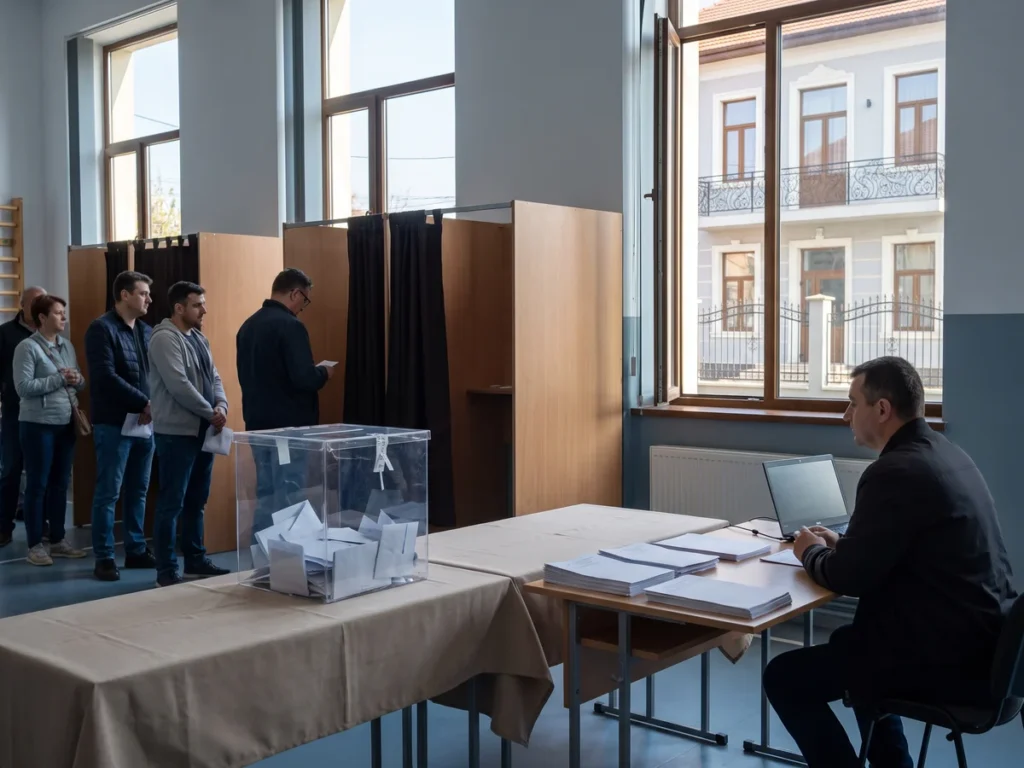
In brief
- Two years after the vote, Parliament approves the ordinance that combined the European Parliament elections with the local ones on 9 June 2024.
- The law changes nothing in the ordinance: it confirms the single polling day, the joint electoral bureaus, simultaneous candidacy for the European Parliament and for a local office, the single mobile ballot box and the voting hours from 7 a.m. to 10 p.m.
- Approval was given by the majority required for organic laws, under Article 76(1) of the Constitution, because electoral matters call for that type of vote.
Published: Official Gazette of Romania (Monitorul Oficial) no. 588 of 20 July 2026
In force from: 23 July 2026
The ordinance that tied the European Parliament elections to the local ones on 9 June 2024 has received Parliament’s approval in July 2026. Law no. 145/2026, published in Official Gazette of Romania no. 588 of 20 July 2026, has a single article and approves Government Emergency Ordinance no. 21/2024, as subsequently amended, without adding or removing anything. It is one of eight laws approving ordinances published in the same issue, alongside the one on property taxation.
The ordinance thus approved was adopted on 8 March 2024 and published the same day, in Official Gazette of Romania no. 195. It provided that the elections for Romania’s members of the European Parliament and the elections for the local public administration authorities would be held on Sunday, 9 June 2024, with the electoral period starting on 12 March 2024 and ending three days after the publication of the results.
Combining the two ballots was decided at the time by emergency ordinance, only a few months before polling day, which produced one of the most contested public debates of that year. The present approval closes the parliamentary procedure on the act without reopening the substance of that debate.
What it changes in practice
The first effect is purely legal: the ordinance can no longer be rejected. Until it is approved, an act adopted by the Government by way of emergency remains pending before Parliament, and rejecting it would have raised questions about the validity of the electoral operations carried out on its basis. Law no. 145/2026 removes that uncertainty.
The second effect is one of precedent. The rules now confirmed become the model that any future combination of ballots will look to. They concern the organisation of a double vote on the same day: joint electoral bureaus for both ballots, separate ballot papers, the same polling stations, the same voting hours and the same stamps bearing the word „VOTAT”, the Romanian for voted.
The third effect concerns the content that has been confirmed. The ordinance provided that a person could stand at the same time for the European Parliament and for the office of local councillor, county councillor, mayor or president of the county council. It also provided that, by way of derogation, local elected officials holding office on the date it entered into force could join any political party in order to stand on its behalf, without losing their mandate.
The fourth effect concerns the logistics of the vote, as they were fixed at the time: voting between 7 a.m. and 10 p.m., a single mobile ballot box that could travel only within the territorial area of the polling station, the printing of ballot papers by the state-owned company „Monitorul Oficial”, allowances of 330 lei for each day of activity for the members of the electoral bureaus, and the ban on a candidate, their spouse, relatives or in-laws up to the third degree sitting on those bureaus.
The fifth effect is budgetary and retroactive by its very nature: the cost of organising the elections was borne by the state budget, through the budgets of the Ministry of Internal Affairs and the Ministry of Foreign Affairs, by way of derogation from several articles of the 2024 state budget law.
What has changed compared with the previous situation
Compared with the text of the ordinance, nothing. The formula used by Parliament is the simplest one available: the ordinance is approved, as subsequently amended. There is no amending article, no addition and no repeal.
What does change is the status of the act. An emergency ordinance produces effects from the moment it is published, but it remains subject to parliamentary scrutiny. From 23 July 2026, the measures taken in 2024 are backed by a law, not merely by an act of the Government.
One procedural detail is worth noting. The law was passed in compliance with Article 76(1) of the Constitution, that is, by a majority of the members of each Chamber, the regime of organic laws. The other approval laws published in the same issue of the Official Gazette of Romania invoke paragraph (2), a majority of those present. The difference comes from the subject matter: the rules governing elections fall within the field reserved to organic laws.
Nothing changes, on the other hand, for future elections. The ordinance referred expressly to the ballot of 9 June 2024, and approving it does not extend those rules to any other election. Any future combination of ballots requires an act of its own.
Advantages and disadvantages
What it improves
- It closes, after two years, the legal uncertainty surrounding the act under which two national ballots were organised.
- It confirms by law a set of technical rules for running a double vote, which remains a reference point for similar situations.
- It removes the theoretical risk that a rejection by Parliament would trigger belated challenges to the electoral operations of 2024.
- It adds no new rules, so it creates no obligations for local authorities or for voters.
What remains a problem
- Two years and four months between the adoption of the ordinance and its approval by law is a gap that is hard to justify for an act affecting a national ballot.
- Approval without amendments means that the criticisms raised in 2024 against combining the elections were neither debated nor settled in the text of the law.
- The rule that allowed local elected officials to switch to any party without losing their mandate is confirmed as it stands, although it was one of the most contested provisions.
- The approval has no practical effect for citizens, because all the operations it refers to are long since completed.
- Parliament did not take the opportunity to lay down general rules on combining elections, so every future situation will again require a separate act.
Practical advice
- If you are researching electoral litigation from 2024, bear in mind that the basis for those operations now includes an approval law, not only the ordinance. A correct citation covers both acts.
- For local administrations, the approval opens no new deadlines and calls for no action. This law generates no reporting obligations.
- If you are interested in the rules for running a double ballot, the ordinance thus approved is the most complete source available in Romanian law, because it describes the solutions that were actually applied.
- Keep in mind the difference between approving an ordinance and amending it. Here Parliament merely approved, so the text remains exactly as published in 2024, with the amendments made up to that point.
- For future elections, always check the specific act governing that particular ballot. The 2024 rules do not apply automatically.
- If you work with data on election funding, Articles 26 and 27 of the ordinance set out precisely which categories of expenditure were covered through the budgets of the two ministries.
Frequently asked questions
Does anything change for voters?
Why did approval take two years?
What does it mean that the elections were combined?
Could a person stand for two offices at once?
What was the rule on local elected officials switching parties?
Does the law apply to future elections as well?
Why was an organic law majority needed?
Original text of the legal act
The text below is reproduced in Romanian, the official form of publication.
The full text, as published in the Official Gazette of Romania
Official Gazette of Romania no. 588 of 20 July 2026 16 pages PDF, 110 KB the act starts on page 8
Open the official PDFDownload the PDF
The viewer is not shown on small screens. Use the buttons above to open or download the file.
This article is for informational purposes only and does not constitute legal advice. For specific situations, consult a licensed attorney or tax advisor.