
In brief
- The Government has approved expenditure of 109,237,906.62 lei excluding VAT, that is, 132,177,867.01 lei including VAT, for 300 sites from which payment of the rovinietă, the charge for using the national road network, and of the TollRo charge will be checked. There are 250 fixed sites, on the national road network, and 50 mobile ones. The execution period is 10 months, and the money is split into 32,177,867.01 lei in 2026 and 100,000,000.00 lei in 2027.
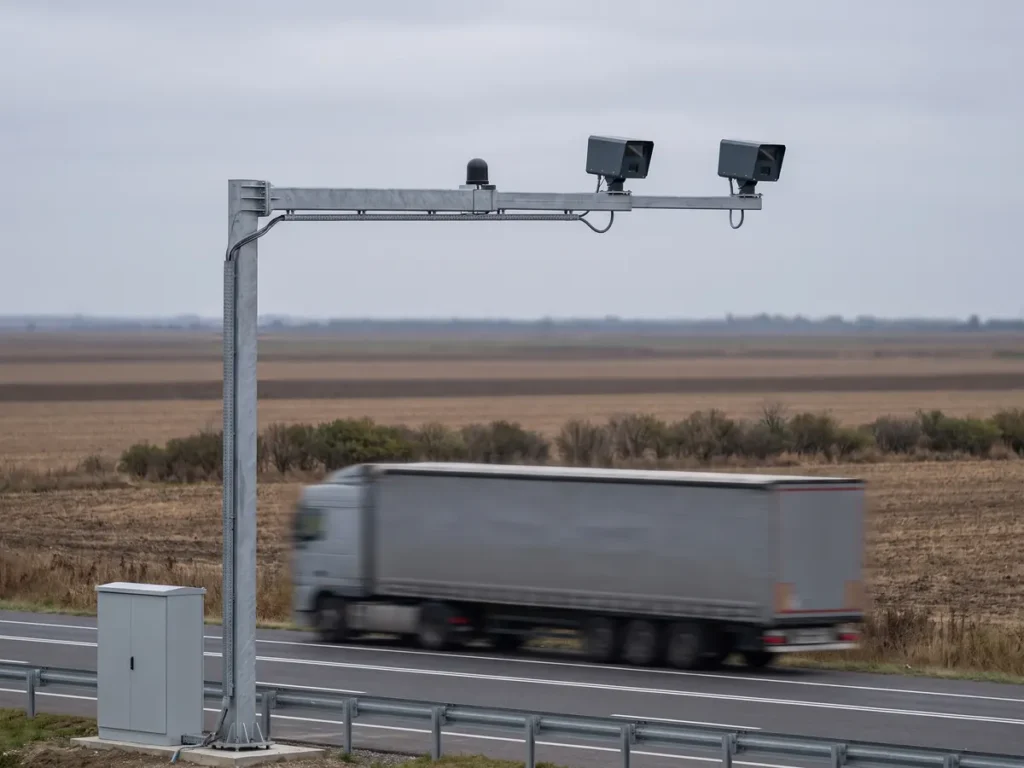
- Most of the sum, 105,241,841.18 lei, that is, 96.3% of the value excluding VAT, goes on equipment, licences, cantilever mounts, installation and utility connections. The purchase covers 1,208 automatic number plate reading cameras for the 250 fixed sites and 50 for the mobile ones, 1,258 in all, plus 500 road signs and 7,500 metres of safety barrier. For all 300 sites, two monitoring workstations are provided.
- The memorandum approved by the Government keeps a target that expires in less than 100 days: shifting 10% of road traffic in passengers and freight to the railways „between 2020 and 2026”. The project now approved has 10 months of execution and finishes, at best, in July 2027. Publicity for the project, 1,125,000 lei, is three times the sum provided for obtaining permits and approvals.
Published: Official Gazette of Romania (Monitorul Oficial), Part I, no. 816 of 24 September 2026
In force from: 24 September 2026, the date of publication
From 24 September 2026, the National Company for Road Infrastructure Administration has approval for the expenditure on the part of the new road charging system that catches drivers who have not paid: 300 control sites, 109,237,906.62 lei excluding VAT and 10 months of execution. The charges those sites will be checking already exist, because the TollRo charge has applied since 31 August 2026, alongside the classic rovinietă. What is new now is not a charge, but the physical infrastructure through which it will be enforced.
The project has two lots. Lot 1, the central IT system, is already under way, with money from the National Recovery and Resilience Plan, on the basis of Government Decision no. 589/2025. The explanatory memorandum lists what has been done on it so far: the analysis of the existing IT system, the design of the TollRo system, the commissioning of equipment in the main data centre, at CESTRIN, and in the secondary one, at Brașov, plus the development of the sales, enforcement and penalty modules. Lot 2, the one approved now, covers the second stage, the purchase of equipment and licences, and the third stage, identifying the locations on the national road network and building the infrastructure.
The enforcement set-up is described figure by figure. There will be 250 fixed sites and 50 mobile ones, and the software licences are bought for all 300. Of the 250 fixed devices, 190 will use cantilever mounts that already exist on the road, and for the other 60 new mounts are being bought, with their utility connections. At each site, signs informing drivers of payment checks and speed limit signs are installed, and over a length of about 30 metres a steel safety barrier with containment level H4 is put in place. That is where the 500 signs in the table come from, two per fixed site, and the 7,500 metres of barrier, 30 metres multiplied by 250.
What is actually being bought: 1,208 automatic number plate reading cameras for the fixed sites and 50 for the mobile ones, 250 video surveillance devices, 250 processing units for the fixed sites and 50 for the mobile ones, 250 power supplies, 250 uninterruptible power supplies, 250 outdoor cabinets, 250 switches, 300 firewalls, 300 geographic positioning devices, 300 time server components, 60 cantilever mounts, 60 utility connections and two monitoring workstations. Technical support for all the components of the system is provided for five years.
The money is divided as follows: 105,241,841.18 lei for equipment, licences, cantilever mounts, installation and connection, 1,500,000.00 lei for supervision services, 1,125,000.00 lei for publicity, 1,000,000.00 lei for price adjustment and 371,065.44 lei for obtaining permits and approvals. A total of 109,237,906.62 lei, plus VAT of 21%, that is, 22,939,960.39 lei, so 132,177,867.01 lei. The financing comes from the Transport Programme 2021-2027 and from the state budget, through the budget of the Ministry of Transport and Infrastructure, and responsibility for how the sums are used rests with the ministry, through the company.
What it changes in practice
The first effect is felt by freight hauliers with vehicles over 3.5 tonnes. For them, the system has to identify at all times the route travelled on the national road network, through on-board equipment, through a phone application connected to satellite or to mobile networks, or on the basis of a user declaration in the form of an electronic route ticket. The charge is set automatically, according to the distance travelled by road category, the characteristics of the vehicle and the Euro emissions class. The 300 control sites are the link that checks whether the charge so calculated has been paid.
The second effect is procedural and reaches the driver directly. The memorandum says expressly that the control sites collect data about the vehicles passing through or within their range, send it to the central IT modules, and there the information is processed and, where appropriate, administrative offence reports are drawn up. In other words, the penalty now starts with a fixed camera, not with a patrol stopping a vehicle in traffic, and the driver learns of the fine afterwards.
The third effect concerns the calendar. The execution period is 10 months, counted from the moment the project starts, so the middle of 2027 at the earliest. The phasing confirms it: 32,177,867.01 lei in 2026 and 100,000,000.00 lei in 2027, that is, 24.3% and 75.7% of the total including VAT. From 24 September to 31 December 2026 there are 99 days left, so this year’s tranche means average spending of about 325,000 lei a day, on a project for which the tender is not even announced in the act.
The fourth effect concerns the unit cost, which is the only figure useful for comparing the project with other investments. The 109,237,906.62 lei excluding VAT divided by 300 sites give 364,126 lei per site, and 440,593 lei with VAT included. The sum covers equipment, licences, installation, utility connections, signage, safety barrier and five years of technical support, but it does not cover subsequent operation, which remains with the company.
The fifth effect is on the company’s budget. The utility connections needed for the fixed sites to work, that is, electricity and communications, are expressly placed on the National Company for Road Infrastructure Administration, and the cantilever mounts are installed through the regional roads and bridges directorates, under maintenance contracts that already exist. So part of the effort falls into the current road maintenance budget, outside the 109.24 million lei.
What has changed compared with the previous situation
Until 24 September 2026, the only part of the road charging project with money approved was Lot 1, the central IT system, through Government Decision no. 589/2025 and with financing from the National Recovery and Resilience Plan. The enforcement part existed as an intention in the structure of the project, but it had neither an approved value nor an established source of financing.
It now has both. Lot 2 receives 109,237,906.62 lei excluding VAT and moves to a different source: the Transport Programme 2021-2027, plus the state budget through the budget of the Ministry of Transport and Infrastructure. The change of source between the two lots of the same project is not explained in the memorandum, but it has a practical consequence: the two stages no longer depend on the same deadlines and the same eligibility conditions.
The level of detail has changed too. The explanatory memorandum approved now contains the full list of equipment, with 17 items and quantities, the number of locations, the length of safety barrier and the number of signs. For the first time it is possible to calculate from public documents how much a road charging control site costs in Romania.
What has not changed is the legal framework of the charges. The obligation to pay comes from Law no. 226/2023 on the application of certain road charges on the national road network in Romania, and interoperability with the systems of the other Member States comes from Government Ordinance no. 8/2022, approved by Law no. 203/2022. The present decision touches none of those texts, changes no charge and introduces no new obligation for road users.
Advantages and disadvantages
What it improves
- It closes the gap between the charge and enforcement. The TollRo charge has applied since 31 August 2026, and until now there was no fixed mechanism for checking payment of it with money approved.
- It puts public figures on a cost that was not known: 364,126 lei excluding VAT per control site, with equipment, installation, signage and five years of technical support included.
- It reuses existing infrastructure. Of the 250 fixed devices, 190 are mounted on cantilever mounts that already exist, so only 60 new mounts are being bought.
- It provides for road safety around each site: speed limit signs and a steel safety barrier with containment level H4, over about 30 metres at each site.
- It includes five years of technical support for all components, so maintenance costs do not come as a surprise in the first year of operation.
- It ties enforcement to the vehicle’s Euro emissions class, which makes the „polluter pays” principle applicable and not only the distance-based charge.
What remains a problem
- Among the objectives of the new charging system, the memorandum keeps the shift of 10% of road traffic to the railways „between 2020 and 2026”, a window that closes on 31 December 2026, that is, 98 days after publication. The project approved has 10 months of execution.
- The summary table puts the whole value excluding VAT, 109,237,906.62 lei, in the column for external non-reimbursable funds, and the VAT of 22,939,960.39 lei in a column with no source indicated, although Article 2 names two sources of financing.
- Publicity for the project costs 1,125,000.00 lei, three times more than obtaining all the permits and approvals, 371,065.44 lei. The memorandum does not explain what is done with that money.
- The price adjustment reserve is 1,000,000.00 lei, that is, 0.95% of the equipment line. For a purchase of hardware and licences running over 10 months, the margin is very thin.
- The 1,208 cameras for 250 fixed sites give 4.83 cameras per site, a number that does not divide exactly and that the memorandum does not break down by location.
- For 300 control sites, two monitoring workstations are provided, and the memorandum does not say how many people operate them and on what shift pattern.
- The table gives 250 switches, but 300 firewalls, 300 positioning devices and 300 time server components, so the mobile sites receive part of the network equipment and not the rest, with no explanation.
- The memorandum describes the rovinietă as applying to freight vehicles „mai mică de 3,5 tone”, under 3.5 tonnes, and TollRo to those „> 3,5 tone”, over 3.5 tonnes, so a vehicle with a maximum authorised mass of exactly 3.5 tonnes, the most common threshold in light transport, appears in neither of the two categories.
Practical advice
- If you run freight vehicles over 3.5 tonnes, check now which of the three ways of reporting your route you are using: on-board equipment, phone application or electronic route ticket. Automatic enforcement checks payment, not good intentions.
- Update the Euro emissions class of every vehicle in your fleet in your own records. The charge, and therefore the check on it, is based on that class, and a wrong classification produces payment differences.
- Do not expect patrols stopping vehicles in traffic. The offence report is drawn up on the basis of the data collected by the cameras and sent to the central modules, so notification comes after the event, to the address of the keeper.
- If you use the electronic route ticket, keep the proof for every journey. It is the only form in which payment rests on a user declaration, and therefore also the easiest for the other side to contest.
- Construction and telecommunications firms working with the regional roads and bridges directorates can follow the works installing the 60 new cantilever mounts and the utility connections, which are carried out under existing maintenance contracts, not through a new tender.
- Equipment suppliers can read the list in the annex as tender specifications given in advance: 17 items, quantities, five years of technical support included and a price adjustment reserve of only 1,000,000.00 lei.
- If you are interested in the locations, bear in mind that they have not yet been fixed. Identifying the control sites is part of the third stage of the project and runs alongside the purchase of the equipment.
Frequently asked questions
What exactly did the Government approve?
How many control sites will there be, and where?
What is checked at these sites?
How is the fine imposed?
When does the enforcement system start working?
What money pays for it?
Does anything change in the charges I pay now?
What has already been done on Lot 1?
Editorial analysis
The act solves a real problem, and it solves it in the wrong order compared with what the public was told. The distance-based charge for lorries has applied since 31 August 2026, while the fixed mechanism for checking payment of it obtains expenditure approval only on 24 September 2026, with an execution period of 10 months and a phasing that puts the bulk of the money into 2027. Between those two moments, enforcement rests on what already exists, that is, on patrols and on the old system, and the explanatory memorandum implicitly admits as much when it describes the analysis of the existing IT system as the starting point.
The first observation that cannot be seen by reading the act from start to finish turns on a date. Among the objectives the new charging system „has to include” is the shift of 10% of road traffic in passengers and freight to rail transport „between 2020 and 2026”. That window closes on 31 December 2026, that is, 98 days after the decision was published, and the project that is supposed to contribute to it starts now and lasts 10 months. The text was carried over, without updating, from an earlier generation of public policy documents. The comparison is easy to make: in August 2026, the Government noted in the railway strategy for 2026-2030 that 1,688 kilometres of railway are under speed restrictions. A modal shift target framed for 2020-2026 cannot be met by a railway reporting its own restrictions in 2026.
The second observation concerns a figure that does not divide. The table calls for 1,208 automatic number plate reading cameras „for the 250 fixed sites”, so 4.83 cameras per site. The number is not a whole one, which means the locations are not identical, probably because they have different numbers of lanes. The explanation is plausible, but the memorandum does not give it, and without it there is no way of checking either whether 1,208 covers the network or how the number was arrived at. The other quantities, by contrast, check out at once: 500 signs for 250 fixed sites are exactly two per site, and 7,500 metres of barrier are exactly 30 metres at each of the 250, as the text provides.
The third observation concerns the network equipment, where the quantities tell a story the text does not. There are 250 switches, but 300 firewalls, 300 geographic position devices and 300 time server components. The difference of 50 corresponds exactly to the mobile sites, which therefore receive a firewall, positioning and time synchronisation, but no switch. In a system where the evidence produces administrative offence reports, time synchronisation and position are essential, and their presence at the mobile sites is coherent. The absence of a switch suggests a different communications architecture at the mobile sites, but the memorandum does not describe it.
The fourth observation concerns the proportions within the project budget. Equipment, licences, cantilever mounts, installation and connection take 105,241,841.18 lei, that is, 96.3% of the value excluding VAT. What is left is divided between supervision, 1,500,000.00 lei, publicity, 1,125,000.00 lei, price adjustment, 1,000,000.00 lei, and permits, 371,065.44 lei. Two of those lines deserve questions. Publicity costs three times more than all the permits and approvals together, for a project that sells nothing and asks nothing of the public. The price adjustment reserve, by contrast, is only 0.95% of the hardware line, for a purchase of equipment and licences running over 10 months, in a market where the prices of electronic components move a great deal more than 1% in a year.
The fifth observation concerns VAT. Article 2 of the decision names two sources of financing, the external non-reimbursable funds from the Transport Programme 2021-2027 and the state budget through the budget of the Ministry of Transport and Infrastructure. The summary table in the annex, however, puts the whole value excluding VAT, 109,237,906.62 lei, in the column for external funds and enters the VAT of 22,939,960.39 lei in a column headed merely „Valoarea – lei TVA”, value in lei, VAT, with no source at all. The usual practice is for non-eligible VAT to be covered from the state budget, and combining Article 2 with the table leads to that conclusion. We have not flagged it in the errata because the two texts, read together, leave only one reasonable reading. What remains is that a table of 22.9 million lei does not name who pays.
Finally, an observation about references. The memorandum cites „Directiva (UE) nr. 362/2022 a Parlamentului European și a Consiliului din 24 februarie 2022”, Directive (EU) no. 362/2022 of the European Parliament and of the Council of 24 February 2022, whereas the official form of the number is Directive (EU) 2022/362, with the year before the number. The act is identifiable, because the date and the subject matter cited, the amendment of Directives 1999/62/EC, 1999/37/EC and (EU) 2019/520, match exactly, so this is not an error with legal consequences. It is, however, an inversion that spreads: anyone searching for „Directive 362/2022” in the European databases finds nothing.
What should be changed
- The modal shift target should be recalibrated or taken out of the memorandum. A 2020-2026 window in a document approved in September 2026, for a project lasting 10 months, is not an objective but a piece of text left over from another generation of documents. Replacing it with a target dated after 2027 would make the memorandum verifiable at the end.
- The summary table should name who pays the VAT. One word at the head of the column, „state budget”, would turn 22,939,960.39 lei from a sum with no source into a clear obligation, and Article 2 would no longer have to be read together with the table in order to understand the split.
- The publicity line should be itemised or reduced. 1,125,000.00 lei for communicating a project that enforces payment of road charges calls for a justification by activity, particularly when all the permits and approvals cost 371,065.44 lei.
- The price adjustment reserve should be sized to the real risk of the hardware market. 0.95% of the equipment line, over 10 months, produces either a renegotiation or a saving on specifications. A usual percentage, of a few units, would cost less than a stalled procurement.
- The memorandum should break the 1,208 cameras down by category of location. A table with the number of lanes and the number of cameras by type of fixed site would show how the figure was arrived at and would make coverage of the network verifiable.
- The mass threshold should be written without a gap. The current wording puts the rovinietă on freight vehicles „under 3.5 tonnes” and TollRo on those over 3.5 tonnes, leaving out precisely the 3.5-tonne vehicle. „Up to and including 3.5 tonnes” closes the problem in five words.
- The number of monitoring stations should be matched to the number of sites. Two workstations for 300 control sites generating offence reports call for a sizing justification, with working hours and number of operators, otherwise processing capacity becomes the system’s real limit.
Original text of the legal act
The text below is reproduced in Romanian, the official form of publication.
The full text, as published in the Official Gazette of Romania
Official Gazette of Romania no. 816 of 24 September 2026 8 pages PDF, 77 KB the act starts on page 2
Open the official PDFDownload the PDF
The viewer is not shown on small screens. Use the buttons above to open or download the file.
This article is for informational purposes only and does not constitute legal advice. For specific situations, consult a licensed attorney or tax advisor.