
In brief
- The Ministry of Energy is setting up verification and control teams for the energy label of products, each made up of 3 specialists from its own staff, appointed by order of the head of the institution.
- Checks are carried out on paper, visually, on the shop floor and online, and the teams may request technical documentation, may propose corrective and restrictive measures and report into the European registers EPREL and ICSMS.
- Businesses are notified in advance of who is coming to inspect them. The order comes against the background of infringement case INFR(2025)2074 on energy labelling and ecodesign.
Published: Official Gazette of Romania (Monitorul Oficial) No 665 of 11 August 2026
In force from: 11 August 2026
The energy label on your fridge or your washing machine has been around for years, but who checks whether the letter printed on it matches reality? Until now, in practice, almost nobody. The Ministry of Energy is now creating the teams that will do exactly that. Order No 797/2026 of the interim Minister of Energy was published in Official Gazette of Romania No 665 of 11 August 2026 and approves the setting up of the teams that verify and control the energy label. It is the second move of this summer on energy efficiency, after Law No 168/2026 on the decarbonisation of heating and cooling.
The legal basis is twofold. Domestically, article 3 of Law No 121/2014 on energy efficiency gives the Ministry of Energy, through its energy efficiency unit, powers over the energy labelling of certain categories of products and recognises it as the national authority competent for market surveillance in this field. At European level, article 7(4) of Regulation (EU) 2017/1369 asks member states for precisely this: to check.
The concrete reason behind the order is more direct, and it is written into the preamble: the need to make market surveillance operational, including in the context of infringement case INFR(2025)2074 on energy labelling and ecodesign. In other words, Romania is already facing proceedings before the European Commission for failing to put this control in place, and the order is the administrative answer.
The teams do not work alone. They may call on the specialist support of the Romanian Society of Energy Auditors and Managers, SAMER, under Cooperation Protocol No 243.106 of 31 January 2025 in the field of energy efficiency. In addition, the teams may include, where appropriate, specialists from the National Authority for Consumer Protection or from other authorities with relevant market surveillance powers, brought in under the conditions laid down by law.
What it changes in practice
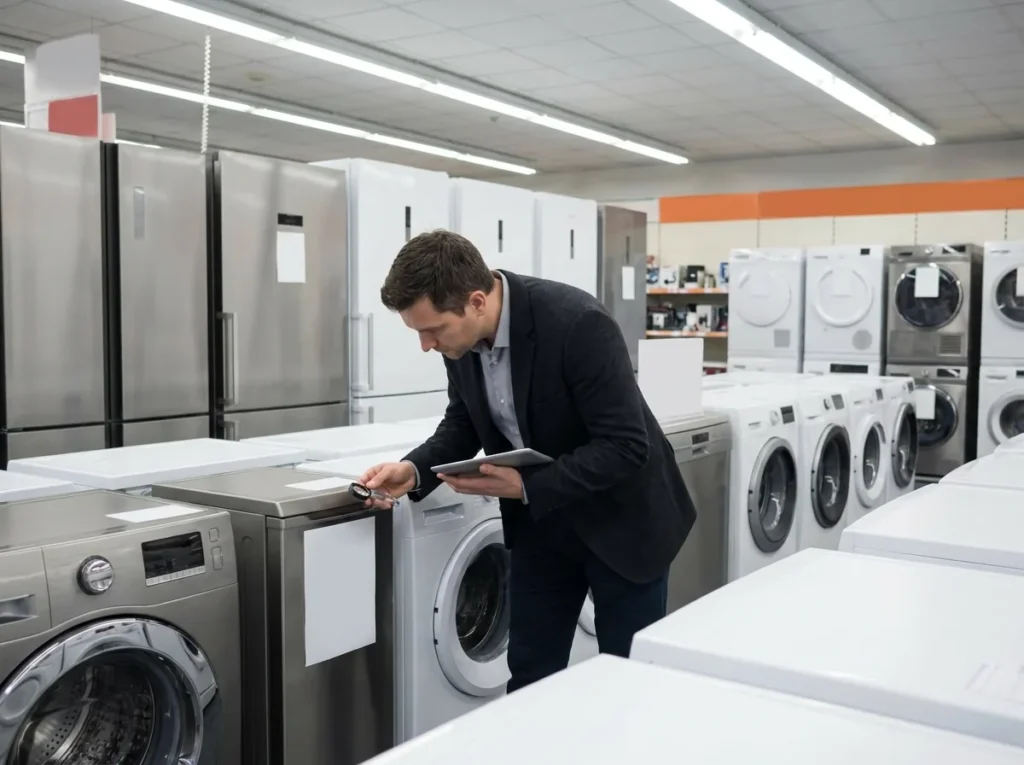
Enforcement extends online, not just to the shop floor. Article 2 explicitly lists documentary and visual checks, checks at physical points of sale and checks in the online environment. A shop that displays the wrong energy class on its website can be inspected just like one with a window on the high street.
The business knows in advance who is coming. The identification details of the verification and control team are notified in advance to the operators subject to control measures. This is not a surprise inspection, but an announced one.
The teams can demand technical documentation and propose measures. Beyond the check itself, they request technical documentation from businesses and propose corrective and restrictive measures. The order does not set the penalties; it sets the mechanism through which non-compliance comes to be established.
The data feeds two European registers. The teams supply the information needed for reporting into EPREL, the European Product Registry for Energy Labelling, and into ICSMS, the Information and Communication System on Market Surveillance. This is the part that matters for the infringement file.
The actual procedure is still to be published separately. Checks are to be carried out in line with the operational procedure on the verification of the energy label, which will be approved by a further order of the Minister of Energy and published in the Official Gazette of Romania as well. Until then, the framework remains incomplete.
What has changed compared with the previous situation
Until now, the market surveillance power in the field of energy labelling existed on paper, in Law No 121/2014, but there was no structure to exercise it. The order creates precisely that missing link: named teams, with a fixed membership of three specialists and a clear list of the types of checks they carry out.
The second new element is the opening towards other institutions. Bringing in specialists from the National Authority for Consumer Protection acknowledges a practical fact: the energy label is at once a matter of energy efficiency and a matter of accurate consumer information, and the two authorities were ending up in the same shop anyway.
Cooperation with SAMER brings in technical expertise from outside the ministry, on the basis of a protocol signed back in January 2025. In effect, the ministry admits that on its own it lacks the technical capacity to assess label compliance across every category of product.
The European reference framework has been consolidated in the meantime too, through Government Ordinance No 20/2023, which applies Regulation (EU) 2019/1020 on market surveillance, and through Directive (EU) 2023/1791 on energy efficiency. The order sits on top of these rules without amending them.
Advantages and disadvantages
What it improves
- Consumers gain a real guarantee that the letter on the label means something, because someone finally turns up to check it.
- Honest retailers no longer compete against those advertising better energy classes than the real ones.
- Checking the online environment covers exactly the area where the label was easiest to manipulate or leave out.
- Bringing in the National Authority for Consumer Protection avoids duplicating inspections on the same subject.
- Reporting into EPREL and ICSMS aligns Romania with European practice and responds directly to the infringement proceedings.
What remains a problem
- Three specialists from the ministry’s own staff are few for a market with thousands of product models and hundreds of retailers.
- Notifying the team’s details in advance removes the element of surprise and leaves time for last-minute corrections.
- The operational procedure, meaning the actual rules governing the inspection, has not been published yet, so the order on its own produces no checks.
- The order lays down no penalties of its own, only the proposal of measures, which leaves the final effect to other pieces of legislation.
- The measure comes after the infringement proceedings were opened, not before, which shows a reactive pace of regulation.
Practical advice
- If you sell energy-related products, check your technical documentation now. The teams can request it, and its absence is the first non-compliance established in practice.
- Keep an eye on what you display in your online shop, not just in the physical one. Checks in the online environment are expressly provided for in article 2 of the order.
- Make sure your products are correctly registered in EPREL. The European register is one of the sources underpinning the control teams’ reporting.
- When you receive the notification with the team’s details, prepare the full file, not just the label: the product fiche, the technical documentation and the declaration of conformity.
- Watch for the publication of the operational procedure in the Official Gazette of Romania. It will contain the concrete rules governing how the check is run.
- As an ordinary buyer, compare the label with the product fiche in EPREL. The QR code on the label leads straight to the official entry.
Frequently asked questions
Who actually carries out the energy label inspection?
Is the inspection announced or unannounced?
What kind of checks are carried out?
What are EPREL and ICSMS?
Why is this order appearing now?
Can fines be issued on the basis of this order?
Original text of the legal act
The text below is reproduced in Romanian, the official form of publication.
The full text, as published in the Official Gazette of Romania
Official Gazette of Romania no. 665 of 11 August 2026 16 pages PDF, 121 KB the act starts on page 2
Open the official PDFDownload the PDF
The viewer is not shown on small screens. Use the buttons above to open or download the file.
This article is for informational purposes only and does not constitute legal advice. For specific situations, consult a licensed attorney or tax advisor.