
In brief
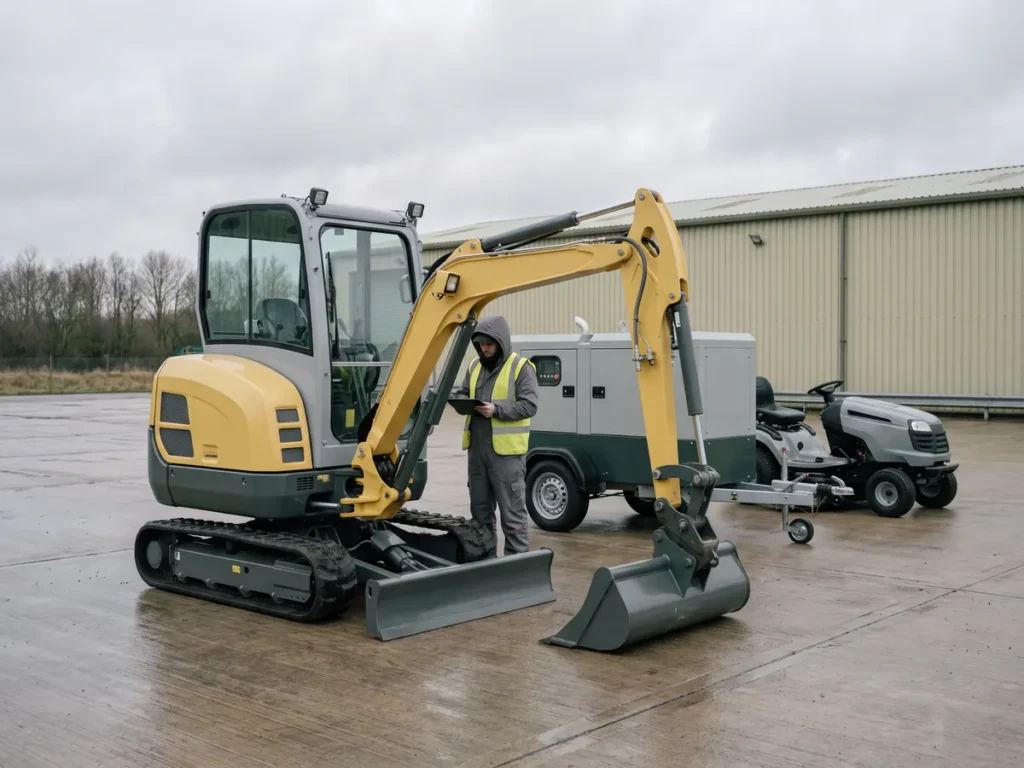
- Machinery used outdoors, from generators and compressors to excavators and lawnmowers, will be able to be placed on the Romanian market without CE marking, but only if the European Union activates the internal market emergency mode, and only for as long as it lasts.
- Equipment that reaches the market this way has to carry a visible statement that it is a „bun relevant în situații de criză”, a crisis-relevant good, and the label has to be clear, legible and drafted in Romanian.
- An obligation almost twenty years old also disappears: manufacturers no longer send the Labour Inspectorate and the European Commission a copy of the declaration of conformity for each type of equipment.
Published: Official Gazette of Romania (Monitorul Oficial) no. 730 of 31 August 2026
In force from: 31 August 2026
Romania is preparing its rules for the situation in which the European market seizes up and a machine has to get quickly to where it is needed. Government Decision no. 679/2026, published in Official Gazette of Romania no. 730 of 31 August 2026, amends Government Decision no. 1.756/2006 on limiting the level of noise emissions produced by equipment for use outdoors and transposes Article 1 of Directive (EU) 2024/2.749. It belongs to the same family of European instruments as the platform through which the single industrial licence is now obtained online, which serves the contact points for critical raw materials and net-zero technologies.
The basic act, dating from 2006, sets out how much noise machinery used outdoors is allowed to make and how that is proved. It covers self-propelled or movable machines intended for use in the open air, plus non-powered equipment for industrial or environmental applications. In practice, everything that works on a building site, in a garden or in a park and can be heard.
The novelty has nothing to do with noise, but with what happens when the Union declares an internal market emergency. The decision introduces a new chapter, XV^1, with four articles, which is activated only if the European Commission adopts an implementing act under Article 28 of Regulation (EU) 2024/2.747, and only for equipment designated as crisis-relevant goods.
What it changes in practice
The first effect is the derogation from CE marking. Under the emergency mode, equipment for which the Commission has extended the validity of an authorisation issued by one Member State to the whole Union may be placed on the Romanian market. Such equipment does not carry the CE marking, by express exception from the ordinary rules, but it has to display the information that it is being placed on the market as a crisis-relevant good. The information and the labels have to be clear, easy to understand, legible and drafted in Romanian.
The second effect concerns notified bodies, that is the laboratories and institutions that certify conformity. They have to give priority to applications concerning equipment on the Commission’s list, regardless of whether the applications were filed before or after the emergency mode was activated. Prioritisation may not generate disproportionate additional costs for manufacturers, and the bodies have to make reasonable efforts to increase their testing capacity.
The third effect is on market control. The control body gives priority to the surveillance of equipment on the Commission’s list, coordinates through the Union Product Compliance Network and may assist other national authorities, including by sending expert teams or making testing capacity available. When it takes corrective measures on equipment authorised under the emergency mode, it has to inform the Commission and the authorities of all the other Member States within 24 hours, through the ICSMS system.
The fourth effect is a permanent simplification which has nothing to do with any crisis. Article 16 of the 2006 decision, which required the manufacturer or its authorised representative to send the Labour Inspectorate and the European Commission a copy of the declaration of conformity for each type of equipment placed on the market in Romania, is repealed.
The fifth effect is that Romania is giving up its own method of measuring noise. Annex no. 3 to the 2006 decision, „Metodă de măsurare a zgomotului emis în aer de echipamentele utilizate în exteriorul clădirilor”, the method for measuring airborne noise emitted by equipment used outdoors, is repealed, and all references to it are replaced by references to the annex to Delegated Regulation (EU) 2024/1.208.
What has changed compared with the previous situation
The 2006 regime had a single route: a piece of equipment reached the market after the conformity assessment procedure, with the CE marking and with the guaranteed sound power level indicated. There was no situation in which the rule could be suspended. There is one now, but subject to three cumulative conditions written into Article 17^1: the Commission must have adopted the implementing act, the equipment must have been designated a crisis-relevant good, and the arrangement lasts as long as the emergency mode. One provision survives the deactivation of the mode, Article 17^3(6), on the immediate application of Commission acts adopted on imperative grounds of urgency relating to the health and safety of persons.
Who receives the information changes too. Until now the control body informed the Ministry of Economy and Trade, and Article 10(4) provided a communication route of its own. Now the Commission and the Member States are informed through the Information and Communication System for Market Surveillance, ICSMS, under Government Ordinance no. 20/2023, and that paragraph is repealed. The name of the ministry is updated throughout to „Ministerul Economiei, Digitalizării, Antreprenoriatului și Turismului”, the Ministry of Economy, Digitalisation, Entrepreneurship and Tourism.
For anybody living next to a building site, nothing changes. The sound power limit values stay as they are in the act, and Article 17, which allows the competent authorities to restrict the use of equipment in areas considered sensitive, including by limiting working hours, has not been touched.
Advantages and disadvantages
What it improves
- In a crisis, a machine that is urgently needed can reach the market without waiting for the full certification procedure, but only on the basis of an authorisation extended by the Commission to the whole Union.
- The derogation is tightly framed: three cumulative conditions, a list of equipment drawn up by the Commission and a duration limited to the emergency mode.
- The label has to be in Romanian and to state expressly that the product is placed on the market as a crisis-relevant good, so the buyer can tell the difference.
- Manufacturers are freed from having to send a copy of the declaration of conformity for each type of equipment, a formality dating from 2007.
- The noise measurement method is aligned directly with the European regulation, so there is no longer a national text left behind at every update.
What remains a problem
- Equipment without the CE marking reaches the market alongside equipment that carries it, and the only distinguishing sign is a statement on the label.
- Prioritising applications at notified bodies means ordinary applications drop down the queue, and the act says nothing about what happens to them.
- What happens to equipment still on the market after the emergency mode is deactivated is settled by Commission acts, not by this text.
- The obligation repealed by Article 16 disappears without being replaced by anything else, so the record of declarations of conformity now sits with the manufacturer alone.
- The new chapter cannot operate on its own: without the Commission’s implementing act, the four articles are written, in force and inert.
Practical advice
- If you manufacture or import outdoor machinery, stop sending the copy of the declaration of conformity to the Labour Inspectorate and to the European Commission. The obligation has been repealed, but the declaration itself remains mandatory and has to be kept.
- Update the references in your technical documentation. Annex no. 3 to the 2006 decision no longer exists; the noise measurement method is the one in the annex to Delegated Regulation (EU) 2024/1.208.
- If you are buying a machine and it has no CE marking, check whether it carries the statement that it is a crisis-relevant good. Outside an emergency mode activated by the Commission, the absence of the CE marking remains an irregularity.
- If you are a notified body, prepare your prioritisation procedure in advance. The obligation also covers applications filed before the mode is activated, not just new ones.
- If you operate equipment in residential areas, bear in mind that the rules on use have not changed. Local authorities can still limit operating hours in the areas they consider sensitive.
- Keep an eye on the Commission’s implementing acts. Without them the emergency chapter produces no effect at all, and the list of equipment covered is drawn up there and nowhere else.
Frequently asked questions
Which equipment is covered?
When can the CE marking be dispensed with?
How do I recognise such a piece of equipment?
Are the noise limits changing?
Which obligation has gone for manufacturers?
What happens if equipment authorised during a crisis turns out to be dangerous?
Do these rules apply from today?
Editorial analysis
The act solves a problem that the pandemic and the energy crisis made plain: when the internal market seizes up, the ordinary certification rules become an obstacle precisely for the products that are needed fastest. The Union built Regulation (EU) 2024/2.747 for that, and Directive (EU) 2024/2.749 pushed the mechanism down into ten product directives. Romania is transposing here the part that concerns the noise of outdoor equipment. It is a sound transposition and, unlike many others, one made with clear cumulative conditions rather than elastic wording.
What is not apparent from reading the act end to end is that it contains two unrelated things. The emergency chapter is a conditional future: it produces no effect until the Commission presses the button, and if it never presses it, the four articles remain a dead letter. The repeal of Article 16, on the other hand, produces effects from today and for everyone. A compressor manufacturer no longer sends anything to the Labour Inspectorate or to the Commission, an obligation that had existed since January 2007. It is the only change in this act that anybody will feel in the coming month, and it is tucked away at point 7 of a single article with ten points.
The third observation concerns the control architecture. The new text sets three deadlines, but only one of them belongs to Romania: the 24 hours within which the control body has to inform the Commission and the other Member States after a corrective measure. The rest, that is the list of equipment, the conditions for placing on the market, the labelling and traceability requirements, the corrective or restrictive measures, are settled by Commission acts. In other words, under the emergency mode the Romanian authority acts fast but decides almost nothing.
One figure is worth adding for context. The 2006 decision entered into force on publication in Official Gazette of Romania no. 48 of 22 January 2007, and Article 16 survived nineteen years, even though the obligation it imposed, sending a copy on paper or by email to two institutions, had been overtaken by European systems such as ICSMS back in the previous decade. The repeal comes attached to the transposition of a directive about something else, which tells you that clean-ups of this kind happen here occasionally rather than systematically.
What should be changed
- A rule for equipment left on the market after the emergency mode closes. The text says the measures apply for as long as the mode lasts, but an excavator sold in that period stays in use for ten years. Who checks its conformity afterwards, and on what basis, ought to be stated in the decision rather than left entirely to Commission acts.
- A deadline for the ordinary applications pushed behind the priority ones. The prioritisation in Article 17^2 is necessary, but it creates an invisible queue. A maximum period for resuming them, counted from the deactivation of the mode, would protect manufacturers who do not make crisis goods.
- A public register of equipment placed on the market without CE marking. The statement on the label is useful on the shelf, but it does not help with resale, with hire or with a later inspection. A list published by the control body would solve that at minimal cost.
- A systematic clean-up of reporting obligations that have become pointless. Article 16 was repealed on the occasion of a transposition. A pass of this kind would be worth making through all the product decisions that still require paper submissions to institutions which already receive the same data through ICSMS.
- A public announcement at the moment of activation. If the emergency mode is activated, buyers and users ought to learn of it from somewhere other than the Official Journal of the Union. An announcement by the control body, with the list of equipment covered, would be the minimum mechanism.
Original text of the legal act
The text below is reproduced in Romanian, the official form of publication.
The full text, as published in the Official Gazette of Romania
Official Gazette of Romania no. 730 of 31 August 2026 16 pages PDF, 109 KB the act starts on page 2
Open the official PDFDownload the PDF
The viewer is not shown on small screens. Use the buttons above to open or download the file.
This article is for informational purposes only and does not constitute legal advice. For specific situations, consult a licensed attorney or tax advisor.