
In brief
- The Senate has approved a parliamentary inquiry by the Committee on Constitutionality into the meeting held on 14 August 2026 between interim Prime Minister Ilie Bolojan and the President of the Constitutional Court, Judge Elena-Simina Tănăsescu.
- The committee must clarify the circumstances, nature and purpose of the meeting, the topics discussed and why it took place in the office of the President of the Senate.
- The report goes to the Standing Bureau within 14 days, that is by 7 September 2026.
Published: Official Gazette of Romania (Monitorul Oficial) no. 701 of 24 August 2026
Adopted: 24 August 2026
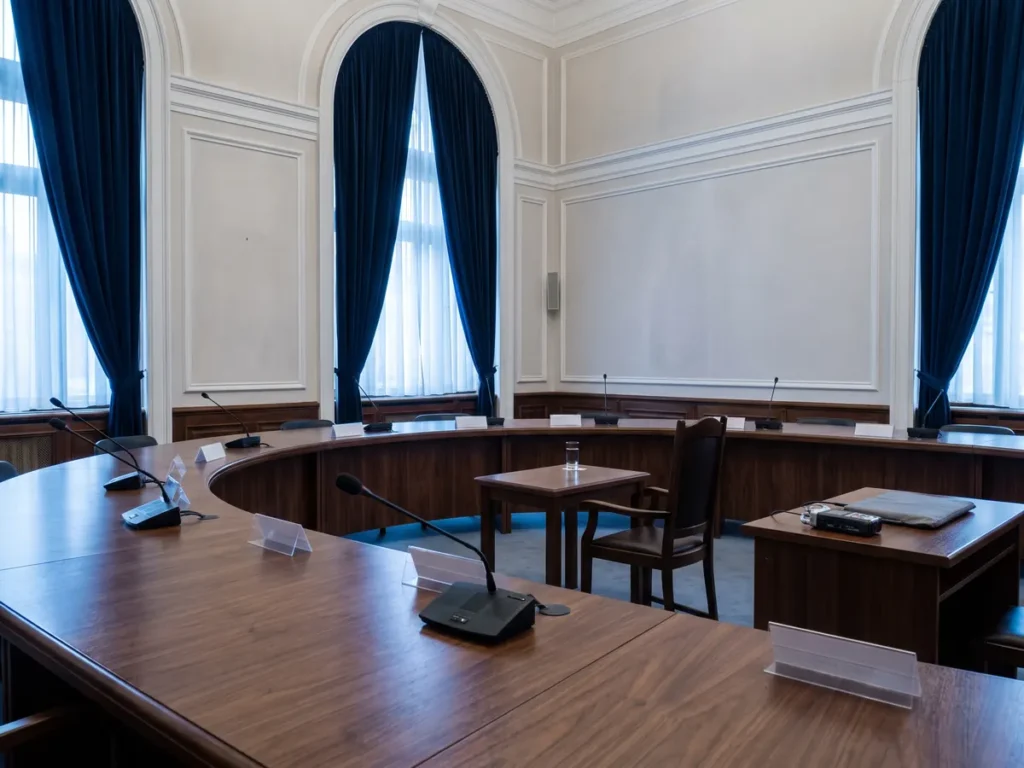
A meeting on an August day, held in the office of the President of the Senate, has become the subject of a parliamentary inquiry because on one side of the table sat the interim Prime Minister and on the other the President of the court that was about to rule on cases with institutional stakes. Through Resolution no. 113 of 24 August 2026, published in the Official Gazette of Romania no. 701 of the same day, the Senate approved the conduct of a parliamentary inquiry by the Committee on Constitutionality. The draft had appeared as item 2 on the agenda of the extraordinary session convened for 24 to 26 August and was adopted on the very first working day.
The committee’s mandate was later extended: Senate Resolution no. 118/2026 adds to the inquiry a review of the circumstances of a trip taken by a judge of the Constitutional Court.
The legal basis is art. 67 of the Constitution, under which each chamber adopts resolutions in the presence of a majority of its members, read together with art. 78 of the Senate’s Rules of Procedure. A parliamentary inquiry is an oversight instrument that the chambers can activate through their standing committees, with the approval of the plenary.
The subject matter is described in detail in the text of the resolution itself. The Committee on Constitutionality must examine and clarify the circumstances in which the meeting took place, its nature and purpose, the reason why it was held in the office of the President of the Senate, and the topics discussed on that occasion, on 14 August 2026.
What it changes in practice
The first effect is that the committee is activated. From the moment of publication, the Senate’s Committee on Constitutionality holds a mandate of inquiry, not merely one of issuing opinions. That allows it to request documents and to hear persons, within the limits of the rules of procedure.
The second effect is that the subject matter is fixed. The resolution does not leave the committee free to widen the inquiry. It lists four elements: the circumstances of the meeting, its nature and purpose, the reason for the venue chosen and the topics discussed.
The third effect is the deadline. The conclusions are to be set out in a report submitted to the Standing Bureau within 14 days of the adoption of the resolution, that is by 7 September 2026. That is a short deadline for a parliamentary inquiry.
The fourth effect concerns the public reasoning. The text of art. 2 explains why the Senate considers clarification necessary: because, in relation to the place and the timing of the meeting, the Constitutional Court was about to rule on cases with institutional stakes, including for the political party represented by the interim Prime Minister. The resolution states that the purpose of the meeting must be clarified transparently, since the independence of a jurisdiction depends just as much on the conduct of those who hold office within it.
The fifth effect is one of institutional precedent. The resolution expressly records that, in the Senate’s view, the Constitutional Court is not a political authority but the guarantor of the supremacy of the Constitution and the sole authority of constitutional jurisdiction. That wording appears in the body of a normative act published in the Official Gazette of Romania, not in a political statement.
What has changed compared with the previous situation
Until this resolution, the meeting of 14 August 2026 was a matter of public debate with no institutional procedure attached to it. It now becomes the subject of a parliamentary procedure, with a designated committee, a defined subject matter and a reporting deadline.
The second change concerns the level at which the decision is taken. A parliamentary inquiry is not triggered by a committee’s own decision but by the approval of the chamber’s plenary. The fact that the Senate voted in favour means that a majority considered clarification necessary.
The third change concerns the relationship between the branches of government. A parliamentary inquiry that looks at the conduct of the President of the Constitutional Court touches a sensitive area of the separation of powers. The resolution does not target the content of any decision of the Court, but the circumstances of a meeting, although the line between the two is a matter of legal debate.
What does not change is the status of the Court’s decisions. No parliamentary inquiry can review or annul a decision of the Constitutional Court, which remains final and generally binding under art. 147 para. (4) of the Constitution.
Advantages and disadvantages
What it improves
- It brings within an institutional procedure a subject that would otherwise have remained a topic of public debate alone, with nothing verified.
- It confines the subject matter of the inquiry to four clearly defined elements, which reduces the risk of it becoming an instrument of general pressure.
- It sets a short deadline of 14 days, so the outcome will not get lost in an open-ended procedure.
- The reasoning is published in full in the Official Gazette of Romania, so anyone can read the grounds on which the vote rested.
What remains a problem
- A parliamentary inquiry into the conduct of the President of a constitutional court raises legitimate questions about the limits of parliamentary oversight.
- The text of the resolution already contains an assessment of the context, which can be read as anticipating the conclusions the committee is meant to reach.
- The 14-day deadline is short for hearings and for checking documents, in the middle of the parliamentary recess.
- The resolution does not say what happens to the report once it has been submitted to the Standing Bureau, nor whether it becomes public.
Practical advice
- Read the full text of the resolution before forming an opinion. The reasoning in art. 2 is longer than the operative part and explains the Senate’s line of argument.
- Do not confuse a parliamentary inquiry with judicial proceedings. The committee does not establish guilt and does not impose penalties, it draws up a report.
- Keep an eye on 7 September 2026, when the 14-day deadline for submitting the report to the Standing Bureau expires.
- Check separately what the resolution says and what the commentary about it says. The act concerns the circumstances of a meeting, not the content of any decision of the Court.
- If you want to follow the proceedings, look for the work of the Senate’s Committee on Constitutionality. That is the committee designated by art. 1 of the resolution.
- Bear in mind that the decisions of the Constitutional Court remain final and generally binding whatever the conclusions of the report.
Frequently asked questions
What exactly is being investigated?
Who carries out the inquiry?
What is the legal basis?
How long does the inquiry last?
Why does the Senate consider clarification necessary?
Can the inquiry change a decision of the Constitutional Court?
Errors and inconsistencies in the published text
- The preamble invokes an article of the Constitution that does not say what is attributed to it. The resolution is adopted „în temeiul prevederilor art. 67 din Constituția României, republicată”, on the basis of art. 67 of the Constitution of Romania, republished. Art. 67 lays down nothing but the quorum for a sitting: „Camera Deputaților și Senatul adoptă legi, hotărâri și moțiuni, în prezența majorității membrilor.”, the Chamber of Deputies and the Senate adopt laws, resolutions and motions in the presence of a majority of their members. It confers no power of inquiry. The constitutional text that does confer it is art. 64 para. (4), under which each chamber sets up standing committees and may establish committees of inquiry or other special committees, and that provision appears nowhere in the resolution. In an act whose very subject is the constitutionality of a course of conduct, the constitutional basis cited is the wrong one.
- Art. 3 sets a deadline without saying when it starts to run. The text requires that the report „va fi prezentat Biroului permanent în termen de 14 zile”, will be submitted to the Standing Bureau within 14 days, with no starting point at all: not the adoption of the resolution, not its publication, not the committee’s first sitting. Nor is it said whether the 14 days are calendar days or working days, which, over an interval that runs across the end of the parliamentary recess, can mean either 7 September or 11 September 2026. The only deadline in the whole act is thus the one thing the committee cannot work out from the text.
- Art. 2 treats as established the very context that would justify the inquiry, without identifying anything that can be checked. The parenthesis in the middle of the article states that „Curtea Constituțională urma să se pronunțe asupra unor cauze cu miză instituțională, inclusiv pentru formațiunea politică reprezentată de Ilie Bolojan”, that the Constitutional Court was about to rule on cases with institutional stakes, including for the political party represented by Ilie Bolojan. No case number, no hearing date and no decision is given. In an act published in the Official Gazette of Romania which declares its purpose to be „aflarea adevărului”, establishing the truth, the reader has nothing from which to check the premise on which the entire procedure rests. On top of that, the first objective listed in art. 2, „împrejurările în care a avut loc întâlnirea”, the circumstances in which the meeting took place, repeats word for word the subject matter already fixed in art. 1.
Editorial analysis
The question behind the resolution is a legitimate one and does not depend on anybody’s political camp: if the head of the executive and the president of the constitutional court meet ten days before that court is due to rule, the public is entitled to know what they talked about. The trouble is that the act through which the Senate asks the question is not built to obtain an answer. Of its three articles, one gets the constitutional basis wrong, one mixes the mandate up with its own conclusion, and the third imposes a deadline with no beginning. These are not drafting slips, they are precisely the things on which it depends whether the September report will be taken seriously by those who did not vote for the resolution.
The second thing the text shows is that the mandate steers clear of the very person who could answer one of the four questions. Art. 2 asks the committee to clarify „motivul pentru care întrevederea s-a desfășurat în biroul președintelui Senatului”, the reason why the meeting was held in the office of the President of the Senate. That office belongs to the President of the Senate, who signs this resolution, Mircea Abrudean. The inquiry is thus approved by the chamber whose president hosted the meeting, and the host’s role appears neither in the subject matter set out in art. 1 nor among the objectives in art. 2. It is the one element in the whole file that the Senate could have clarified without asking anything of anybody outside.
The third element is what the committee can actually do. Art. 111 para. (1) of the Constitution requires the Government and the other bodies of the public administration to supply the information and the documents requested by parliamentary committees. The Prime Minister falls under that obligation. The Government had at that point been dismissed by a motion of censure and was left with limited powers, and the investiture procedure restarted only in September, when the President signed the decree designating a candidate for the office of Prime Minister. The Constitutional Court is not a body of the public administration, and its president cannot be compelled to appear before a committee of the Senate. The inquiry can therefore end, perfectly lawfully, with a report in which half the table is missing, and the resolution provides nothing for that scenario, not even an obligation to record it.
What is worth noting in the act’s favour is that the reasoning was placed in the body of the resolution and not in an explanatory memorandum left in a drawer. The closing sentence of art. 2, that „Curtea Constituțională nu este o autoritate politică, ea este garantul supremației Constituției și unica autoritate de jurisdicție constituțională”, the Constitutional Court is not a political authority, it is the guarantor of the supremacy of the Constitution and the sole authority of constitutional jurisdiction, is published in the Official Gazette of Romania and stays there, binding on those who voted for it as well. The same transparency ought to have been applied to the rest: if the premise about the pending cases was solid enough to set an inquiry in motion, it was solid enough to be written down with case numbers.
What should be changed
- Replacing the basis given in the preamble with art. 64 para. (4) of the Constitution. A one line corrigendum, published in the Official Gazette of Romania, removes the only formal argument on which the resolution could be challenged. As long as the basis invoked is the quorum rule, mounting that challenge takes no imagination at all.
- Fixing the moment from which the 14 days run, and what kind of days they are. The formula „în termen de 14 zile calendaristice de la data publicării prezentei hotărâri”, within 14 calendar days of the publication of this resolution, closes the question. Without it, the committee sets its own deadline, and any overrun becomes arguable.
- Bringing the host’s role within the subject matter of the inquiry. If the venue of the meeting is one of the four questions, then who made the office available, and in what capacity, is part of the answer. Left outside the mandate, the question in art. 2 can only receive half an answer.
- Documenting the premise in art. 2, or taking it out of the text. The cases „cu miză instituțională”, with institutional stakes, then pending before the Court have case numbers and public hearing dates. Listing them turns a political assertion into a fact that can be checked; their absence leaves the committee to investigate starting from a conclusion already written into the act that gives it its mandate.
- A rule on what happens after the Standing Bureau. The resolution stops at the handing over of the report. It does not say whether the report is debated in plenary, whether it is published, or by when. A report that never becomes public does not serve the declared purpose, maintaining public confidence, it serves only the Senate’s internal procedure.
- A general protocol for the relationship between Parliament and the constitutional judges. The situation will recur, and improvising case by case is the worst option for both institutions. A written procedure, distinguishing between an invitation and an obligation to appear and expressly ruling out any discussion of decisions already delivered, would protect both parliamentary oversight and the independence of the jurisdiction.
Original text of the legal act
The text below is reproduced in Romanian, the official form of publication.
The full text, as published in the Official Gazette of Romania
Official Gazette of Romania no. 701 of 24 August 2026 16 pages PDF, 119 KB the act starts on page 10
Open the official PDFDownload the PDF
The viewer is not shown on small screens. Use the buttons above to open or download the file.
This article is for informational purposes only and does not constitute legal advice. For specific situations, consult a licensed attorney or tax advisor.