
In brief
- The national state of alert is extended by another 30 days, from 29 September until 28 October 2026 inclusive. It is the third period in a row in the same chain: the first began on 31 July 2026, the second on 30 August, and with this one the total reaches 90 uninterrupted days of alert. The reason this time is an energy one, and it comes down to a single thing: the Danube water that cools the reactors at Cernavodă.
- The figures in the preamble show how tight the interval is. The flow rate of the Danube where it enters the country, at Baziaș, falls from around 1,450 m³/s at the end of September towards 1,185-1,200 m³/s in the median scenario, between 10 and 13 October 2026, that is a drop of 17 to 18 per cent. At Cernavodă, the probable critical window lasts eight days, between 15 and 22 October, and in the unfavourable scenarios the threshold of −262 cm is reached or passed.
- The act orders no power cuts and restricts no right of the population. The works at Cernavodă continue, and the National Power Grid Company „Transelectrica” receives the same general mandate as in July: raising output, securing imports or cutting consumption. Those directly concerned are the operators on the Danube and in the power system, not the household consumer, for whom nothing changes from 29 September 2026.
Published: Official Gazette of Romania (Monitorul Oficial), Part I, no. 824 of 28 September 2026, pages 7-8
In force from: on publication, 28 September 2026, while the extended period of 30 days runs from 29 September until 28 October 2026 inclusive
On 28 September 2026 the National Committee for Emergency Situations (CNSU) adopted a decision of one and a half articles, published the same day, by which the state of alert declared at the end of July goes on for another 30 days. It is the second extension, after the one in August, when the state of alert was carried through to 28 September. The operative part has four short articles, but the preamble takes up a page and a half, and that is where all the information that matters sits: the flow forecast, the risk window at Cernavodă and the state of electricity generation in October.
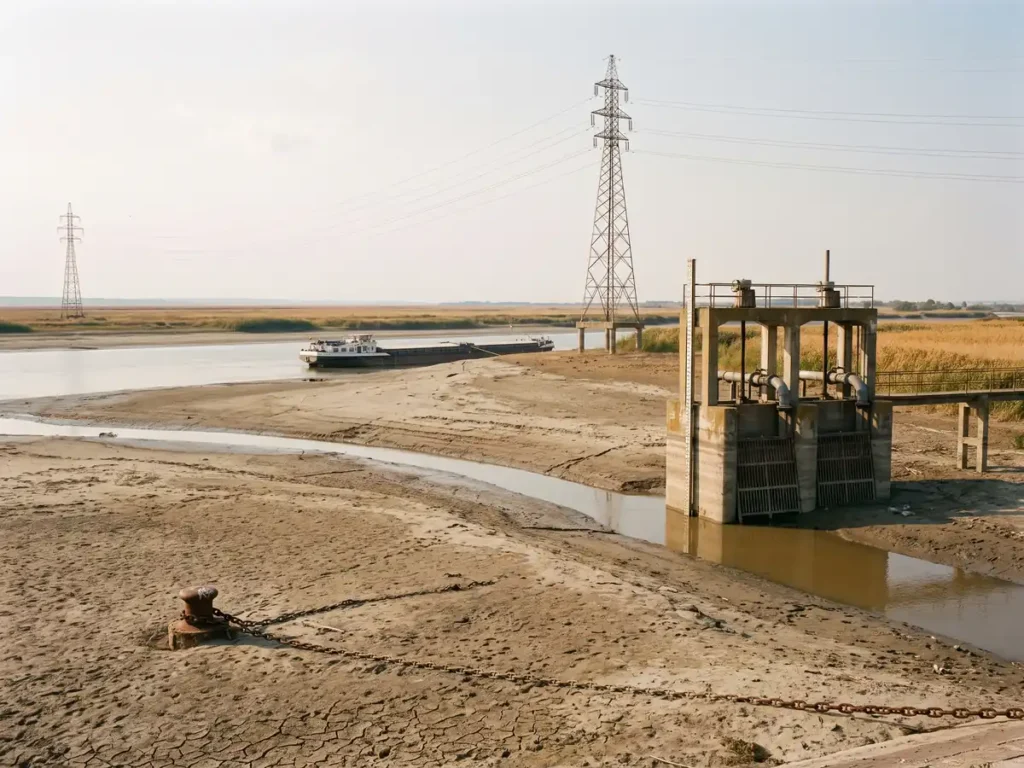
The order of events is worth repeating, because it is easily lost in a chain of five decisions with numbers so close together. On 31 July 2026, by CNSU Decision no. 15/2026, published in the Official Gazette of Romania, Part I, no. 637 of the same day, the committee declared a state of alert throughout the country for 30 days. The document said plainly why: Unit 1 of the Cernavodă Nuclear Power Plant had been shut down in a safe state since 27 July, and Unit 2 was running, according to the reports of Societatea Națională Nuclearelectrica, „la limita marjelor de securitate nucleară”, at the edge of the nuclear safety margins, because the level of the Danube had fallen. The technical decisions followed: no. 16/2026, on 1 August, with the profiling of the Pârjoaia rock and a submerged sill made of barges; no. 20/2026, on 21 August, with dredging on the Izvoarele-Cernavodă stretch, a groyne to steer the current and the suspension of lock operations on the Danube-Black Sea Canal at the level of 1.55 m dMB; no. 21/2026, on 28 August, the first extension; no. 22/2026, adopted on 1 September and published the next day, which gave up the groyne and replaced it with a temporary narrowing of the Dunărea Veche, the Old Danube branch, using vessels and barges, with a trigger level of 1.58 m dMB.
What exactly was measured. The basis for the extension is the „Analiza factorilor de risc”, the analysis of risk factors, registered with the Ministry of Energy under no. 44.200/SDE of 28.09.2026. From it the preamble retains four things. First, the flow rate at Baziaș: a deficit regime throughout the interval 28 September-31 October 2026, with a fall from around 1,450 m³/s towards 1,185-1,200 m³/s in the median scenario, between 10 and 13 October, followed by „o recuperare lentă”, a slow recovery. Second, the level at Cernavodă: a probable critical window between 15 and 22 October, with the threshold of −262 cm approached or passed in the unfavourable scenarios, which, the act writes, „confirmă persistența riscului operațional pentru asigurarea nivelului necesar răcirii”, confirms that the operational risk to securing the level needed for cooling persists. Third, the winter: the analysis is to be extended to the scenario in which the Danube does not return to acceptable values, while the freezing of the Dunărea Veche would make the situation worse. Fourth, the works at Cernavodă, which are to be carried on and completed by the National Administration „Apele Române” and by the Autonomous Administration „Administrația Fluvială a Dunării de Jos” Galați.
The power system side. The preamble takes stock, figure by figure, of where the electricity in October comes from. The coal units can run at a maximum of 1,200 MW, with limited fuel reserves and mostly on working days. Wind has a maximum of 2,500 MW and a minimum of 600 MW in the coming week, but in the first ten days of October a maximum of 1,000 MW and the same minimum of 600 MW are expected. Photovoltaic output falls below 2,800 MW and keeps falling as the day grows shorter. In Hungary, at the Paks nuclear plant, one unit is on a planned withdrawal from operation between 19 September and 10 October 2026, some 500 MW less in the region. And maximum demand at the evening peak is forecast at up to 8,000 MW.
What the decision actually orders. Article 1 extends the state of alert by 30 days, starting on 29 September 2026. In Article 2, the first paragraph maintains the emergency intervention measures and works ordered by Decisions nos. 20/2026 and 22/2026, in order to secure the raw water at the plant’s intake, and leaves the door open for „orice alte măsuri operative și soluții tehnice identificate ca fiind necesare”, any other operational measures and technical solutions found to be needed. The second paragraph requires Transelectrica to order all the measures needed for the running of the national power system, „inclusiv prin creșterea producției tuturor surselor disponibile, asigurarea importurilor sau reducerea consumului”, including by raising output from all available sources, securing imports or cutting consumption. Under Article 3, the institutions named in Decisions nos. 20/2026 and 22/2026 are supported by the other central and local authorities. Article 4 orders publication and communication to all the components of the National Emergency Management System.
What it changes in practice
The calendar. The extended period begins on 29 September 2026, the day immediately after publication, and ends on 28 October 2026 inclusive. There is not a single day of pause between the three periods: the first ended on 29 August, the second began on 30 August and ended on 28 September, the third begins on 29 September. Added together, they make 90 days of uninterrupted state of alert, from 31 July to 28 October 2026.
The works at Cernavodă go on, with the thresholds set in September. The system approved by CNSU Decision no. 22/2026 stays active: stage I means the controlled narrowing of the Dunărea Veche with vessels and ballasted barges, along an alignment of about 600 m, and it is triggered when the level of 1.58 m dMB measured at the plant, in the intake basin, is reached or fallen below. If the effect is insufficient, stage II follows, a modular closure with pontoons and inflatable barriers over about 170 m, and closure with rock fill remains the last reserve. The success criterion for the first stage is a gain in level of the order of 10 cm at the plant.
Navigation can be stopped, and that is the only real restriction in the whole chain. When the threshold of 1.58 m dMB is reached, the Ministry of Transport and Infrastructure, through the National Company „Administrația Canalelor Navigabile”, the Autonomous Administration „Administrația Fluvială a Dunării de Jos” Galați and the Romanian Naval Authority, order the restriction or temporary suspension of navigation and of lock operations on the Danube-Black Sea Canal and on the affected stretches of the Dunărea Veche. The notices and the procedures have to be prepared in advance, Decision no. 22/2026 requires, precisely so that activation does not have to wait for paperwork. For shipowners, forwarders and the port of Constanța, this is the effect with money in it.
For the ordinary consumer, the act produces no direct effect. No decision in the chain orders scheduled interruptions, introduces consumption quotas or addresses households. The formula in Article 2(2) is a mandate given to the transmission system operator, not a measure applied to anybody. Whoever has a supply contract keeps it unchanged, and prices are not touched by this decision.
The money. The financing is not reopened here, because it remains the one in the decisions that are maintained, and they follow two different schemes. For the dredging and the equipment in Decision no. 20/2026, the National Administration „Apele Române” pays out of its own revenue and expenditure budget for 2026, from the goods and services heading, and later recovers from Societatea Națională Nuclearelectrica, on the basis of an estimate, the costs of loading, transport and operation; the part carried out by the Autonomous Administration „Administrația Fluvială a Dunării de Jos” Galați is borne by the budget of the Ministry of Transport and Infrastructure. For the modular system narrowing the riverbed, approved by Decision no. 22/2026, the budget of the Ministry of Environment, Waters and Forests is proposed to be supplemented from the Reserve Fund at the Government’s disposal.
What has changed compared with the previous situation
The operative part is almost identical to the August one, with a single addition. The August decision, no. 21/2026, maintained the measures ordered by Decision no. 20/2026. Now the ones ordered by Decisions nos. 20/2026 and 22/2026 are maintained, because the second appeared in the meantime. Likewise, Article 3 now refers to both. For the rest, the text of the operative part repeats itself, including the wording about Transelectrica, taken up word for word from Decision no. 15/2026 of 31 July.
The forecast has worsened on hydrology and has moved to another subject on energy. In August, the preamble of Decision no. 21/2026 spoke of a flow rate of approximately 1,350 m³/s at Baziaș, with a temporary rise towards 1,600 m³/s on 30 and 31 August. Now a fall towards 1,185-1,200 m³/s between 10 and 13 October is forecast. The change of scenario has moved the risk as well: in August it was a matter of a heatwave and extreme heat, now of normal temperatures, with drops at night, and of a critical hydrological window in the middle of the month.
On generation, the picture is different from a month ago. Wind, which in August was given a maximum of 800 MW and a minimum of 200 MW, now has a maximum of 2,500 MW in the coming week, but drops to 1,000 MW in the first ten days of October, that is a reduction of 60 per cent from the week’s peak. Photovoltaic output has fallen from a peak below 3,000 MW to one below 2,800 MW. At Paks, where in August output had been raised to around 90 per cent of installed capacity, one unit is now shut down on a planned basis until 10 October. And the evening peak has risen from „over 7,500 MW” to „up to 8,000 MW”.
Winter appears, for the first time in the chain. None of the earlier decisions mentioned the winter scenario. This one calls for the analysis of risk factors to be extended to the most unfavourable winter situations, in which the Danube does not return to acceptable values, and it expressly names the risk that the Dunărea Veche freezes over. It is the only signal in the text that the administration is preparing for a problem longer than the October window.
Advantages and disadvantages
What it improves
- Legal continuity is secured without a single day’s gap. The third period begins exactly on the day after the second ends, so the works at Cernavodă and the emergency regime for procurement are not interrupted even administratively.
- The preamble publishes operational data that would otherwise never reach the public: the forecast flow rate at Baziaș, the level threshold at Cernavodă, the capacities available from coal, wind and photovoltaic, the estimated peak demand. They are verifiable figures, with a date and with the number of the source document.
- The express maintenance of the measures in Decisions nos. 20/2026 and 22/2026 means that the technical thresholds and the responsibilities are not renegotiated every month. Whoever carries them out knows at what level he goes into action and with what solution.
- No right of the population is restricted and no measure touches household consumers. The only restrictions in the whole chain of decisions concern navigation and access to the intervention areas on the Danube, so the alert remains one of infrastructure.
- For the first time in the chain an analysis for the winter is called for, not only for the immediate window. It is a change of horizon, from managing the next month to preparing for a season.
What remains a problem
- The extension stops on 28 October, although the risk interval that the preamble itself invokes runs until 31 October 2026. The last three days of the deficit hydrological regime stay, on paper, outside the state of alert.
- „Reducerea consumului”, cutting consumption, appears for the third time in three decisions, without ever being defined. Nowhere does it say who decides, at what threshold, for which categories of consumer and with what public announcement. The reader cannot find out whether he risks anything, or when.
- Article 2(1) refers as a block to Decisions nos. 20/2026 and 22/2026, although the second expressly stopped four measures from the first, those in Articles 2, 3, 8 and 10. The reader has to open both acts to find out what is actually maintained.
- Periodic public information is missing entirely. The level measured at the plant and the flow rate at Baziaș are communicated between institutions as they come in, but no text in the chain requires them to be published, although it is on them that the stopping of navigation is triggered.
- The decision says nothing about the state of the plant’s two units. The last official information in the Official Gazette of Romania dates from 28 August 2026, when Government Decision no. 684/2026 spoke of „perspectivele incerte de repornire a Unităților 1 și 2”, the uncertain prospects of restarting both units.
Practical advice
- If you are a household consumer, you have nothing to do. The extension of the state of alert does not change your contract, does not change your price and announces no interruptions. Any message that says otherwise does not rest on the text of this decision.
- If you have cargo on the Danube-Black Sea Canal or on the Dunărea Veche, watch the level of 1.58 m dMB at the plant. That is where the restriction or suspension of navigation and of lock operations is triggered, and Decision no. 22/2026 requires the notices to be prepared in advance, so activation can be quick.
- If you are a large industrial consumer, ask your supplier and the network operator, in writing, on what conditions your consumption would be cut and on what legal basis. The text gives no detail, but the question put before a tense situation is cheaper than the explanations afterwards.
- Remember the two dates that matter in October: 10-13 for the forecast minimum flow rate at Baziaș and 15-22 for the critical level window at Cernavodă. Between them lie the eight days in which it is decided whether the works narrowing the riverbed are still enough.
- For the status of the act, check the Official Gazette of Romania in the last week of October 2026. Either a new extension decision appears, or the committee declares the state of alert at an end, and both are published in Part I.
- Do not confuse the numbers. The decisions of the National Committee for Emergency Situations have their own annual series, so the committee’s Decision no. 23/2026 has nothing to do with a Government decision bearing the same number.
Frequently asked questions
How long does the state of alert last?
Am I at risk of losing power?
What does the cut in consumption in Article 2(2) mean?
What is happening to the Cernavodă plant?
What did Decisions nos. 15, 20 and 22 of 2026, referred to here, provide?
Does the state of alert restrict any of my rights?
Who pays for the works?
From when does the decision produce effects?
Editorial analysis
The decision does the job the moment asks of it: it keeps alive a legal regime on which works under way on the Danube depend, and it adds nothing that would frighten anyone without reason. The preamble is by far the best part, because it publishes figures nobody would otherwise see. The problems are not ones of drafting, but of fit between what the risk analysis says and what the committee decides on the basis of it.
The first mismatch is visible only if you count the days. The analysis of risk factors describes a deficit hydrological regime for the period 28 September-31 October 2026, that is 34 days. The state of alert is extended by 30 days from 29 September, so until 28 October inclusive. Three days of described but uncovered risk remain, and they fall exactly at the end of a critical window that the act places between 15 and 22 October. The eight days of the window close six days before the alert expires, which leaves an extremely short interval for assessing the result and preparing the next decision. The 30 days look like an administrative cadence, not a duration deduced from the forecast.
The second mismatch comes from comparing two acts. The threshold of −262 cm invoked in the preamble for the unfavourable scenarios is one centimetre below the level of approximately −261 cm which Decision no. 22/2026 had set, in Article 2(4), as an auxiliary operational benchmark at the Cernavodă gauging station. In other words, the unfavourable scenario the act announces already goes past the benchmark set three and a half weeks earlier. Nowhere in the text is this said, although it is the only figure in the preamble that has an exact counterpart in an earlier decision.
The third observation has to do with the arithmetic in the preamble, which is done nowhere. The evening peak is forecast at up to 8,000 MW. Of the sources listed, coal gives a maximum of 1,200 MW and wind, at the minimum announced for the first ten days of October, 600 MW. Together, 1,800 MW, that is 22.5 per cent of the peak. The only large figure on the list, the photovoltaic output below 2,800 MW, is not there at the hour of the evening peak, when the sun has set. The act lists available capacities without relating them to the demand it forecasts itself, and the reader is left with the impression of a reassuring list where the figures say something else.
The fourth observation concerns the instrument, not the diagnosis. Article 2(2) asks Transelectrica, among other things, for a cut in consumption. The electricity market safety measures the company can actually apply are those in Government Decision no. 603/2026, and their application was extended by Government Decision no. 684/2026 only until 30 September 2026, that is two days after this decision of the committee. If the Government does not extend again, the state of alert continues 28 days beyond the term of the market instruments that accompanied it. The two calendars, that of the alert and that of the safety measures, were synchronised in August, when both stopped at the end of September. Now they have come apart.
What should be changed
- The length of the extension should cover the risk window invoked. If the Ministry of Energy’s analysis describes a deficit regime until 31 October 2026, the extension ought to run that far, not only to 28. The practical effect: three days of legal cover for the works and for the navigation restrictions, plus being spared an extra decision adopted in haste at the end of the month.
- Article 2(1) should list what exactly stays in force from Decision no. 20/2026. Decision no. 22/2026 stopped the measures in Articles 2, 3, 8 and 10 of it, and the block reference to both acts forces anyone carrying them out to rebuild the list himself. A paragraph of three lines would close the problem and remove the risk that an abandoned threshold, the one of 1.55 m dMB, is invoked instead of the one in force, of 1.58 m dMB.
- The cut in consumption should be defined once, in the text. Who decides, at what adequacy threshold, for which categories of consumer, with how much notice and in what form of public announcement. The practical effect: industrial consumers could plan their production, and the population would know that the measure does not concern it, instead of learning that from interpretations.
- A public bulletin, kept up to date, with the two figures that trigger the measures. The level measured at the plant, in the intake basin, and the flow rate at Baziaș are already communicated between institutions as they come in. Publishing them daily, in a single place, would give shipowners and port businesses real notice before lock operations are suspended, instead of a notice appearing on the same day.
- Synchronisation with the market measures. The extension of the state of alert and the extension of the application of Government Decision no. 603/2026 ought to end on the same day, or the second ought to be tied to the duration of the alert. Otherwise the committee is asking Transelectrica for measures for a period in which the framework that allows them may no longer be in force.
- An update on the state of the two units, in the preamble. The whole chain of decisions exists because of the cooling of the reactors, but no decision after 31 July 2026 says any more whether the units are running, at what output and since when. One line would turn the act from an administrative measure into a document on which the real course of the problem can be followed.
Original text of the legal act
The text below is reproduced in Romanian, the official form of publication.
The full text, as published in the Official Gazette of Romania
Official Gazette of Romania no. 824 of 28 September 2026, pages 7-8 8 pages PDF, 85 KB the act starts on page 7
Open the official PDFDownload the PDF
The viewer is not shown on small screens. Use the buttons above to open or download the file.
This article is for informational purposes only and does not constitute legal advice. For specific situations, consult a licensed attorney or tax advisor.