
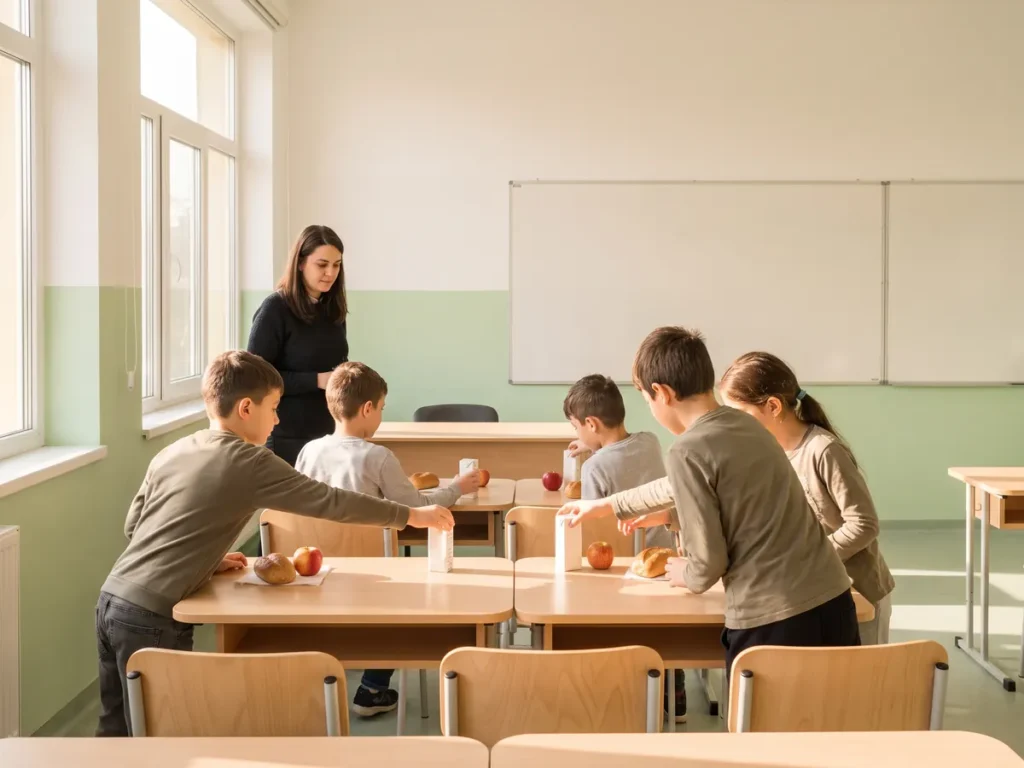
In brief
- The „milk, bread roll and fruit” programme has a budget of 802,447 thousand lei for the 2026-2027 school year, split across three products and two distribution periods: 7 September to 22 December 2026 and 11 January to 18 June 2027.
- Schools no longer pay for products that are not consumed: the surplus is redistributed within the same school, to the other pre-school children and pupils.
- The same decision also rewrites last year’s budget, for 2025-2026, and moves 12.4 million lei from Bucharest to 20 counties, without changing the national total.
Published: Official Gazette of Romania (Monitorul Oficial) no. 728 of 31 August 2026
In force from: 31 August 2026
A week before classes start, the Government has settled the money for the milk, bread rolls and fruit handed out in schools. Government Decision no. 682/2026, published in Official Gazette of Romania no. 728 of 31 August 2026, allocates 802,447 thousand lei for the 2026-2027 school year and amends the operating rules of the Romanian School Programme, approved by Government Decision no. 652/2023. It is the second substantial intervention in education this autumn, after the second procedure for the teaching career bonus, also published at the end of August.
The sum is broken down as follows: 107,393 thousand lei for fresh fruit and vegetables and 37,289 thousand lei for the accompanying educational measures; 376,214 thousand lei for drinking milk and dairy products without added milk powder, plus another 37,289 thousand lei for educational measures; 242,307 thousand lei for bakery products, these entirely from the national budget; and 1,955 thousand lei for evaluating the programme. The five items add up to exactly 802,447 thousand lei.
The European share of the funding comes from the European Agricultural Guarantee Fund, under Commission Implementing Decision (EU) 2026/873 of 21 April 2026: 6,178,236 euro for fruit and vegetables including the educational measures, and 11,303,390 euro for milk and dairy products, again including the educational measures. Bakery products, that is, the bread roll and the bread stick, remain entirely on Romanian money, because the European scheme does not cover them.
What it changes in practice
Schools feel the first effect directly. Until now, unconsumed products were the school’s problem, and the school could end up paying for them. Article I(4) of the new decision states that any surplus left over for objective reasons is redistributed within the same group of pre-school children and pupils, „astfel încât instituțiile de învățământ să nu mai fie obligate la plata contravalorii produselor neconsumate”, so that schools are no longer required to pay the value of the unconsumed products. It is the only provision in the whole act that changes a payment obligation of a school.
The second effect concerns days when classes are not held on site. The decision extends the regime applicable in exceptional situations beyond the epidemiological context: labour disputes, extreme weather, infrastructure and utility failures, heavy pollution and any other situation in which the authorities order a switch to online teaching. In those cases, the bread roll or bread stick portion may be replaced with biscuits or dry pretzels, the dairy product may be replaced with milk, the educational measures may be delivered online, and tasting sessions may be provided at home, through one package per pupil. The condition is that these options be provided for in the procurement documents before the award procedure is launched.
The third effect is for pupils attending classes online: they are entitled to the products just like those physically present, and a pupil counts as present if he or she took part in at least one lesson a day online.
The fourth effect has to do with money and the calendar. Amounts broken down from VAT that remain unused at the end of the budget year are settled, with one new exception: amounts intended for invoices issued in December, for products distributed by 31 December and not paid by the close of the year, stay in the surplus of the local budget and are used exclusively in January, for the same purpose. It is a way out of the situation where a December invoice goes unpaid because the money has gone back to the budget.
The fifth effect concerns suppliers and town halls. Payment claims to the Agency for Payments and Intervention in Agriculture are filed, starting with the 2026-2027 school year, within three months of the end of classes, and the agency pays within three months of filing. For the school year ending on 18 June 2027, that means the last filing date falls around 18 September 2027, and payment may arrive as late as December 2027, except where administrative investigations are under way, in which case the deadline is extended.
What has changed compared with the previous situation
The least visible change is also the most interesting. Article III replaces Annexes nos 1 to 3 to Government Decision no. 775/2025, that is, the budget of the 2025-2026 school year, which ended on 19 June 2026. The national totals are untouched: 106,603 thousand lei for fruit and vegetables, 375,612 thousand lei for milk, 241,919 thousand lei for bakery products, exactly the figures published in Official Gazette of Romania no. 881 of 25 September 2025.
What changes is the map. Comparing the new annexes with those of 2025, line by line, a single pattern emerges: the column for the first distribution period, 8 September to 19 December 2025, is identical everywhere, and all the changes are in the column for the second period, 8 January to 19 June 2026. And in that column, the only administrative unit that loses money is the municipality of Bucharest. No county is in the red.
The figures: for fruit and vegetables, Bucharest falls from 5,171 to 3,078 thousand lei, and the 2,093 thousand lei are shared among 14 counties. For milk, it falls from 17,854 to 11,922 thousand lei, and the 5,932 thousand lei go to 11 counties. For bakery products, it falls from 11,499 to 7,153 thousand lei, and the 4,346 thousand lei reach 15 counties. In total, 12,371 thousand lei, almost 12.4 million, move from the capital to the rest of the country, and Bucharest’s allocation for the second term falls by around 36%, from 34,524 to 22,153 thousand lei.
The largest individual increases are Mures, with 2,192 thousand lei more for milk, Cluj, with 1,320 thousand lei more for bakery products, and Vrancea, with 1,033 thousand lei more, again for milk. Nowhere does the decision explain why this shift is being made, but the mechanism in Article 17(3), rewritten at the same time, says that transfers between allocations are made „pe baza gradului de utilizare a sumelor alocate”, on the basis of the take-up rate of the allocated amounts, so the most likely explanation is the actual consumption reported in the second term.
The remaining amendments to Government Decision no. 652/2023 are administrative: the reports of the Agency for Payments are made at the request of the Ministry of Agriculture, based on the data available at that moment; the consolidated statement of the quantities distributed becomes a mandatory document of the payment claim; the EAGF aid is capped proportionally, by applying an annual percentage to the eligible value of each claim; and throughout the decision „Ministerul Educației” becomes „Ministerul Educației și Cercetării”, the Ministry of Education becoming the Ministry of Education and Research.
Advantages and disadvantages
What it improves
- Schools no longer pay for unconsumed products, and the surplus stays with the pupils of the same school instead of being invoiced or thrown away.
- The budget is approved a week before classes start, so procurement can begin in time for the distribution starting on 7 September 2026.
- The situations in which classes are suspended are no longer only epidemiological but also strikes, extreme weather, utility failures or pollution, and the programme has written rules for each of them.
- December invoices left unpaid at the end of the year no longer lose their funding: the money stays in the surplus of the local budget and is used in January, for the same purpose.
- The figures add up: the five items in Article I(2) come to exactly the announced total, and the totals of the six annexes match each item.
What remains a problem
- The budget of the 2025-2026 school year is amended more than two months after that year ended, and the decision does not say what data the redistribution was based on.
- Bucharest loses around 36% of its second-term allocation, and the city districts have no mechanism for contesting the new distribution.
- The deadline for filing payment claims, three months from the end of classes, applies only from the 2026-2027 school year, so older claims remain under the previous regime.
- Replacing the bread roll with biscuits or pretzels and the dairy product with milk works only if the option was written into the procurement documents beforehand, so a school that failed to anticipate is left without a solution on the day the situation arises.
- Payment of the European aid may take up to six months from the end of classes, and the agency’s three-month deadline is extended without limit if administrative investigations are under way.
Practical advice
- If you are a parent, note the dates: distribution starts on 7 September 2026 and stops on 22 December 2026, then resumes on 11 January 2027 and ends on 18 June 2027. Outside those intervals, the programme does not operate.
- If you are a head teacher, ask the county school inspectorate for the consolidated statement of quantities distributed per product category. From this year it is a mandatory document of the payment claim, and without it the town hall’s file is incomplete.
- If you are a mayor or in charge of procurement, write into the procurement documents, before launching the procedure, the options of replacing the bread roll with biscuits or dry pretzels and the dairy product with milk. The law allows them only if they were provided for in advance.
- Check in Annexes nos 4 to 6 whether your county received a larger allocation for the second term of the 2025-2026 school year. Twenty counties received more, and the amounts relate to a school year that has already ended.
- If you have invoices issued in December for products distributed by 31 December and not yet paid, do not settle them back to the budget. The amounts stay in the surplus of the local budget and are used in January, exclusively for the same purpose.
- Suppliers filing payment claims for the 2026-2027 school year have three months from the end of classes, that is, until roughly 18 September 2027. The deadline is applied through the APIA IT system, at the county centre.
Frequently asked questions
How much does each pupil get?
Who pays for the bread roll and the bread stick?
What happens to products that are not consumed?
Do pupils attending classes online still receive the products?
Why is the budget of a school year that has already ended being amended?
When do suppliers receive the European money?
What happens if the school switches to online teaching?
Does the programme continue after 2027?
Editorial analysis
The decision does two very different things under one title, and the second is buried in Article III. The first is the budget for the new school year, approved on time and with the figures adding up: the five items in Article I(2) come to exactly 802,447 thousand lei, and the totals of the three annexes match each item, down to the last leu. That is not something to take for granted in an act with 51 table rows in each annex.
The second thing is a silent revision of last year. The line-by-line comparison between the new annexes and those in Official Gazette of Romania no. 881 of 25 September 2025 shows a pattern too clean to be accidental: the first distribution period is untouched in every row, and all the changes sit in the second. Bucharest loses in all three annexes, the counties gain in all three, and nobody else loses anything. The amount moved, 12,371 thousand lei, is around 36% of the capital’s second-term allocation and 1.6% of the programme’s annual budget. In other words, the capital consumed below its allocation, and the difference was taken to where the products were actually handed out.
The reading is plausible, but it remains a reading, because the decision says nothing about it. There is not a single sentence in the whole act explaining why the annexes of a completed school year are being changed, nor any public reporting showing the take-up rate by county. Article 15(3), rewritten right now, provides that the agency reports the consolidated county-level situation to the ministry „la solicitarea acestuia, în funcție de datele disponibile la momentul solicitării”, at the ministry’s request and based on the data available when the request is made. That is reporting on demand, neither periodic nor public. The data on which 12.4 million lei were moved are visible nowhere.
The evaluation figure is worth setting alongside it: 1,955 thousand lei, or 0.24% of the programme’s budget, for a report covering four school years which the Ministry of Agriculture has to send to the European Commission. It is the only budget line that produces knowledge about what works and what does not, and it amounts to a twentieth of the sum Bucharest loses through the revision in Article III.
What should be changed
- An explanatory note attached to any revision of an annex. When a decision moves money between counties for a completed school year, the text should contain the basis of the calculation: the take-up rate per county, the quantities distributed and the number of pupils. Without it, 20 counties receive money and one municipality loses it without anyone being able to check why.
- The reporting under Article 15(3) should be made periodic and public. The wording „la solicitarea acestuia, în funcție de datele disponibile”, at the ministry’s request and based on the data available, turns a reporting duty into an occasional request. A twice-yearly statement, published on the website of the Agency for Payments, would make redistributions a visible consequence of data already known, rather than an end-of-August surprise.
- A firm deadline for paying the EAGF aid. The three-month deadline is extended „until the administrative investigations are concluded”, with no limit at all. A maximum deadline, even six additional months, would give suppliers a horizon and the administration a reason to close the investigations.
- Product replacement options should be standard in the procurement documents. Today, the right to replace the bread roll with biscuits on online school days exists only if the town hall wrote it into the tender specifications. It would be simpler for the option to be mandatory in the framework documentation, while using it stayed optional.
- Publication, once a year, of the real cost per portion and per county. The allocations in the annexes are lump sums, and price differences between counties remain invisible. A table with the average cost per portion would immediately show where procurement is expensive and would give a benchmark for the next tenders.
Original text of the legal act
The text below is reproduced in Romanian, the official form of publication.
The full text, as published in the Official Gazette of Romania
Official Gazette of Romania no. 728 of 31 August 2026 16 pages PDF, 114 KB the act starts on page 6
Open the official PDFDownload the PDF
The viewer is not shown on small screens. Use the buttons above to open or download the file.
This article is for informational purposes only and does not constitute legal advice. For specific situations, consult a licensed attorney or tax advisor.