
In brief
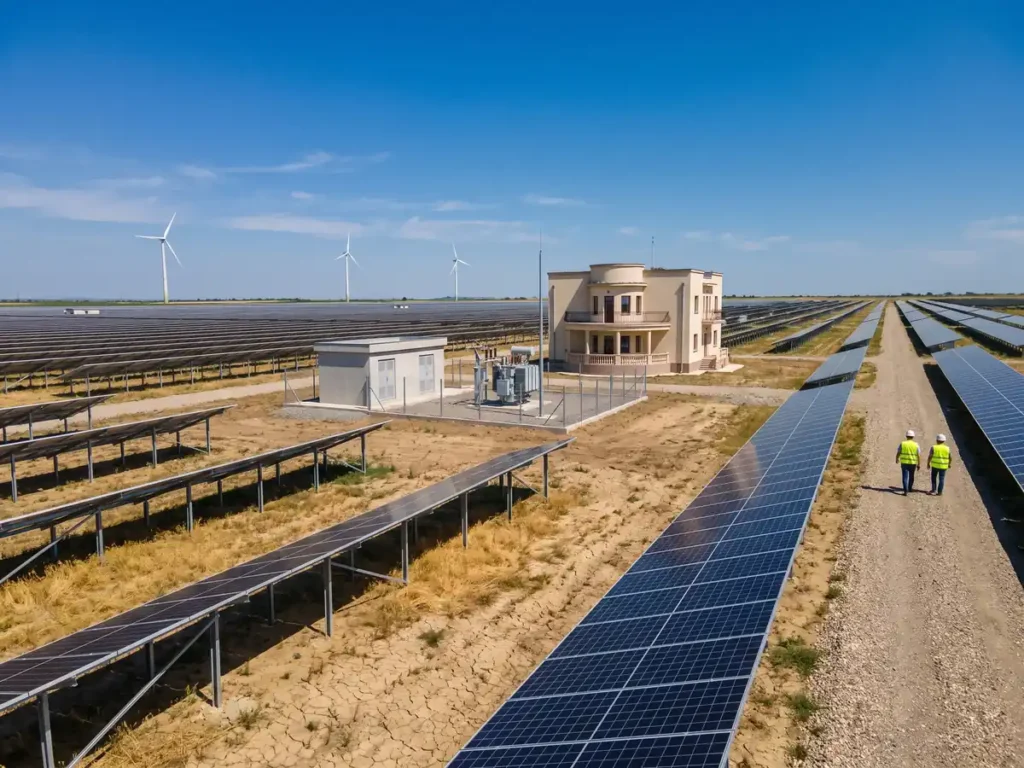
- Class IV and V farmland that can no longer be worked, together with degraded or unproductive land managed by the National Authority for the Administration of State Domains, Fisheries and Aquaculture, may be declared RES acceleration areas and granted under concession for solar parks, wind farms and storage capacity.
- The concession is awarded by public auction by open outcry, for no more than 25 years, extendable up to a maximum of 49 years. The participation guarantee is 10% of the minimum royalty and the bidding step is 5%.
- Permitting moves to an electronic one-stop shop, with a maximum term of 6 months from the filing of a complete application and tacit approval if the authorities fail to answer, except for projects that go through environmental impact assessment.
Published: Official Gazette of Romania (Monitorul Oficial) no. 592 of 20 July 2026
In force from: 23 July 2026
The state is opening up for green energy precisely the farmland it has nothing left to grow on. Law no. 159/2026, published in Official Gazette of Romania no. 592 of 20 July 2026, amends Law no. 268/2001 and creates a new category of public land, the areas suitable for accelerating renewable energy projects, which are granted under concession by open outcry auction. The measure comes in the same year as the extension to 2028 of the deadlines for renewable energy investments financed from the Modernisation Fund.
The land concerned belongs to the public and private domain of the state and is managed by the National Authority for the Administration of State Domains, Fisheries and Aquaculture. The law was promulgated by Decree no. 434/2026 and applies from 23 July 2026.
The act answers three questions, in this order: which land is in play, how it is awarded and how long permitting takes. For each of them the criteria are written into the law rather than left to implementing rules.
What it changes in practice
The first effect is the appearance of RES acceleration areas. The new paragraph (21) of Article 2 of Law no. 268/2001 designates as such the land in the public and private domain of the state, managed by the authority and not served by land improvement infrastructure, which falls into one of three situations: class IV and V farmland that cannot be used for agriculture, as established by soil and agrochemical studies; degraded or unproductive land that cannot be used for agriculture; land located outside Natura 2000 sites, outside other areas protected for nature and biodiversity conservation and outside the main migration routes of species.
The second effect is the split by technology. Inside the area, the land is identified for each technology according to its own criteria: for solar, compact and flat land, optimal exposure to the sun established on the basis of information from the National Meteorological Administration, a minimum of obstacles that would shade the panels and access to grid connection infrastructure; for wind, an adequate wind resource, again based on meteorological data, and compliance with the minimum distances between turbines and from residential areas or infrastructure; for storage, flat land and proximity to the grid and to generating plants.
The third effect concerns the designation procedure. By way of derogation from Article 153(1) of Government Emergency Ordinance no. 163/2022, the areas are designated by an act of the minister of agriculture and rural development and are to be included afterwards in the general plan for designating acceleration areas. Where the plan covers degraded or unproductive land managed by the authority, it must first go through the strategic environmental assessment for plans and programmes provided for by Government Decision no. 1.076/2004 and, where applicable, through the appropriate assessment under Article 28 of Government Emergency Ordinance no. 57/2007.
The fourth effect is the list of exclusions, taken over from the criteria of Government Emergency Ordinance no. 163/2022: Natura 2000 sites and other areas protected for nature and biodiversity conservation, the main migration routes of species, historical monuments and protected built areas, except for the artificial or built-up surfaces inside them, as well as other areas identified as sensitive on the basis of official maps.
The fifth effect is the award method. Point (i), newly inserted in Article 4(1), allows land designated as an RES acceleration area to be granted under concession by public auction with open outcry, following the procedure in the new Annex no. 5, by way of exception from Articles 19 to 21 of the same law and by way of derogation from Articles 302 to 320 of Government Emergency Ordinance no. 57/2019. Contract holders declare and pay the royalties quarterly, by the 25th day of the month following the end of the quarter.
The sixth effect is record keeping. Article II requires the authority to set up and manage the single national register for land owned by the state and placed under its administration.
The seventh effect is the permitting timetable. Projects in acceleration areas follow the procedure in Articles 16 to 162 of Government Emergency Ordinance no. 163/2022, and the authorities issuing opinions, agreements, permits, certificates and licences are required to observe the deadlines set there. Permitting goes through a digitalised One-Stop Shop mechanism, built on the single electronic point of contact for industrial licensing and coordinated through the Industrial Licence Office, with a maximum term of 6 months from the filing of a complete application. The absence of an answer within the deadline counts as tacit approval, unless the project falls under environmental impact assessment, where an explicit decision is required.
The eighth effect concerns the environment. The competent authority applies a simplified screening procedure and may issue the opinions without environmental impact assessment and without appropriate assessment, provided that the project fully complies with the criteria of the area and with the mitigation measures and that the screening shows a negligible risk of unforeseen significant adverse effects. For photovoltaic projects, the law expressly recognises agrivoltaic solutions, which allow crops to be grown under the panels, and ecovoltaic ones, which preserve habitats for local flora and fauna.
What has changed compared with the previous situation
The first change concerns the purpose of the land. Law no. 268/2001 governed the privatisation of the companies that managed state farmland and set up the authority keeping the records of that land. Now the same land acquires a second regime, concession for electricity generation, applicable only where the soil no longer supports agriculture.
The second change is the award procedure. Concessions of publicly owned assets are as a rule run under Articles 302 to 320 of the Administrative Code, with bids submitted in sealed envelopes. Here a public auction by open outcry applies, with a bidding step of 5% of the minimum royalty and award on the spot, at the highest level offered.
The third change concerns who designates the areas. The general rule in Government Emergency Ordinance no. 163/2022 ties designation to the national plan. The new law allows the minister of agriculture to designate the land by his own act, with inclusion in the plan following afterwards.
The fourth change is the permitting deadline. Until now a developer collected the opinions separately, from each institution, each with its own deadline. The law sets a single deadline, 6 months from the complete application filed electronically, which may be extended once by no more than 6 months and only in exceptional circumstances, stated in writing before the initial deadline expires.
The fifth change is the register. Until now the records of state land managed by the authority had no single national register provided for by law.
What does not change is the legal filter applied to the land. Land subject to restitution or claimed, land for which title deeds have been issued and land under litigation before the courts all remain outside the procedure.
Advantages and disadvantages
What it improves
- Land that no longer produces anything agricultural gains an economic use, without taking good arable land out of circulation.
- The exclusion criteria are written into the law, not into implementing rules: Natura 2000 sites, migration routes, historical monuments, sensitive areas.
- The electronic one-stop shop and the 6-month deadline replace the walk of the file from one institution to another.
- An open outcry auction can be seen as it happens, and the step of 5% of the minimum royalty is fixed, so it cannot be negotiated behind closed doors.
- Agrivoltaic and ecovoltaic solutions are expressly recognised, so the land can stay partly productive under the panels.
- The single national register brings the records of state land into one verifiable place.
What remains a problem
- Tacit approval shifts the risk onto the environment and the neighbouring properties: if an authority fails to answer in time, the opinion counts as given.
- Issuing the opinions without environmental impact assessment depends on a risk classified as negligible, which the law does not define through measurable criteria.
- The minimum royalty is not set by law but by an internal committee of the authority, for each auction separately.
- A cumulative term of up to 49 years locks up the land for almost two generations.
- The two-bidder condition can be circumvented: if the first auction fails to attract two eligible files, a single bidder is enough at the second one.
- Classifying land as class IV or V depends on soil and agrochemical studies, and the law does not say who orders them, who pays for them and who checks them.
Practical advice
- If you develop solar, wind or storage projects, follow the acts of the minister of agriculture designating the RES acceleration areas. They appear before inclusion in the national designation plan.
- Look on the authority’s website for the participation conditions, the required documents, the tender specifications and the minimum royalty. They are approved by the Privatisation, Concession and Lease Committee within 15 days of the entry into force of the procedure.
- The auction notice is published in the Official Gazette of Romania, Part VI, in a national daily and in a local one. From publication you have 20 days to file your participation documents.
- Prepare the money in two instalments: the participation guarantee, 10% of the minimum royalty, and 25% of one year of the royalty bid, payable on award. The remaining 75% is paid by the end of the contract year.
- Calculate the performance guarantee separately: 50% of the leu equivalent of the annual royalty in euro, lodged within 60 days of signing and updated every year, by 31 January, if the leu/euro exchange rate has risen.
- Do not delay the works. The contract is terminated by operation of law, without notice and without going to court, if you do not start the works within the deadline in the documentation and in any case no later than 6 months from the conclusion of the contract.
- File the bid together with the schedule for meeting the permitting requirements within 6 months of signing and with the commissioning timetable. Progress is reported quarterly, with supporting documents.
- If you are a neighbouring owner or an environmental organisation, check whether the designation plan went through the strategic environmental assessment for plans and programmes and, where applicable, through the appropriate assessment.
Frequently asked questions
What is an RES acceleration area?
Which land can fall into this category?
How is the land awarded?
How long can the concession last?
What happens if only one bidder turns up?
How long does permitting a project take?
Can construction go ahead without environmental impact assessment?
Original text of the legal act
The text below is reproduced in Romanian, the official form of publication.
The full text, as published in the Official Gazette of Romania
Official Gazette of Romania no. 592 of 20 July 2026 32 pages PDF, 179 KB the act starts on page 21
Open the official PDFDownload the PDF
The viewer is not shown on small screens. Use the buttons above to open or download the file.
This article is for informational purposes only and does not constitute legal advice. For specific situations, consult a licensed attorney or tax advisor.