
In brief
- The state company that runs the spa treatment resorts has an approved budget for 2026 only from 18 September 2026. The year was already on day 261 out of 365, and the budget sets revenue of 171.182 million lei, expenditure of 168.329 million lei and 828 employees on average.
- It receives nothing from the budget. The line for subsidies is struck through, the one for transfers has been left blank, nothing is entered for European funds, and the 32.657 million lei for investment comes entirely from own sources.
- Out of every 1,000 lei collected, 17 are left. The programmed net profit is 1,312,000 lei, but its distribution, as written in the annex, adds up to 1,456,000, that is 144,000 lei more than the profit that exists.
Published: Official Gazette of Romania (Monitorul Oficial), Part I, no. 792 of 18 September 2026, pages 11-13
In force from: 18 September 2026, the date of publication in the Official Gazette of Romania, Article 2 of the order setting no later date
The company that runs the State’s spa treatment resorts received its 2026 budget with 104 days left of the year. Joint Order no. 1.092/1.087, published on 18 September 2026, approves for Societatea de Tratament Balnear și Recuperare a Capacității de Muncă „T.B.R.C.M.” S.A. revenue of 171.182 million lei and expenditure of 168.329 million lei. Acts that put a figure on public money reach the Official Gazette of Romania in every size, from the 287,671 lei that a three-day forum in Bucharest cost up to the annual budget of a company with 828 employees. The difference here is that the money does not come from the State budget: the line for subsidies is struck through, and the one for transfers has been left blank.
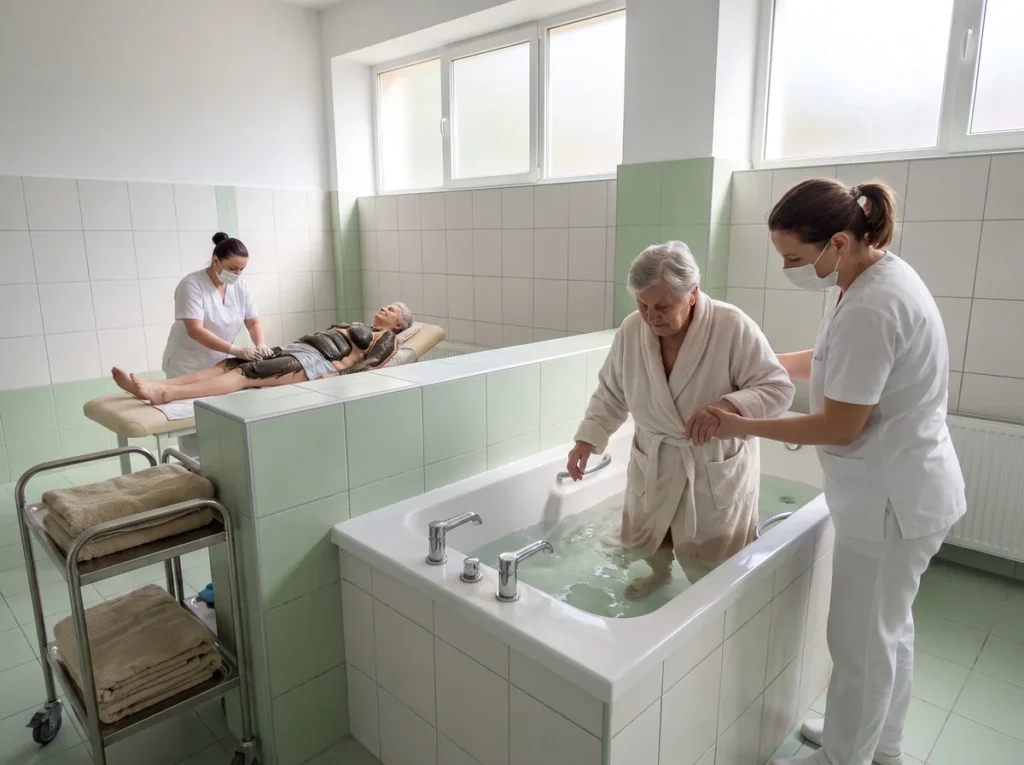
The sole shareholder is the National Public Pension House, written into Article 1 of the order itself, and that is why the document concerns the pensioner who goes for treatment. According to the company’s own presentation, it runs 13 spa complexes, from Amara and Lacu Sărat to Covasna, Olănești and Băile 1 Mai, with 3,181 beds, through which more than 70,000 visitors pass every year. Measured against that number, the 171.182 million lei work out at about 2,445 lei collected for each visitor, and the 32.657 million for investment at about 10,200 lei for each bed.
The annex, reproduced in facsimile across three pages of the Official Gazette of Romania, shows where the money goes. Staff costs are the largest item, 77.284 million lei, or 45.9% of the total. Of that, 72.462 million are costs of a salary nature, split into 65.619 million of salaries and 6.843 million of bonuses, to which are added 3.263 million for mandate contracts and for the management and supervisory bodies and 1.559 million of contributions owed by the employer. Next come goods and services, 61.416 million, then other operating expenses, 25.584 million, and taxes and duties, 4.045 million. Financial expenses are struck through, so the company plans no interest to pay.
What is left at the end is little. The programmed gross result is 2.853 million lei, current profit tax 1.541 million, and net profit 1,312,000 lei. One indicator in the annex says the same thing more directly: for every 1,000 lei of total revenue, 983 lei of expenditure are programmed, so 17 are left. On that margin, the net profit comes to less than 19 lei for each of the year’s more than 70,000 visitors.
The headcount rises during the year: 828 employees on average, but 873 forecast at the end of the year. The average monthly earnings per employee, calculated on the costs of a salary nature, are entered at 7,048 lei, and the same earnings recalculated under the State budget law at 6,913 lei. Labour productivity appears at 205 thousand lei per person, and the lines for overdue payments and overdue receivables are empty, meaning that the company declares no debts unpaid at maturity.
One thing is missing from the whole document: the column for the previous year. The annex has a single column of figures, headed „Propuneri an curent 2026”, that is proposals for the current year, with nothing achieved in 2025 beside it. How the budget compares with last year cannot be said from the act, and it is precisely the comparison with 2025 that decides whether the limits on salary costs imposed for 2026 have been observed.
What it changes in practice
For someone who buys or receives a treatment voucher, the order changes nothing directly. It sets no tariff, it does not touch the criteria for granting vouchers and it says nothing about the number of places allocated through the pension house. What it does is fix the ceiling within which the company may spend until 31 December 2026.
For the company, the effect is immediate and restrictive. Article 10(1)(a) of Government Ordinance no. 26/2013 says that the costs of a salary nature and the headcount at the end of the year approved in the budget are maximum limits that cannot be exceeded. The 72.462 million lei and the 873 people therefore become firm thresholds, and going beyond them requires an amendment approved by the same route, through a joint order of the two ministries.
For employees, the order opens a right to money, but a small one and with a questionable figure. Profit sharing is entered at 144,000 lei for 828 employees on average, that is about 174 lei per person for a whole year. The sum is due only if the programmed profit is actually made, because the distribution is made out of the accounting profit left after tax, not out of the forecast one.
For the budget from which pensions are paid, the effect shows on a single line. The dividends of 728,000 lei are entered in full under „dividende cuvenite altor acționari”, dividends due to other shareholders, and the lines for dividends due to the State budget and to the local budget are empty. Since the shareholder is the National Public Pension House, the money returns to the institution that runs the state social insurance budget, not to the State budget.
For the taxpayer there is an effect that is nowhere spelled out in the act but follows from it: the company asks for no public money for investment. The line for budget appropriations has been left blank, and the 32.657 million lei of investment expenditure have as their source exactly the same amount of own financing sources. The investment is almost 25 times larger than the year’s net profit, so it rests on depreciation and on reserves, not on the 2026 earnings.
What has changed compared with the previous situation
Until 18 September 2026 the company operated without an approved budget for the current year. The rule for that situation is written in Article 8(1) of Government Ordinance no. 26/2013: until the budget for the current year is approved, economic operators may incur total monthly expenditure within the limit of one twelfth of the total expenditure approved in the budget for the previous year. In practice, the company ran on the 2025 budget divided by twelve.
That regime grew tighter during the year. Article 6(1) of the same ordinance allows 45 days from the entry into force of the State budget law for submitting the budget for approval, and Article 8(4) provides that an operator whose budget is not approved within a further 45 days after that deadline may commit and incur monthly expenditure of only 90% of that limit, starting with the following month and until the date of approval. Law no. 43/2026 on the State budget entered into force on 30 March 2026, so the submission deadline fell on 14 May, and the one under Article 8(4) on 28 June 2026.
The concrete change is therefore the exit from that reduced regime. With the budget signed on 19 August 2026 and published on 18 September, the company moves back from the 90% ceiling to spending under its own budget for the year. What has changed since January is the legal basis, not the amount: until now it was spending on the basis of last year, and from now on it spends on the basis of a document that has the figure 2026 on it.
What can be checked has changed as well. The 2025 budget said nothing about how many people the company would have at the end of 2026 and how much profit it was aiming for. Now there are public figures for both, 873 employees and 1,312,000 lei, plus a salary ceiling that can be compared with the outturn at the end of the year.
Advantages and disadvantages
What it improves
- The budget of a state company becomes public in full, with 59 lines of indicators, not just with the totals. Anyone can see how much goes on salaries, how much on goods and services and how much on management.
- A period of improvisation comes to an end. From 18 September 2026 the company spends according to figures drawn up for 2026, instead of last year’s budget divided by twelve.
- The large figures add up. Total revenue is the sum of its components, total expenditure likewise, the gross result is exactly the difference between them, and the two efficiency indicators come out at the published values.
- The company asks for no money from the budget. It has no subsidies, no transfers, and the 32.657 million lei of investment are covered entirely from own sources.
- A headcount ceiling is approved as well, not only a money ceiling. The 873 people at the end of the year are a maximum limit, so hiring cannot go on without limit until December.
- The legal deadline for approval was observed. The 150 days from the entry into force of the budget law expired on 27 August 2026, and the last signature is dated 19 August.
What remains a problem
- The distribution of the profit does not add up. The three destinations total 1,456,000 lei out of a profit of 1,312,000, and the difference is exactly the sum entered for employee profit sharing.
- Employee profit sharing exceeds the ceiling written on the annex’s own line. The 144,000 lei are 10.98% of the net profit, and the limit is 10%.
- The column for the previous year is missing. Without the figures achieved in 2025 it cannot be said whether the budget is rising or falling, nor whether the salary limits imposed for 2026 have been observed.
- The budget reaches the reader with 104 days left of the year. A spending ceiling published after 71.5% of the year has passed can no longer guide almost any decision.
- Revenue is not broken down by source. The 170.126 million lei from operations appear as a single sum, so it cannot be seen how much comes from treatment vouchers paid out of the social insurance budget and how much from visitors who pay for themselves.
- Two figures in the annex cannot be verified from the annex. The notes at the end refer the average monthly earnings to „Anexa de fundamentare nr. 2”, the supporting annex no. 2, a document that is not published.
- The profit tax remains unexplained. A sum of 1.541 million lei on a gross profit of 2.853 million means an effective rate of 54%, more than three times the statutory rate of 16%, with no mention of what produces it.
Practical advice
- If you want a treatment voucher, do not look here. The order contains no tariff, no award criterion and no number of places. Those are set by the acts of the pension house, not by the company’s budget.
- If you are an employee of the company, note the figure of 144,000 lei on line 33 of the annex and check it at the end of the year. The sum is a forecast, it is divided among about 828 people and it is due only out of the profit actually made, after tax.
- If you follow how public money is spent, note the ceilings that count: 72.462 million lei of costs of a salary nature and 873 employees at 31 December 2026. They are maximum limits, and any overrun requires an amending order published in the Official Gazette of Romania as well.
- When you compare with last year, do not expect to find the comparison in the act. The annex has a single column of figures. For the trend you need the order that approved the 2025 budget and the company’s financial reports.
- If you are interested in how efficient the company is, look at line 57, not at the profit. The 983 lei of expenditure per 1,000 lei of revenue say more than the sum of 1,312,000 lei, because they show how thin the margin is.
- If you need the salary costs broken down by category, ask for the supporting annexes. Government Emergency Ordinance no. 89/2025 requires them to be shown separately there, and those annexes do not appear in the Official Gazette of Romania.
- Remember 18 September 2026 as the moment of entry into force, not 7 or 19 August. The two dates in the heading are the dates of the two ministries’ signatures, and a minister’s order takes effect from publication.
Frequently asked questions
What company is T.B.R.C.M. and why does the State pay it?
How much does it receive and how much does it spend in 2026?
How many employees does it have?
How much of the revenue comes from treatment vouchers paid out of the social insurance budget?
What profit does it plan and what does it do with it?
Why does a budget for 2026 appear only in September 2026?
How did the company operate until the budget was approved?
Who signed the order and why does it have two numbers?
Can I see the 2025 figures in order to compare?
What happens if the company exceeds the approved amounts?
Errors and inconsistencies in the published text
- Annex, line 38. The annex enters 584,000 lei as undistributed profit going to other reserves. Line 32 gives the profit to be distributed, 1,312,000 lei, and lines 33 and 34 take 144,000 and 728,000 lei out of it respectively, so what is left is 440,000 lei, not 584,000. Added together, the three destinations give 1,456,000 lei, 144,000 more than the profit that exists, that is exactly the sum for employee profit sharing, distributed twice. Article 1(1)(g) of Government Ordinance no. 64/2001 defines this line as the profit left undistributed on the previous destinations, so the difference can only be a calculation error, not a choice.
- Annex, line 33. Employee profit sharing is entered at 144,000 lei, while the text of the same line caps it „în limita a 10% din profitul net”, within the limit of 10% of the net profit. The net profit, line 26, is 1,312,000 lei, so the ceiling is 131,200 lei. The approved sum exceeds it by 12,800 lei, being 10.98% of the net profit. The same limit is also written in Article 1(1)(e) of Government Ordinance no. 64/2001.
Editorial analysis
Recalculated line by line, the budget is correct almost everywhere. Total revenue of 171.182 million lei is the exact sum of the 170.126 million from operations and the 1.056 million of financial revenue. Total expenditure of 168.329 million comes out exactly from the four operating items, 61.416 plus 4.045 plus 77.284 plus 25.584. Staff costs add up from their three components, and the costs of a salary nature from salaries and bonuses. The 2.853 million of gross result is the exact difference between the totals, and the net profit of 1,312,000 lei follows exactly once the tax is deducted. The two efficiency indicators come out as well: the productivity of 205 thousand lei per person is the ratio between operating revenue and the 828 employees, and the 983 lei of expenditure per 1,000 lei of revenue are exactly the ratio of the totals. The only place where the arithmetic gives way is the last step, the distribution of the profit, where 144,000 lei are allocated twice.
The calendar contradicts the usual reflex here, and the figures say why. Law no. 43/2026 on the State budget entered into force on 30 March 2026, so the 150-day deadline for approval laid down in Article 4(6) of Government Ordinance no. 26/2013 expired on 27 August 2026. The last signature on the order, that of the Ministry of Finance, is dated 19 August 2026, eight days before the deadline. The approval was not late. What was late is everything else: the same paragraph requires transmission to the Ministry of Finance within 120 days, that is by 28 July 2026, and the document could not have arrived there before 7 August, the date on which the labour ministry signed it, so at least ten days past that deadline. Then 30 days passed between the last signature and publication in the Official Gazette of Romania. An act approved within the deadline became public on day 261 of the year, and the law sets no deadline at all for the step that consumed the most time.
Two provisions combined produce a consequence that reading the order does not reveal. Article 6(1) of the same ordinance allows 45 days from 30 March for submitting the budget, that is until 14 May 2026, while the approval memorandum on which the order rests is dated 10 June 2026, 27 days later. Article 8(4) adds a further 45 days, until 28 June, after which the monthly spending ceiling drops to 90% of one twelfth of the previous year’s budget, starting with the following month and until approval. It follows that in July and August 2026 the company operated with a spending ceiling cut by one tenth, because of a delay produced in the administrative machinery, not at the company. Beyond that, the sanction laid down in Article 4(8), suspension of appropriations from the State budget, would have hit nothing in any case: line 47 of the annex, budget appropriations, is blank, so the company has nothing to be suspended.
The gravest weakness of the document is an absence. The annex has a single column of figures, „Propuneri an curent 2026”, with nothing achieved in 2025 beside it. Yet the entire regime of salary discipline for 2026, written in Article XXXVI of Government Emergency Ordinance no. 89/2025 and invoked in the preamble of the order itself, is built by comparison with the past: salary entitlements are held at the level of 30 November 2025, premiums and bonuses at the level payable in 2025, and any increase in the costs of a salary nature requires the Government’s approval by memorandum and cannot exceed the forecast average price increase index. Failure to observe these rules is an administrative offence, sanctioned by a fine of 20,000 to 60,000 lei. With a single column published and with the supporting annexes left unpublished, the reader has no way of checking whether the ceiling was observed, although paragraph (9) of the same article requires exactly those costs to be shown separately there. The same shows in the average monthly earnings: dividing the 72.462 million lei by 828 employees and by 12 months gives 7,293 lei, not the 7,048 written in the annex, and the difference is explained by a deduction of about 2.433 million lei required by Article 3(f) of Government Ordinance no. 26/2013. The figure reconciles, but only for whoever opens the definition, because the amount deducted appears on no published line. Equally unexplained is a profit tax of 1.541 million lei on a gross profit of 2.853 million, that is an effective rate of 54%, 1.085 million above the statutory rate of 16%.
What should be changed
- The profit distribution lines should be validated arithmetically before signature. An automatic check that rejects a form in which the destinations total more than the profit to be distributed would have stopped the 144,000 lei allocated twice from the outset, with no analytical work at all.
- The published annex should have the column for the previous year. With the 2025 outturn beside the 2026 proposals, anyone could see in two minutes whether the budget is rising or falling and whether the salary ceiling imposed for 2026 was observed, instead of inferring it from documents that are not published.
- The law should set a deadline for publication too, not only for approval. The 150 days were met with eight days to spare, but the act became public 30 days after the last signature. A publication deadline of a few days from signature would turn formal compliance with the law into information that is useful in time.
- Operating revenue should be broken down by source. A simple split between receipts from treatment vouchers borne by the social insurance budget and those from clients who pay for themselves would show how dependent the company is on the pension house, which is the information the reader is actually after.
- The supporting annexes should be published, or at least summarised in the main annex. Two figures in the document, the average monthly earnings and their recalculated variant, are defined by reference to an act that does not appear in the Official Gazette of Romania, so nobody outside can verify them.
- The sanction for missing the deadline should be adapted to companies that take no money from the budget. Suspending budget appropriations has no effect on an operator whose appropriations line is blank, so such cases would need a consequence that reaches someone.
Original text of the legal act
The text below is reproduced in Romanian, the official form of publication.
The full text, as published in the Official Gazette of Romania
Official Gazette of Romania no. 792 of 18 September 2026, pages 11-13 16 pages PDF, 151 KB the act starts on page 11
Open the official PDFDownload the PDF
The viewer is not shown on small screens. Use the buttons above to open or download the file.
This article is for informational purposes only and does not constitute legal advice. For specific situations, consult a licensed attorney or tax advisor.