
In brief
- The Government has started the expropriation of 211 privately owned plots, 22,075 square metres in total, on a strip added to the already approved corridor of Lot 3 of the Bacău-Pașcani Motorway. The land lies in five localities in Iași County: Mircești, Hălăucești, Mogoșești-Siret, Stolniceni-Prăjescu and Pașcani.
- Compensation adds up to 101,679.42 lei, money from the state budget, from the loan component of the National Recovery and Resilience Plan. That works out at an average of 481.89 lei per entry, and 91 of the 211 entries receive less than 100 lei.
- The strip does not change the route of the motorway. It is needed for moving utility networks, poles and pipes that do not fit inside the original corridor, and owners have 20 calendar days from notification to present themselves to the expropriating authority.
Published: Official Gazette of Romania (Monitorul Oficial) no. 738 of 2 September 2026
In force from: 2 September 2026, the date of publication
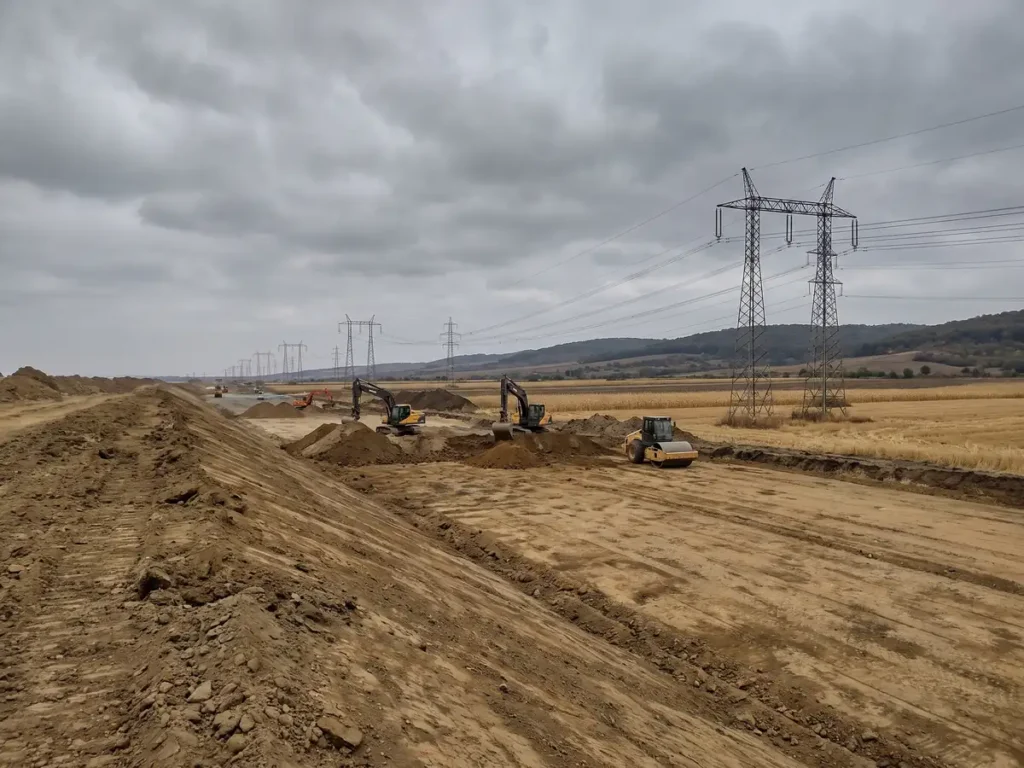
The Romanian State is taking another 2.2 hectares of private land on the last lot of the Bacău-Pașcani Motorway, so that it has somewhere to move the poles and pipes standing in the way of the works. Government Decision no. 672/2026, adopted on 27 August 2026 and published in Official Gazette of Romania no. 738 of 2 September 2026, starts the expropriation of 211 privately owned properties on the territory of the communes of Mircești, Hălăucești, Mogoșești-Siret, Stolniceni-Prăjescu and of the municipality of Pașcani, all in Iași County. It is the same kind of act by which, a week earlier, the western bypass of Timișoara received an additional strip for moving pipes and cables: the route of the road is not altered, what is added is the land onto which the displaced networks end up.
The act runs to 39 pages in the Official Gazette of Romania, but almost everything that takes up space is tables. The operative part itself covers one page and six articles. Annex no. 1 is the site plan, reproduced in facsimile over 30 pages. Annex no. 2 is the list of the 211 private properties, with the names of the owners, the field block, the parcel, the surface taken and the sum due to each. Annexes no. 3 and no. 4 cover the land that is already publicly owned and that merely changes administrator.
The expropriating authority is the Romanian State, represented by the Ministry of Transport and Infrastructure, through the National Company for Road Infrastructure Administration, CNAIR. The legal basis is Article 12(1) of Law no. 255/2010 on expropriation for a public utility purpose, the text stating that private properties needed for relocating utilities, for access roads, for borrow pits and for other works connected with the public project may be expropriated. Without it, the land under a pole moved 30 metres to the side would have no way of entering the expropriation corridor, because the motorway does not run there.
The total sum is 101,679.42 lei, according to the total printed at the end of Annex no. 2, a figure the 211 entries confirm when added together: 22,075 square metres and 101,679.42 lei. In Article 3(1), however, the Government writes „102 thousand lei”, rounding up by 320.58 lei, which changes no sum owed to any owner, because the individual amounts are those in the annex. The money is allocated through the budget of the Ministry of Transport and Infrastructure, under chapter 84.01 „Transport”, subchapter 03 „Road transport”, title 61, article 61.06, that is, from the loan component of the National Recovery and Resilience Plan. This is borrowed money, which has to be repaid.
Lot 3 runs from Mircești to Pașcani, is 28.09 kilometres long and is the last of the three lots of the Bacău-Pașcani section. The technical and economic indicators of the whole project were approved by Government Decision no. 688/2022, on 25 May 2022: 77.39 kilometres and 7.44 billion lei including VAT. Over the 28.09 kilometres of Lot 3, the 22,075 square metres expropriated now amount to some 786 square metres per kilometre, a strip less than a metre wide if it were stretched along the whole length. In reality it is not stretched out, but bunched at the points where a network has to be diverted.
On the same A7 Motorway corridor, in September 2026 the Government approved the technical and economic indicators of the Buzău orbital road, 1.09 billion lei for 13 kilometres.
What it changes in practice
The first effect is immediate and depends on nobody. From 2 September 2026, the 211 properties in Annex no. 2 form part of the expropriation corridor. The procedure that follows is set out in Law no. 255/2010 and unfolds in steps with fixed deadlines. CNAIR notifies the owners by post and displays the list at the town halls and on its own website, under Article 8(1). From the date of notification, the owner has 20 calendar days to present themselves at the headquarters of the expropriating authority, under Article 8(2). Within at most 5 working days from the expiry of that period, the expropriating authority issues the expropriation decision, and ownership passes to the State by operation of law, on the date the decision is issued, under Article 9. Whether the owner turns up or not does not stop the transfer.
The second effect concerns the money. Within 30 days of publication of the decision, that is by 2 October 2026, the expropriating authority asks the Ministry of Finance to open the budget appropriation, under Article 4(8) of the implementing rules approved by Government Decision no. 53/2011. Only after that request is approved does the period under Article 3(2) of the present decision start to run: at most 30 days for transferring the sums into a treasury account opened in the name of CNAIR. Added together, the two periods can take more than 60 days from publication until the money reaches the place where it will be paid out.
The third effect concerns the networks. Article 12(2) of Law no. 255/2010 provides that, after publication of the expropriation decision, the utility operators in the area of the works are notified to start within 5 days the procedures for clearing the site, by diverting or protecting the networks they own. Publication on 2 September 2026 therefore starts this clock too, not only the one running for the landowners.
The fourth effect is the one in Annexes no. 3 and no. 4, where nothing is expropriated. Annex no. 3 contains a single property, belonging to the State: 240 square metres out of a railway plot of 128,242 square metres at Hălăucești, administered by the Ministry of Transport and Infrastructure and held under concession by the CFR National Railway Company. Annex no. 4 contains 14 properties belonging to town halls, all with the land use category „Road”, adding up to 677 square metres. Public property is not expropriated, it is transferred between public holders, and no compensation is paid for it. Adding up the three annexes, the corridor grows by 22,992 square metres, almost 2.3 hectares.
The fifth effect concerns planning and land. Article 5 of the decision requires the additional site plan to be brought to the attention of the public by display at the headquarters of the local councils involved and on the website of the expropriating authority. For an owner in Stolniceni-Prăjescu who does not open the Official Gazette of Romania, the town hall noticeboard is the first place where they can find out that a patch of their land is on the list.
What has changed compared with the previous situation
The expropriation corridor of the Bacău-Pașcani Motorway is not new. It was approved by Government Decision no. 1.372 of 9 November 2022, published in Official Gazette of Romania no. 1.129 of 23 November 2022, which started the expropriation along the motorway route itself. What is being added now is an additional site, that is, the land needed for ancillary works, in this case the moving of utilities. The route of the motorway remains the one in the project.
Nor is this the first addition of the kind on this section. On 4 May 2026, the Government had adopted Decision no. 374/2026, likewise for an additional site needed for relocating utilities on the Bacău-Pașcani Motorway, but in localities in Bacău and Neamț counties. Decision no. 672/2026 takes the same operation further north, onto Lot 3, in Iași County.
The practical difference from the initial expropriation is one of scale and shape. In 2022 a continuous band was taken, as wide as the motorway. Now 211 small pieces are being taken, scattered over 28 kilometres. The average area of an entry is 105 square metres, 133 of the entries are under 50 square metres, and 21 are under 5 square metres. The smallest entry is one square metre and is worth 2.85 lei. The difference also shows in identification: 151 of the 211 entries, that is 72%, have neither a cadastral number nor a land book number, only the field block and the parcel from the town hall records. Those 151 entries carry 60,201.41 lei, that is 59% of all the money.
Who collects has changed too. Of the 211 entries, 57 belong to the town halls themselves, as land in the private domain of the commune or of the municipality, with provisional registration. They are worth 39,842.69 lei, that is 39.2% of the total. Another 28 entries carry the note „Unidentified owner” in the owner column and add up to 3,021.37 lei, sums that will be placed on deposit until someone proves their title. That leaves 126 entries with named owners, 167 distinct names, sharing 58,815.36 lei.
Advantages and disadvantages
What it improves
- The Lot 3 works get the land they need in order to move the networks, without touching the approved route of the motorway and without a fresh round of technical and economic indicators.
- The list is public, gives names and states a sum for each entry. An owner can check exactly what surface is being taken and how much they receive, without depending on what someone tells them over the phone.
- The total sum is covered in advance and has a precise source in the 2026 budget, with chapter, subchapter, title and article written into the act, so payment does not depend on a later budget revision.
- The 28 entries with an unidentified owner do not block the works: the money is placed on deposit, and title can be proved later as well, under the footnote in Annex no. 2.
- The publicly owned land, the State’s 240 square metres and the town halls’ 677, is dealt with by transfer, without payment and without an expropriation procedure.
What remains a problem
- The individual sums are derisory for most of those concerned. 91 of the 211 entries receive under 100 lei, 58 receive under 50 lei, and 14 receive under 10 lei. The minimum is 2.85 lei.
- The procedure costs more than the compensation. An owner has to travel to the headquarters of the expropriating authority within 20 days, carrying the title deeds, for sums that sometimes do not cover the bus fare.
- Co-ownership multiplies the effort. 32 entries have several holders, and entry 56 in Mogoșești-Siret has ten, for 185.06 lei in total, that is 18.51 lei per person.
- The most common unit price, 2.85 lei per square metre on 125 of the 211 entries, means 28,500 lei per hectare of arable land. Anyone who considers that low has only the courts as an alternative.
- Nowhere does the act say which decision approved the initial corridor onto which this additional site is grafted, so the reader cannot reconstruct the whole picture unaided.
- The deadlines are not symmetrical. The owner has 20 calendar days; the administration has up to 30 days to request the opening of the appropriation and another 30 to transfer the money.
Practical advice
- Check the town hall noticeboard and the CNAIR website, not just your post. Article 8(1) of Law no. 255/2010 requires the list to be sent to owners by post, but also displayed at the headquarters of the local council and on the website of the expropriating authority. If the notification goes astray, the display remains.
- Note the date on which you receive the notification. From that date run the 20 calendar days, not working days, within which you must present yourself at the headquarters of the expropriating authority for the compensation to be set, under Article 8(2).
- Take your title deeds in original and in copy: title of ownership, contract, certificate of inheritance, land book extract if you have one. On 151 of the 211 entries there is no cadastral number in the annex, so the burden of proving who you are falls largely on you.
- If the land has several co-owners or heirs, agree in advance and, if possible, give a power of attorney to a single person. Ten separate trips for 185 lei make sense for nobody.
- Lodge the payment request within the 10 days from the display of the list of properties, under Article 19 of Law no. 255/2010. The verification committee then has 15 days for the documentation, and if the papers are incomplete you get another 15 days to complete them.
- Do not count on the fact that you have not signed anything. Ownership transfers by operation of law on the date the expropriation decision is issued, under Article 9, whether or not you presented yourself. What you lose by staying away is a delay in payment, not the land.
- If the sum seems small to you, you can challenge it in court. Article 22 of Law no. 255/2010 gives you the right to go to court within the general limitation period, which runs from the communication of the decision setting the compensation, and Article 23 exempts claims concerning the amount from court stamp duty. What you cannot challenge is the transfer of ownership to the State.
- Work out in advance whether the case is worth it. Obtaining higher compensation usually requires a valuation report, whose cost you advance. On an entry worth a few dozen lei, the expense exceeds the stake; on the entries worth thousands of lei in Pașcani, the arithmetic may look different.
- If you appear under „Unidentified owner”, the sum is not lost. It is placed on deposit, and you can claim it after proving your title with documents, under the conditions laid down by law.
Frequently asked questions
How do I find out whether my land is on the list?
How long do I have to present myself?
Can I refuse the expropriation?
When do I get the money?
I disagree with the sum. What do I do?
Why are the sums so small?
What does an additional site for relocating utilities mean?
Is the route of the motorway changing?
Why do town halls appear on the list of expropriated owners?
What happens to the entries where the owner is not identified?
Errors and inconsistencies in the published text
- Annex no. 2, entry 201: the parcel is identified as „53,46666667”. The entry belongs to the municipality of Pașcani, private domain with provisional registration, field block 22, total surface 1,514 square metres, of which 6 square metres are expropriated for 40.72 lei. The „Parcel” column shows not a cadastral identifier but a decimal number with eight decimal places, sitting in the table next to parcels 802/16/1 and 802/36/1/1. The same number appears in the printed edition too, on page 42 of Official Gazette of Romania no. 738, so this is not a loss in extraction from the PDF. The entry has neither a cadastral number nor a land book number, so from the annex the property cannot be located. The consequence is not budgetary but one of identification: Article 9 of Law no. 255/2010 transfers ownership of the properties on the list, and Article 4 of the decision places on the Ministry of Transport and Infrastructure, through CNAIR, responsibility for the accuracy of the data entered. A property that cannot be identified from the list will block registration of the corridor in the land book on that entry.
Editorial analysis
As a piece of legislation, the decision is clean. The totals close to the last ban, which does not always happen with expropriation annexes: the 211 entries added together give exactly 22,075 square metres and 101,679.42 lei, the values printed on the total line. The legal basis is correctly chosen, Article 12(1) of Law no. 255/2010 being precisely the text that permits expropriation of land needed for relocating utilities. The funding source is written down to the level of the budget article. That is no small thing for an act of 39 pages of which 37 are tables and plans.
What is interesting is not the sum but the way it is shared out. Of the 101,679.42 lei, 39,842.69 lei, that is 39.2%, go back to the town halls, which collect for their own private domain. Another 3,021.37 lei go to 28 entries with no identified owner, so they end up on deposit, not with a person. That leaves 58,815.36 lei, less than 58% of the allocation, actually shared between 126 entries and 167 names. In other words, the state budget pays, out of a loan under the National Recovery and Resilience Plan, almost 40% of a compensation package to local budgets, with all the administrative cost of an expropriation procedure on each of those 57 entries.
The figure that says most about this act does not appear in it. The 211 entries add up to 101,679.42 lei, that is 0.0014% of the 7.44 billion lei including VAT approved by Government Decision no. 688/2022 for the entire Bacău-Pașcani project. For that fraction, the State starts a complete expropriation procedure for each entry: notification by post, presentation at the office, a committee to verify title, an expropriation decision, a decision setting the compensation, payment. On 14 entries, the compensation is under 10 lei. The administrative cost of a single registered letter with acknowledgement of receipt comes close to the whole compensation it carries.
The second asymmetry concerns the calendar and shows only when two texts are put side by side. The owner has 20 calendar days from notification to present themselves, under Article 8(2) of Law no. 255/2010, and if they fail to do so, the expropriation decision is issued anyway within 5 working days, and the land passes to the State. On the other side, Article 4(8) of the implementing rules approved by Government Decision no. 53/2011 gives the expropriating authority 30 days from publication merely to request the opening of the budget appropriation, and Article 3(2) of the present decision adds a further 30 days for transferring the money to CNAIR. That is up to 60 days for the administration to move money from one account to another, against 20 days for a person who has to find their grandfather’s title deed and get to Iași. On top of these come the 90 days under Article 21 for the actual payment.
The same procedure works far away from any motorway: to conserve Lacul Roșu, the State is expropriating 3,214 square metres of forest at Gheorgheni, for 48,357.96 lei in compensation.
What should be changed
- Direct payment, without presentation at the office, below a value threshold. On the 91 entries under 100 lei, the owner’s journey costs more than the compensation. A legal threshold, say 500 lei, below which compensation would be paid on the basis of documents sent electronically or by post, would empty the waiting rooms of the expropriating authority without reducing anybody’s rights.
- A reference to the decision that approved the initial corridor, written into the preamble. The act says the strip forms part of the expropriation corridor of Lot 3, but it does not say which decision approved that corridor. It is Government Decision no. 1.372/2022, published in Official Gazette of Romania no. 1.129 of 23 November 2022. A single reference in the preamble would spare every reader, notary and judge included, a search.
- A mandatory cadastral number for entries in the private domain of the town halls. 151 of the 211 entries have neither a cadastral number nor a land book, and 57 of them belong to the administrative-territorial units themselves. When the owner to be identified is the very body that keeps the records, the absence of cadastral identification has no excuse and produces exactly the kind of illegible entry flagged in the errata.
- Merging the entries of the same owner on the same property. The annex lists each strip separately, so the same plot appears twice a few rows apart: parcels 159/1/14 to 159/1/24 in Stolniceni-Prăjescu each appear twice, with different sums. One row per property, with the surface and the sum aggregated, would shorten the list, simplify notification and remove the impression of double entry.
- Publication of a list of the utilities that have to be moved, together with the site. Article 12(2) of Law no. 255/2010 requires network operators to start the site clearance procedures within 5 days of publication, but the decision does not say which networks these are and who owns them. Without that list, the 5 day period cannot be verified by anybody outside.
- A written reason for each addition to the corridor. This is the second addition on Bacău-Pașcani in four months, after Decision no. 374/2026 of 4 May 2026. The explanatory memorandum stays outside the Official Gazette of Romania, so the published act does not explain why the land was not identified in 2022. One sentence in the preamble, giving the real cause, would show whether this is a change of design or an omission in it.
Original text of the legal act
The text below is reproduced in Romanian, the official form of publication.
The full text, as published in the Official Gazette of Romania
Official Gazette of Romania no. 738 of 2 September 2026 48 pages PDF, 4.6 MB the act starts on page 6
Open the official PDFDownload the PDF
The viewer is not shown on small screens. Use the buttons above to open or download the file.
This article is for informational purposes only and does not constitute legal advice. For specific situations, consult a licensed attorney or tax advisor.