
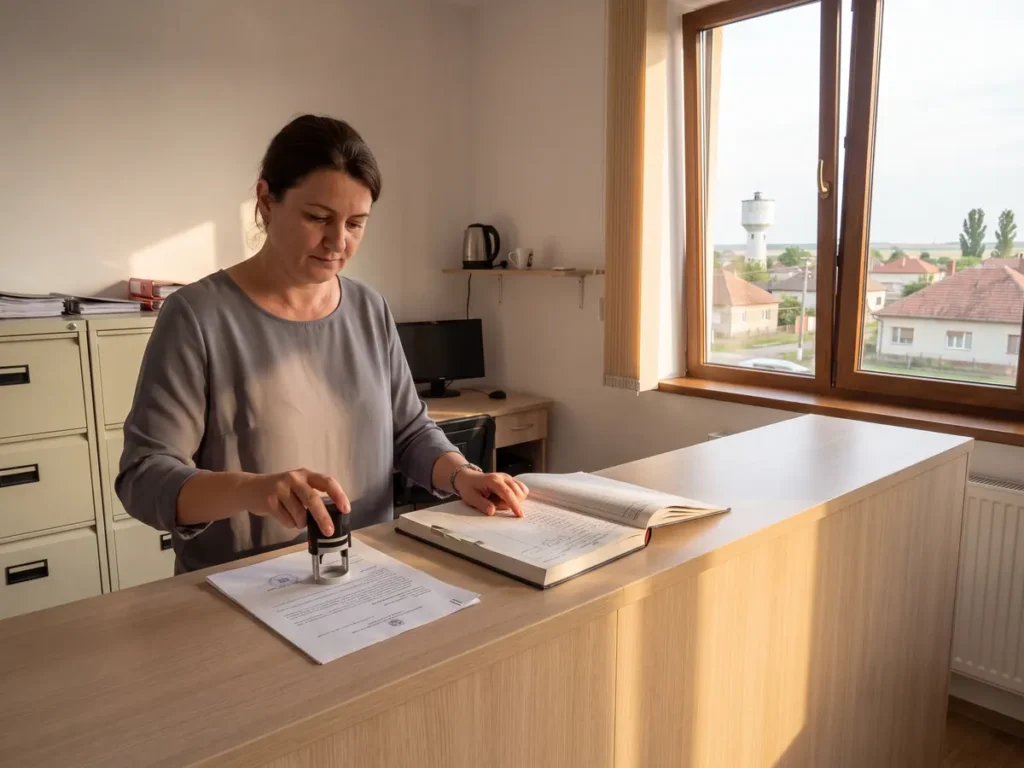
In brief
- The extra 10% on the basic salary stays only with the auxiliary staff of the High Court of Cassation and Justice, of the prosecutor’s office attached to it, of the DNA and of the DIICOT. The Constitutional Court rejected, unanimously, the plea by which court clerks from Teleorman county were asking for the same increase. Decision no. 695 was delivered on 4 December 2025 and was published on 25 September 2026.
- The losers are the court clerks and the other auxiliary staff of the ordinary courts and prosecutor’s offices, who stay on the basic salary without the increase. Their case before the Teleorman County Court goes on with the text unchanged, and the argument about the heavier workload does not help: the Court said that it is not for it to verify statements of fact of that kind.
- The reason for the rejection is one of principle, not of figures. The legislature is allowed to pay staff in specialised structures differently, because the DNA and the DIICOT have exclusive powers of criminal investigation, and that argument holds even though, as the Court writes, the work of the clerks of the DIICOT is not functionally different from that of their colleagues in the prosecutor’s offices attached to the district courts.
Published: Official Gazette of Romania, Part I, no. 818 of 25 September 2026, pages 2-4
In force from: the decision is generally binding from the date of publication, 25 September 2026
The Constitutional Court has confirmed that the 10% increase of the basic salary for specialised auxiliary staff and for ancillary staff may remain reserved to the four structures named in the law, without the rest of the country’s court clerks being able to claim the same treatment. It is the second time in a short while that the constitutional court has said that differences in money inside the „Justice” occupational family are a matter of legislative choice, after it showed earlier this year that not even the 30% cap on the bonuses of justice employees can be challenged on the ground of equality. The provision challenged this time is Article 17(5) of Chapter VIII of Annex no. V to Framework Law no. 153/2017, the annex covering the remuneration of justice staff.
The contested provision is a single sentence. The basic salaries for specialised auxiliary staff and for ancillary staff at the High Court of Cassation and Justice, at the Prosecutor’s Office attached to the High Court of Cassation and Justice, at the National Anticorruption Directorate and at the Directorate for Investigating Organised Crime and Terrorism are those in paragraph (2), increased by 10%. The authors of the plea did not ask for the text to be struck down but for it to be extended: they asked the Court to find unconstitutional precisely the exclusion of court clerks outside the four structures.
The plea arose in a dispute over salary entitlements before the Teleorman County Court, Division for labour disputes, social insurance and administrative and tax litigation, case no. 1.521/87/2021. The court referred it to the Constitutional Court by Judgment no. 11 of 19 January 2022, and before the Constitutional Court the case was given the number 231D/2022. There were three arguments: that the situations of the two categories of court clerks are objectively similar; that at the Prosecutor’s Office attached to the Roșiorii de Vede District Court the staffing plan is smaller and not fully filled, so the workload per person is heavier than at the DNA and the DIICOT; and that the case law of the courts had moved, for judges and prosecutors, towards levelling salaries up to the highest amount being paid within the same occupational family.
For the last argument, reliance was placed on Decision of the Constitutional Court no. 794 of 15 December 2016 and on Law no. 71/2015, and, for the discrimination, on Decision no. 685 of 28 June 2012 and on Decision no. 46 of 15 December 2008 of the High Court of Cassation and Justice, Joint Divisions, which held that the confidentiality bonus must be granted to all employees in similar situations. The Teleorman County Court gave its own view that the plea was unfounded. The presidents of the two Chambers of Parliament, the Government and the Ombudsman sent no point of view. The Public Ministry asked for rejection, relying on Decision no. 547 of 29 October 2024.
The Court’s answer has two steps. The first: the rules rest on a presumption made by the legislature, namely that between the work of court clerks in the specialised prosecutor’s offices and that of court clerks in the prosecutor’s offices attached to the district courts there are, beyond the similarities, also differences capable of justifying different salaries, and as long as the presumption is not arbitrary, Article 16 of the Constitution is not breached. On the second step, the search for the differences moves from the job description to the powers of the institution. The DIICOT, set up by Government Emergency Ordinance no. 78/2016, has exclusive jurisdiction over organised crime and terrorism, and the DNA, under Government Emergency Ordinance no. 43/2002, investigates corruption offences committed in circumstances of increased gravity, for instance with damage greater than the leu equivalent of 200,000 euros.
On the workload argument, the Court refused to enter. It held that it is not for it to assess the accuracy of purely factual assertions; that the legislature has a duty to weigh as much factual data as possible when it adopts a rule, under Article 6(1) of Law no. 24/2000; but that, once the law is adopted, all authorities are bound to apply it as written, by the effect of Article 1(5) of the Constitution. And in paragraph 24 it went further: it accepts that the work of court clerks in towns that are not county capitals may in fact be more intense and carried out in worse conditions, but no legislature can do without the generalisation that a general and abstract rule entails.
What it changes in practice
The first effect is felt by the authors of the plea. Their dispute before the Teleorman County Court goes on with the text left untouched, and the basis on which they hoped to obtain the 10% increase has gone. The decision is generally binding from 25 September 2026, the date of publication, under Article 147(4) of the Constitution.
The second effect concerns any other case with the same subject matter. A rejection as unfounded rules on the merits, so the same criticism, based on equality of rights and on equal pay for equal work, can no longer be raised successfully against the same text. Courts with similar cases on their lists now have an answer from the constitutional court that they can rely on directly.
The third effect is on the figure in the payroll, which changes for nobody. The 10% increase stays at the High Court of Cassation and Justice, at the Prosecutor’s Office attached to the High Court, at the DNA and at the DIICOT. Auxiliary staff in the other courts and prosecutor’s offices stay on the salary in paragraph (2), without the increase, with everything that means for seniority steps and for the calculation bases that start from the basic salary.
The fourth effect is one of method, and it goes beyond the case of court clerks. The Court repeats that the argument about the actual workload does not work before it, however well documented, because it is a matter of fact, not of rules. Anyone preparing a plea in matters of remuneration has here the clearest indication: staffing plans, caseload statistics and workload comparisons are filed with Parliament or the Government, not with the Constitutional Court.
The fifth effect concerns the form in which a change could nevertheless come. The Court said that extending the increase is the business of the legislature, not that it has to stay where it is. An amendment to Annex no. V to Framework Law no. 153/2017 would solve the problem without any litigation, and the present decision does not stand in its way.
What has changed compared with the previous situation
As far as the wording of the law is concerned, nothing has changed. Article 17(5) of Chapter VIII of Annex no. V remains exactly as it was on 28 June 2017, when Framework Law no. 153/2017 was published in Official Gazette of Romania, Part I, no. 492. What has changed is the legal state of the argument: until 25 September 2026 a court could send the criticism to the Court, and from now on it has an answer on the merits.
The second change completes a picture begun ten months earlier. By Decision no. 609 of 11 November 2025, published in Official Gazette of Romania, Part I, no. 273 of 6 April 2026, the Court had already established that the legislature may pay court clerks in the prosecutor’s offices attached to the courts seated in the county capital differently from those in the prosecutor’s offices of the other courts of the same county, the argument being that all county courts are seated in the county capital, under Article 40(1) of Law no. 304/2022 on the organisation of the judiciary. The present decision rests on that one and adds a second plane of comparison, the one between ordinary prosecutor’s offices and specialised structures.
The third change concerns the line of case law on levelling up to the highest amount being paid. The authors tried to bring into the remuneration of auxiliary staff the reasoning built for judges and prosecutors on the basis of Law no. 71/2015 and of Decision no. 794 of 15 December 2016. The present decision closes that route for their case, without touching the case law relied on: the criterion remains the jurisdiction of the structure, and the exclusive jurisdiction of the DNA and of the DIICOT is not found in the prosecutor’s offices attached to the district courts.
The fourth change is a matter of nuance, but it is worth noting. Until now, the usual argument for a difference in salary was that the work performed differs. Paragraph 19 says something else: even if the court clerks of the DIICOT do not perform functionally different work, the State cannot be forbidden from regulating in a nuanced way the salaries of staff in a specialised structure. The justification therefore moves from the content of the work to the organisation of the institution.
Advantages and disadvantages
What it improves
- It gives an answer on the merits, not a procedural rejection. The plea was rejected as unfounded, unanimously, so courts hearing identical cases now have a firm reference point.
- It names the criterion on which the difference rests: the exclusive criminal investigation jurisdiction of the DNA and of the DIICOT, with reference to Government Emergency Ordinance no. 43/2002 and to Government Emergency Ordinance no. 78/2016. A written criterion can be discussed and, if need be, changed by law.
- It openly acknowledges the fact on which the complaint rested. Paragraph 24 accepts that the work in towns that are not county capitals may be more intense and done in worse conditions, and then explains why that does not change the legal answer.
- It does not close the legislative route. It states there that extending the increase is a matter of legislative choice, so an amendment to Annex no. V remains possible without any further litigation.
- It places the decision in a coherent chain, by referring to Decision no. 609 of 11 November 2025, instead of treating the case as something entirely new.
What remains a problem
- The answer came 1,710 days after the referral to the Court, of which 295 fall between the delivery, on 4 December 2025, and the publication, on 25 September 2026. The case before the Teleorman County Court stood still throughout that time.
- Paragraph 19 leaves an unresolved tension. Paragraph 18 holds that the legislature presumed differences between the two kinds of work, while paragraph 19 holds that the work is not functionally different. If the factual presumption falls, all that is left as a basis for the difference in salary is the organisation chart.
- The decision does not show how much, in lei, that 10% amounts to. Without the level of the basic salary from paragraph (2), the reader cannot tell whether what is at stake is a few tens of lei a month or a few hundred.
- The gravity threshold relied on for the jurisdiction of the DNA, the leu equivalent of 200,000 euros, is an amount that loses its value over time, whereas the difference in salary remains a fixed percentage. The decision does not say since when that threshold has existed.
- The workload argument is left without a judge. The constitutional court does not assess facts, the legislature has no obligation to answer an individual complaint, and the trial court applies the text. In practice there is no gate through which an understaffed establishment plan could produce any effect.
- The text does not clarify what happens to the other limb of the criticism, the one about towns that are not county capitals, even though it devotes three paragraphs to it.
Practical advice
- If you have a case pending with the same subject matter, read the operative part first. The rejection is as unfounded, so it concerns the merits, and the same criticism against the same text can no longer succeed.
- Check exactly which paragraph concerns you. The 10% increase is in paragraph (5) of Article 17 of Chapter VIII of Annex no. V, and the salary from which it starts is in paragraph (2) of the same article.
- Do not build a plea on workload. The Court says plainly that it does not assess statements of fact, however well documented. Caseload statistics and staffing plans have an effect on legislative initiative, not in constitutional litigation.
- If you are after a real change, aim at Annex no. V to Framework Law no. 153/2017. The decision says expressly that extending the increase is a matter of legislative choice, so the route is an amendment to the law, with the budgetary impact calculated.
- When you compare salaries between institutions, compare the powers as well. The criterion accepted by the Court is not the daily work but the exclusive jurisdiction of the structure, and a comparison that skips that element does not answer the argument of the decision.
- Bear in mind that the decision produces effects only for the future. Judgments given in similar cases up to 25 September 2026 are not reopened on the strength of it.
Frequently asked questions
Who receives the 10% increase and who does not?
Why did the Court consider the difference lawful?
Does the argument that I have more work count for nothing at all?
What happens to the case in which the plea was raised?
Can anyone still challenge the same text?
What is Annex no. V to Framework Law no. 153/2017?
From when does the decision produce effects?
Was the decision taken unanimously?
Errors and inconsistencies in the published text
- Paragraphs 22-24 against the subject matter of the plea and the operative part. There the Court resolves a criticism about the difference between court clerks in the prosecutor’s offices attached to the courts in the county capital and those in the prosecutor’s offices of the other courts. The text under review, Article 17(5), contains no distinction by locality: it separates the High Court of Cassation and Justice, the prosecutor’s office attached to it, the DNA and the DIICOT from the rest. The operative part declares constitutional only paragraph (5), so the decision does not make it possible to establish which text this second part of the solution ruled on.
- Paragraphs 5 and 16 against paragraphs 6, 22 and 24. The former describe the authors as court clerks at the district courts in county capitals and at the prosecutor’s offices attached to them. The latter give as an example the Prosecutor’s Office attached to the Roșiorii de Vede District Court and discuss the situation of court clerks „de la parchetele de pe lângă judecătoriile din orașe nonreședință de județ”, at the prosecutor’s offices attached to the district courts in towns that are not county capitals. The category to which the authors belong, which is what decides the very comparison the Court makes, comes out of the text in two mutually exclusive forms.
- Paragraph 8. It states that the authors ask for „majorarea de 5%”, the five per cent increase, to be granted to all court clerks at the prosecutor’s offices attached to the district courts, whatever the locality. Nowhere in the text is it shown which provision this 5% increase comes from, and the only increase it quotes, in paragraph 15, is the 10% one in paragraph (5). The reader cannot establish what exactly was requested.
Editorial analysis
The clearest proof that the reasons were written long after the hearing lies in the text of the decision itself. In paragraph 22, the decision delivered on 4 December 2025 cites Decision no. 609 of 11 November 2025 with its full publication reference: Official Gazette of Romania, Part I, no. 273 of 6 April 2026. That reference did not exist on the date of the hearing and could not have been known then, because it appears 123 days later. The total distance is greater still: from the referral to the Court, by Judgment no. 11 of 19 January 2022, to publication, 1,710 days passed, of which 1,415 up to delivery and a further 295 up to publication. A case about salary entitlements therefore stood still for four years and eight months for a three-page answer.
The second observation comes out of combining paragraphs 18 and 19, and it concerns the very foundation of the solution. The Court states, in paragraph 18, that the legislature presumed differences between the work of court clerks in the specialised prosecutor’s offices and that of their colleagues in the prosecutor’s offices attached to the district courts, and the review stops at the question whether the presumption is arbitrary. Paragraph 19, however, says that the court clerks of the DIICOT „nu prestează o activitate în mod funcțional diferită”, do not perform functionally different work. The factual presumption that the Court is reviewing is therefore rebutted by the Court itself, and the difference in salary is left to rest on the jurisdiction of the institution, not on the content of the work. This is an important shift of criterion, made in two sentences, without the decision announcing it.
The third observation concerns the figure on which the explanation rests. To show the increased gravity of the DNA’s cases, the Court relies on the threshold of the leu equivalent of 200,000 euros in Government Emergency Ordinance no. 43/2002. The difference in salary justified by it is, however, a percentage, 10%, which is recalculated with every rise in the basic salary, whereas the threshold in euros is a nominal value, which the decision reads out of the ordinance without saying since when it has been in force and without showing whether it has ever been updated. The criterion that measures the increased gravity of the work therefore sits in a figure without a date, while the reward tied to it remains a percentage.
The fourth observation concerns what cannot be learned from the decision. Nowhere in three pages does a figure in lei appear. The text discusses a 10% increase applied to the salaries in paragraph (2) of the same article, but it does not reproduce a single one of those salaries, so what is really at stake in the case remains unknown to the reader. On the same day, the Official Gazette of Romania published two further decisions on the remuneration of staff paid from public funds, Decision no. 742/2025, on kinesiotherapists in the social assistance system, and Decision no. 876/2026, which struck down the ordinance that was blocking precisely this kind of case. The first uses exactly the same reasoning: the same post, different structures, objectively different situations. The second concerns the very category of dispute from which the case before the Teleorman County Court started.
What should be changed
- The reasons should carry the date on which they were drafted, not only the date of delivery. A decision that cites an Official Gazette of Romania published four months after the hearing shows that the two moments are distinct. Written out together, they would let anyone measure where the time is lost.
- Decisions on remuneration should also reproduce the level of the salary from which the percentage under discussion starts. One line with the amount from paragraph (2) would turn an abstract argument about 10% into information that the reader can set against his own payslip.
- When the Court answers a criticism that does not concern the text forming the subject matter of the plea, it should say so explicitly. Paragraphs 22-24 resolve a comparison that paragraph (5) does not contain and that the operative part does not cover. One sentence of delimitation would prevent them from being relied on in cases that have nothing to do with this text.
- Annex no. V should say why the four structures receive the increase. The criterion of exclusive jurisdiction was built by the Court, not written by the legislature. If that is the true criterion, its place is in the law, where the trial courts can check it too.
- Jurisdictional thresholds expressed in euros should be cited with the date on which they were set. In 2026 the decision uses the figure of 200,000 euros from Government Emergency Ordinance no. 43/2002 as a measure of gravity, without saying when it was established and whether it has changed since.
- The period between delivery and publication should be limited. The 295 days here mean just as many days in which the courts adjudicated without knowing the answer, and the parties waited without being able to do anything.
Original text of the legal act
The text below is reproduced in Romanian, the official form of publication.
The full text, as published in the Official Gazette of Romania
Official Gazette of Romania no. 818 of 25 September 2026, pages 2-4 16 pages PDF, 156 KB the act starts on page 2
Open the official PDFDownload the PDF
The viewer is not shown on small screens. Use the buttons above to open or download the file.
This article is for informational purposes only and does not constitute legal advice. For specific situations, consult a licensed attorney or tax advisor.