
In brief
- Law No. 168/2026 requires an increasing share of renewable energy in heating and cooling: 35.9% in 2027, 37.1% in 2028, 38.6% in 2029 and 41.4% in 2030, through support programmes for replacing old boilers and stoves with heat pumps, solar panels or other solutions.
- Forest biomass used by large operators (plants above 7.5 MW for solid biomass or 2 MW for gaseous biomass) must be exclusively certified and traceable, under fines of up to RON 40,000.
- Who is affected: owners of flats connected to district heating systems (individual metering mandatory by 31 December 2030), municipalities with over 20,000 inhabitants (local heating plan from 2027) and district-heating operators.
Published: Official Gazette of Romania (Monitorul Oficial) No. 647 of 5 August 2026
In force from: 8 August 2026
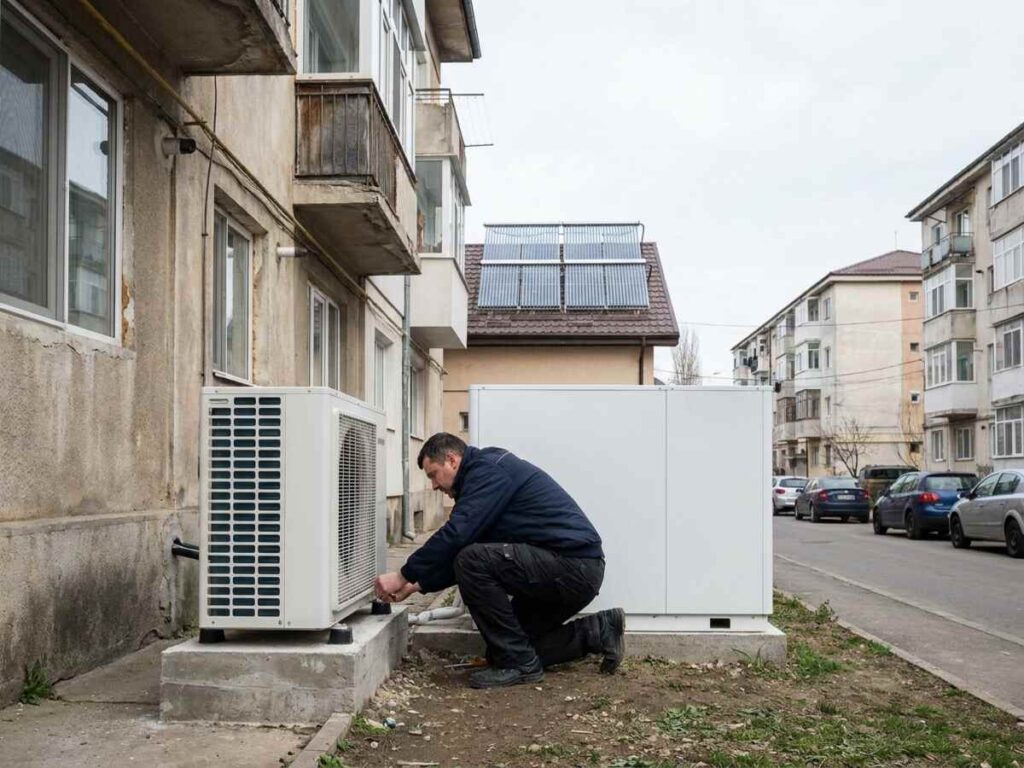
Romania aims, through Law No. 168/2026, to drastically reduce its dependence on firewood and solid fossil fuels for heating homes and buildings, through a clear calendar of annual targets and national programmes for replacing old boilers and stoves with heat pumps, solar panels or other clean technologies. The law, promulgated on 4 August 2026 and published the next day in the Official Gazette of Romania, transposes European decarbonisation objectives for the heating and cooling sector and introduces, for the first time at this level of detail, traceability obligations for forest biomass used on an industrial scale, alongside other recent measures encouraging renewable sources at individual household level, such as quantitative compensation for energy produced from solar panels.
The core of the law is a calendar of targets for the share of renewable sources in heating and cooling: 35.9% in 2027, 37.1% in 2028, 38.6% in 2029 and 41.4% in 2030. To reach them, local authorities, together with central ones, must run voluntary support programmes (so owners are not obliged to change their boiler) for the gradual replacement, by 2040, of heating units older than 10 years or with an efficiency below 65%, prioritising geothermal sources, heat pumps, solar collectors, high-efficiency cogeneration without forest biomass, photovoltaic systems coupled with heat pumps, or the recovery of waste heat. The law also sets minimum quantitative objectives: at least 50,000 units replaced by 2030, 100,000 by 2035 and 250,000 by 2040.
The second major component concerns forest biomass used industrially. Operators with installations above 7.5 MW for solid biomass or 2 MW for gaseous biomass must use exclusively certifiable forest biomass and report annually, by 31 March, a sustainability report independently verified by an accredited third party. Failure to comply is sanctioned with fines between RON 7,500 and RON 40,000, depending on the type of breach.
The methodological framework the law required by 31 August 2026 was published on that very day: how it is decided what each household gets instead of its wood stove.
What it changes in practice
For owners of flats connected to district heating systems, the most concrete effect is a firm deadline: by 31 December 2030, all condominium buildings must have individual meters installed for heating, cooling and hot water, or, where individual metering is not technically feasible or cost-effective, cost allocators fitted on each radiator. In practice, billing by equal shares regardless of actual consumption should become a thing of the past within the coming years.
The money for the networks that carry heat into those flats now has the form on which it is claimed: the 590 million euro guide for district heating gets its pre-financing form 99 days before the last deadline.
For municipalities in towns with over 20,000 inhabitants, the law introduces a new obligation: from 2027, each such local authority must draw up and update, once every 4 years, a local heating and cooling plan, including energy-transition scenarios, communicated to the Ministry of Energy. The same municipalities may delimit, by decision, unified heating zones in which a single centralised technical solution applies, precisely to protect public investments already made in district-heating networks.
In October 2026 the Constitutional Court left in place the exception that lets local councils pay for gas boilers where the heating substation has fewer than 50 users.
For businesses burning forest biomass on a large scale, the law means additional compliance costs (certification, independent verification, annual reporting), but also a risk of sanctions if they use wood from uncertified or unsustainable sources, a sensitive issue given the illegal logging repeatedly reported in recent years.
What has changed compared with the previous situation
- Legal targets, not just recommendations: the share of renewable sources in heating and cooling receives, for the first time, binding percentage targets, year by year, through to 2030.
- New traceability for biomass: large biomass operators must demonstrate annually, through independent verification, that the wood used is certified and sustainable, with sanctions for non-compliance.
- Firm deadline for individual metering: 31 December 2030 for installing meters or cost allocators in all condominiums connected to district systems, an amendment to Energy Efficiency Law No. 121/2014.
- Mandatory local planning: towns with over 20,000 inhabitants must have, from 2027, a local heating and cooling plan, updated periodically.
- Extended corporate governance: district-heating operators with public-enterprise status now explicitly fall under the corporate-governance rules of Government Emergency Ordinance No. 109/2011.
Advantages and disadvantages
What it improves
- Fairer billing for residents of apartment blocks, based on actual consumption, once individual metering becomes the norm by 2030.
- Financial support (EU funds, the Environment Fund, the Modernisation Fund) for replacing old, polluting boilers and stoves with clean technologies, on a voluntary basis.
- Reduced risk of illegal logging, through the traceability and certification obligations for forest biomass used industrially.
What remains a problem
- Boiler-replacement programmes are voluntary; without owners actually applying, the real pace of decarbonisation could remain well below the legal targets.
- Funding depends on annually approved budgets and EU funds, so concrete support for households may be delayed or vary from year to year.
- Individual metering by 2030 involves investment costs for homeowners’ associations, even though installing cost allocators is generally cheaper than installing meters.
Practical advice
- If you live in a block connected to district heating without individual metering: discuss with your homeowners’ association about installing meters or cost allocators early, the legal deadline (31 December 2030) is closer than it seems.
- If you have a solid-fuel boiler or stove older than 10 years: follow your municipality’s and the Ministry of Energy’s support programmes for replacement with a heat pump or solar panels, participation is voluntary and you are not required to change your boiler immediately.
- If you manage a homeowners’ association: check early whether your building qualifies for individual metering or cost allocators, depending on technical feasibility, as the decision affects investment costs.
- If you are a business with a biomass installation above the legal thresholds: prepare traceability documents and the annual independent verification in advance, the report is due by 31 March for the previous year.
- If you live in a town with over 20,000 inhabitants: follow your municipality’s local heating and cooling plan, which from 2027 will show what technical solutions are planned for your area.
Frequently asked questions
What exactly does Law No. 168/2026 require?
Are homeowners required to replace their wood-burning boiler?
What happens if my building doesn’t have individual metering by 2030?
Who verifies that forest biomass is legal and sustainable?
What is a unified heating and cooling zone?
Original text of the legal act
The text below is reproduced in Romanian, the official form of publication.
The full text, as published in the Official Gazette of Romania
Official Gazette of Romania no. 647 of 5 August 2026 16 pages PDF, 114 KB the act starts on page 7
Open the official PDFDownload the PDF
The viewer is not shown on small screens. Use the buttons above to open or download the file.
This article is for informational purposes only and does not constitute legal advice. For specific situations, consult a licensed attorney or tax advisor.