
In brief
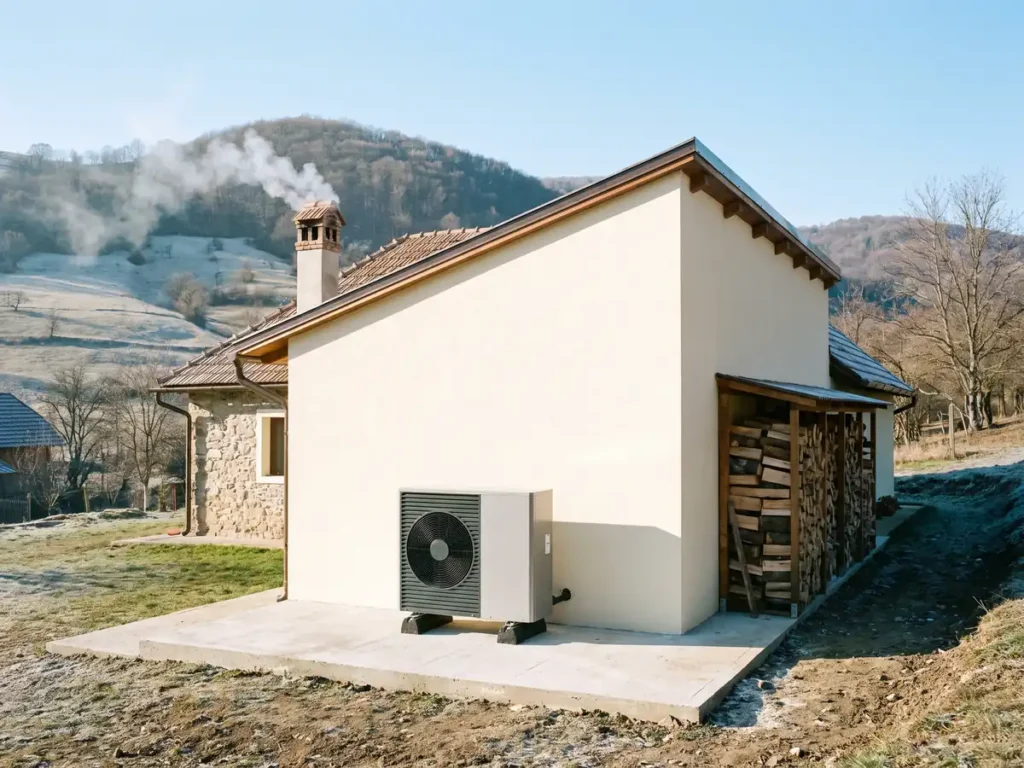
- Four ministries have approved the rules under which town halls will be able to pay for replacing wood-burning stoves and boilers that are more than 10 years old or have an efficiency below 65%. Taking part is voluntary, and it is the owner who applies.
- What you get instead is not your free choice: an Excel calculation tool compares the heat pump, solar thermal panels, geothermal, photovoltaics with storage, cogeneration and connection to district heating over 15 years, and rules out any solution costing more than twice the reference solution.
- For households affected by energy poverty and for vulnerable households, the support may cover up to 100% of eligible costs where the money comes from the Social Climate Fund, and the town hall is under a duty to help them put the file together.
Published: Official Gazette of Romania (Monitorul Oficial) no. 727 of 31 August 2026
In force from: 31 August 2026
From 31 August 2026, the programme for replacing old wood-burning stoves and boilers finally has an operating manual. The joint order of the minister for European investments and projects, the minister of energy, the minister of development and the minister of the environment, published in Official Gazette of Romania no. 727 of 31 August 2026, approves the methodological framework required by Law No 168/2026 on the decarbonisation of the heating and cooling sector. The law had set 31 August 2026 as the deadline for approval, so the order appeared on the very last day allowed.
What is at stake is large and very concrete. The law requires that, by 31 December 2040, at least 250,000 heating units running on wood or solid fossil fuels be replaced, with intermediate targets of 50,000 by the end of 2030 and 100,000 by the end of 2035. Nobody is obliged to change their stove: Article 4(13) of the law states expressly that no general obligation to replace is created and that the use of existing units is not prohibited. What is being built now is the mechanism through which those who do want to change receive public money for it.
Who can apply for support: individual households using a heating unit fired by forest biomass or solid fossil fuel that is more than 10 years old or has an efficiency below 65%; town halls, for public buildings with a social purpose in the same situation; and district heating operators, for the generating units of centralised systems.
What it changes in practice
The first effect is that the technical decision leaves the applicant’s hands and moves into an algorithm. The town hall fills in a calculation tool, and the tool runs two tests. The technical feasibility test checks whether the necessary infrastructure exists at that address: a gas network, sufficient electricity capacity, a district heating system, plus the distance to them and the cost of connecting. The economic justification test compares the 15-year total cost of each remaining solution with the cost of the reference solution and eliminates everything above a threshold, set by default at 2, that is, at twice the reference.
The second effect is that, if several solutions pass both tests, the tool recommends the cheapest one, but the applicant may choose any of the eligible ones. It is the only place in the whole methodological framework where the owner has a real choice.
The third effect concerns what happens when nothing passes. If none of the eight solutions provided for by the law is simultaneously feasible and economically justified, the fallback solution applies: again a wood-fired unit, but a new one, compliant with the ecodesign requirements of Regulation (EU) 2015/1.185. And if even that is not feasible, the tool declares that the site has no eligible solution, and no support is granted.
The fourth effect is a prohibition. Standalone boilers fired by fossil fuels cannot be financed, under Government Ordinance No 16/2025, which transposes Directive (EU) 2024/1.275. The exception, written expressly, covers stoves and micro-cogeneration systems producing electricity and heat at building level, which do not fall within the category of standalone boilers.
What has changed compared with the previous situation
Until this order, Law No 168/2026 had been in existence for three weeks but could not be applied. The law said that town halls set up support programmes, listed the eight energy solutions and fixed the targets for 2030, 2035 and 2040, but it left blank everything that meant implementation: who is eligible, what documents they file, how the feasibility test is done, how much the support covers and how it is paid. All of that was to be approved, under Article 10(1) of the law, by joint order of the four ministers.
The order fills that gap, but not completely. The methodological framework lays down the procedure and the algorithm, but not the figures. The intensity of the support, the minimum share of the budget reserved for vulnerable households, fuel prices, connection costs and infrastructure thresholds are still to be set through the applicant’s guide for each funding source. The only values written anywhere in the document are the 15-year horizon and the threshold of 2.
A similar gap was filled on the district heating networks, again through an order of the minister of energy: the 590 million euro guide now has its pre-financing and reimbursement form.
Who keeps the records also changes. Local authorities report annually, by 31 March, on the state of implementation, to the Ministry of Energy and the Ministry of Development, using the template in Annex no. 2 to Law No 168/2026. The first report is due in 2027.
One novelty worth remembering is the treatment of energy-poor households. For them, the framework provides four measures at once: a minimum reserved share of each programme’s budget, a higher intensity of support, help from the town hall in putting the file together, and the possibility of receiving the money in advance or in instalments, precisely so that they do not have to pre-finance the works. For funding from the Social Climate Fund, the support may reach 100% of eligible costs for the households with the highest degree of vulnerability.
Advantages and disadvantages
What it improves
- The selection rule is the same across the country and the result is generated automatically, so two identical households in different counties ought to get the same answer.
- Households without the money to pre-finance can receive the support in advance or through direct payment to the installer, so they do not have to put up the sum themselves first.
- The town hall is under an express duty to help energy-poor and vulnerable households put the paperwork together, either directly or through designated bodies.
- The cost of connecting to the gas network, to the electricity grid or to district heating enters the calculation, so a solution that is cheap to buy but expensive to hook up can no longer be recommended artificially.
- Participation remains voluntary, and the act repeats this, so nobody can be forced to give up an existing unit.
What remains a problem
- The framework contains no support figure at all. How much a household actually receives will only be known from the applicant’s guide, which has no publication deadline.
- The 15-year calculation is done in constant prices, with no discount rate, so a leu spent in 2041 weighs exactly as much as one spent in 2027.
- The definition of a household affected by energy poverty passes the question on and does not settle on any criterion that can be verified in the text of the act.
- The annex, that is, the calculation tool itself, is published in facsimile, in printable form, and all the values in it appear as „input”. The Excel file that generates the result is not published and no article says who makes it available.
- The targets in the law require 150,000 units in the last five years, three times the pace of the previous five, and the methodological framework contains no acceleration mechanism whatsoever.
Practical advice
- Do not file anything yet. The application goes to the town hall only after the funding authority publishes the call for projects, with the budget and the relevant criteria. Until then there is no file to submit.
- Get the title deed or another document proving a lawful right to use the property ready in good time. It is the first document required by Article 7 and its absence blocks everything.
- Look for the papers of the existing boiler or stove, showing its age and efficiency. If you no longer have them, the framework accepts a statutory declaration, but this is cross-checked against an on-site inspection carried out by the town hall.
- If you qualify as a vulnerable energy consumer under Law No 226/2021, gather the documents that prove it. The classification does not come from the box you tick in the calculation tool, but from the documentary check carried out by the funding authority.
- Check what infrastructure exists at your address and how far away it is: gas network, available electricity capacity, district heating system. Those three facts, plus the distance, decide which solutions stay in the calculation before any discussion about price.
- If you want a particular technology, ask the town hall for the result generated by the calculation tool. It forms part of the funding application file, and if several solutions are eligible you have the right to choose, not only to take the cheapest.
- Do not sell or decommission the equipment that was financed. The beneficiary is under a duty to keep the investment functional and used for its purpose, and failure to comply triggers recovery of the amounts.
Frequently asked questions
Am I obliged to replace my wood-burning stove?
Which units are covered by the programme?
How much does the support cover?
What happens if nothing on the list can be installed at my place?
Can I get money for a gas boiler?
Who runs the feasibility test, me or the town hall?
How is the money paid?
Does it also apply to blocks of flats connected to district heating?
Errors and inconsistencies in the published text
- The reference solution is defined differently in the articles and in the annex, and the whole economic test depends on it. Article 2(c) of the methodological framework defines the reference solution as „înlocuirea unei centrale individuale existente pe lemne cu o centrală individuală nouă pe lemne, care respectă cerințele în materie de proiectare ecologică prevăzute de Regulamentul (UE) 2015/1.185”, that is, replacing an existing individual wood-fired boiler with a new, ecodesign-compliant one. The annex, sheet „Calculator_Individual”, section „3. Parametri de calcul” (calculation parameters), row „Soluție de referință” (reference solution), instead carries the value „= sistemul de încălzire existent”, the existing heating system. These are two different things: a new compliant boiler has an investment cost and reduced consumption, whereas the existing system has zero investment and high consumption. Since Article 11(3) declares a technology economically justified only if the ratio between its 15-year cost and the cost of the reference solution does not exceed the threshold, the two definitions give different denominators and, at the same threshold of 2, different lists of eligible technologies for the same site.
- Annex, section „4. Calculul justificării economice” (calculation of economic justification), row „SACET” (district heating), column „Infrastr.”: the value is „Autonom”, standalone. The same annex has, in section „2. Infrastructură disponibilă și cost estimat de racordare” (available infrastructure and estimated connection cost), a separate „SACET” row, with columns for existence, distance and estimated connection cost, and Article 9(1)(b) expressly requires the tool to use „existența … sistemului de alimentare centralizată cu energie termică, precum și distanța până la acestea”, the existence of the centralised heat supply system and the distance to it. The „Infrastr.” column is what ties each technology to the infrastructure row that conditions it: gas has „Gaz”, heat pumps have „Electric”. By marking connection to district heating as standalone, the link is broken, and checking whether the network exists can no longer influence the feasibility of that solution.
- The definition of a household affected by energy poverty does not close on any criterion. Article 2(e) defines it as the household „care se încadrează în prevederile art. 19”, one falling within Article 19. Article 19(1), however, reproduces the definition of energy poverty as a phenomenon, from Article 2(52) of Directive (EU) 2023/1.791, without any qualifying conditions, and paragraph (2) passes the question on: the verification mechanism „se stabilește în funcție de criteriile specifice fiecărei surse de finanțare”, it is set according to the criteria specific to each funding source, for the „categoria de beneficiar prevăzută la art. 16 alin. (1)”, the beneficiary category provided for in Article 16(1). Article 16(1) provides for no beneficiary category at all, it merely says that the intensity is set on a differentiated basis using the criteria in the funding guide. The chain closes on nothing, even though Article 21(a) reserves a minimum share of each programme’s budget for exactly this category, and Article 21(b) refers, for the increase in intensity, back to Article 16(1), a provision that provides for no increase. By comparison, Article 20 solves the problem for the vulnerable household, by reference to Law No 226/2021 and to Regulation (EU) 2023/955.
Editorial analysis
This framework solves a problem that has blocked every previous stove replacement programme: who decides what gets installed. Until now the choice was made either through the guide or through local negotiation, and the result was that the money went to the solution that was easiest to install, not to the best one over the long run. Here the decision is taken through an explicit 15-year calculation which includes the connection cost, not just the price of the equipment. That is a real improvement, and its transparency can be checked: the result generated by the tool forms part of the application file, so the applicant can ask for it and contest it.
The arithmetic of the targets in the law, however, says something different from what the calendar says. 50,000 units by the end of 2030 means roughly 12,500 a year, if the first call opens in 2027. The next 50,000, by the end of 2035, require 10,000 a year, a slightly slower pace. The last 150,000, between 2036 and 2040, require 30,000 a year, three times as many. In other words, 60% of the 250,000 target is pushed into the final five years of the period, and the methodological framework published now contains no mechanism to prepare for that acceleration. The only instrument provided for a shortfall is the corrective action plan in Article 4(11) of the law, which is triggered only after the gap has opened up and persisted for a year.
The most consequential methodological choice is also the least explained. Article 11(5) requires all 15-year costs to be calculated in constant prices, with no discount rate. In a discounted calculation, future fuel spending is worth less than today’s investment, which favours solutions that are cheap to install. Without discounting, a leu of fuel paid in 2041 weighs exactly as much as one paid in 2027, and the advantage shifts to technologies with low operating costs, that is, to heat pumps. The choice is consistent with the declared purpose of the law, but it silently decides who wins the comparison, and it deserves to be stated as such rather than buried in a paragraph on method.
A third thing shows up in the dates on the order. The minister for European investments and projects signed on 18 August, the other three ministers on 28 August, and publication took place on 31 August, the last day of the deadline set by Article 10(1) of the law. Ten days between the first and the last signature, on an act that conditions a milestone in the National Recovery and Resilience Plan, component 6, reform 6, milestone 128, invoked in the preamble to the order itself. The deadline was met, but with no day to spare, and the applicant’s guide, the document that carries the figures, has no deadline at all.
What should be changed
- A deadline for the applicant’s guide. The methodological framework delegates to the guide the intensity of the support, the share reserved for vulnerable households, fuel prices and infrastructure thresholds, that is, everything that turns the algorithm into money. Without a deadline, an act published on the last lawful day can remain inapplicable indefinitely, and the 2030 target loses years of implementation from the outset.
- Publication of the calculation tool in electronic form, at an address named in the act. The annex in the Official Gazette of Romania is a printable reproduction, with every value marked „input” and the formulas rendered descriptively. Since Article 8(2) requires the test to be carried out „prin completarea instrumentului de calcul”, by filling in the calculation tool, the file that generates the result ought to have a place of publication set by the act, not left to each funding authority.
- A criterion of its own for energy poverty, at least a fallback one. A threshold such as energy spending exceeding a given percentage of the household’s disposable income would immediately give content to Article 19 and would make the four protective measures in Article 21 applicable even to programmes funded from sources that do not impose a definition of their own.
- A public report on the results generated by the tool, not just on the number of units replaced. The annual reporting under Article 27 concerns the state of implementation. If the distribution of recommended technologies, of those actually chosen and of the cases with no eligible solution were published as well, it would be clear within the first year whether the threshold of 2 is correctly calibrated or whether it systematically pushes sites towards the fallback wood-fired solution.
- An explicit alignment between the eight solutions in the law and the list of 12 technologies in the tool. The tool assesses, among others, „Gaz (cu condensare)”, condensing gas, even though Article 4(4) of Law No 168/2026 does not list it among the energy solutions, and Article 12(4) of the framework admits it only for stoves and micro-cogeneration. An express cross-reference, technology by technology, would put an end to the argument about what can be financed and what is calculated only for comparison.
Original text of the legal act
The text below is reproduced in Romanian, the official form of publication.
The full text, as published in the Official Gazette of Romania
Official Gazette of Romania no. 727 of 31 August 2026 16 pages PDF, 557 KB the act starts on page 6
Open the official PDFDownload the PDF
The viewer is not shown on small screens. Use the buttons above to open or download the file.
This article is for informational purposes only and does not constitute legal advice. For specific situations, consult a licensed attorney or tax advisor.