
In brief
- The Ministry of Internal Affairs has entirely replaced the regulation on shipboard service on its own vessels, those used by the Border Police, the Gendarmerie and the other structures that operate boats.
- The new text has eight chapters and 60 pages, covers the duties of the crew, the organisation of the service, the rules on access on board, the health and hygiene measures and the ceremonies, and repeals the 2009 regulation.
- It concerns the seagoing personnel of the ministry, but also anyone who comes on board these vessels: access is approved by the master of the vessel and is recorded in the ship’s log.
Published: Official Gazette of Romania (Monitorul Oficial) no. 689 of 20 August 2026
Issued: 20 July 2026
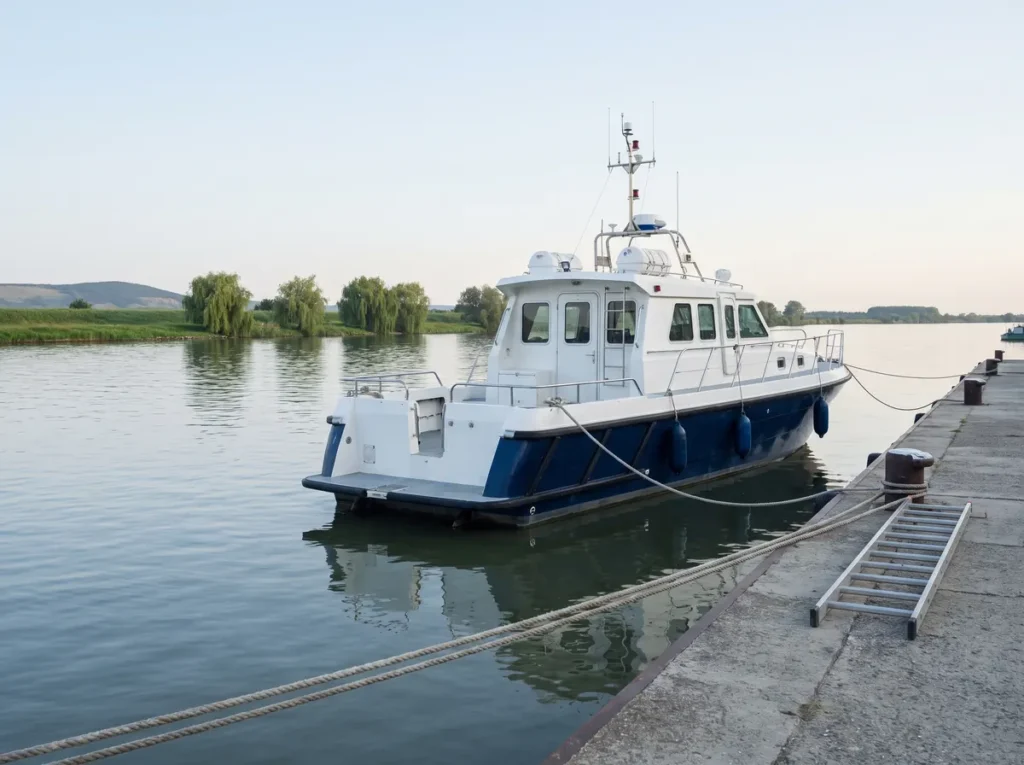
On Border Police vessels the ensign may not be lowered for as long as the mission lasts, and if it is destroyed the spare one is raised at once. This is one of the rules in the regulation that the Ministry of Internal Affairs has just rewritten. Order no. 112 of 20 July 2026 of the deputy prime minister, minister of internal affairs, published in Official Gazette of Romania no. 689 of 20 August 2026, approves the Regulation on shipboard service on vessels belonging to the Ministry of Internal Affairs. It is the second full rewriting of a large internal regulation published in this edition, after the one by which the National Commission for Property Compensation received new rules of operation.
The order has four articles, while the regulation itself is published separately, in Official Gazette of Romania no. 689 bis, over 60 pages. The legal basis is given by Article 3 of Government Ordinance no. 42/1997 on maritime transport and transport on inland waterways, Article 3 of Government Ordinance no. 22/1999 on the administration of ports and Article 7 paragraph (5) of Government Emergency Ordinance no. 30/2007 on the organisation of the Ministry of Internal Affairs.
Under Article 1, the regulation covers six matters: the duties of the members of the crew, the organisation of the services on board the vessel, the organisation and conduct of the specific activities at berth and under way, the rules of internal order, the health and hygiene measures and the ceremonies on board the vessel.
What it changes in practice
The first effect is the basic condition for going out on the water. The vessels held by the structures of the ministry may be used to carry out shipboard service only if they are in operational condition, a state defined cumulatively: the equipment and the installations that ensure the missions, the propulsion, the manoeuvring, the electrical power, the navigation and the communications must work in accordance with the technical regulations in force.
The second effect concerns the legal regime of navigation. While at berth and under way, the vessels observe national and international legislation in the matter of the law of the sea. In international waters, international maritime legislation applies; in the national waters of other states, the rules of those states apply; and navigation through shared border sectors is carried out in accordance with the agreements concluded by Romania with the neighbouring states.
The third effect is the rule on access, which holds for anyone who comes on board. Entries and exits are permitted only by way of the gangway or ladder of the vessel and are recorded in the ship’s log, while approval is given by the master of the vessel, on the basis of the instruction received from the head of the structure of the ministry that holds the vessel. Personnel from the higher echelons come on board on the basis of a service order, a control assignment order or a service assignment order.
The fourth effect has to do with ceremonial, and here the rules are unexpectedly precise. All vessels fly the ensign on the ensign staff or at the gaff, while those without masts and rigging carry it printed on both of the ship’s sides, in the area of the stern. Lowering the ensign during the mission is forbidden, both to the master of the vessel and to any other person embarked. If the ensign has been destroyed during the mission, the spare one is raised at once, and if the means of support has broken, the ensign is flown at the yard or in another visible place. Once the vessel enters repairs, shipyards or naval bases, the ensign is no longer raised.
The fifth effect is the salute, compulsory for personnel. In the interval between the raising and the lowering of the ensign, whoever comes on board or leaves the vessel salutes the ensign of the vessel, at the upper end of the gangway or on the upper platform of the ladder, by turning towards the ensign.
The sixth effect concerns small boats. The regulation states that, on these, the master of the vessel is called boat operator, which brings the internal terminology into line with navigation practice.
What has changed compared with the previous situation
The previous regulation dated from 2009 and had been approved by Order no. 307/2009 of the deputy prime minister, minister of administration and interior, acting, published in Official Gazette of Romania no. 20 of 12 January 2010. Article 3 paragraph (1) of the new order repeals it expressly, starting from the date of entry into force.
This is not a targeted amendment but a complete replacement, after sixteen years. Over that interval both the equipment held by the structures of the ministry and the European framework for the surveillance of the maritime and river border have changed, and the new regulation refers explicitly to the law of the sea and to the agreements on shared border sectors.
The second change is procedural and carries a deadline. Under Article 3 paragraph (2), within 30 days of entry into force, instructions of the minister of internal affairs are to be issued on the certification of the seagoing personnel who hold or are to hold the specialist posts on board the vessels. The deadline expires on 19 September 2026.
Until those instructions are issued, Article 3 paragraph (3) lays down a transitional solution: the previous rules on the certification of seagoing personnel apply accordingly, so no regulatory gap appears between the old regime and the new one.
Advantages and disadvantages
What it improves
- It replaces a regulation sixteen years old with one adapted to the equipment held today and to the international framework of navigation.
- It defines precisely what a vessel in operational condition means, with cumulative conditions, which limits subjective assessment before setting out on a mission.
- It lays down an explicit transitional solution for the certification of personnel, so no vacuum remains until the new instructions are issued.
- Recording every entry and exit in the ship’s log creates a verifiable trace of access on board.
- It refers expressly to the agreements on shared border sectors, which matters for navigation on the Danube and on the Prut.
What remains a problem
- The text that actually applies has 60 pages published in a bis edition, harder to obtain than the ordinary edition.
- The instructions on the certification of seagoing personnel have not been issued yet, so the part that matters most for the careers of the crews remains pending.
- The regulation covers internal organisation alone, with no provisions to clarify the relationship with the persons checked on the water.
- The rules of ceremonial take up a whole chapter, while the operational matters are spread over several chapters, which makes the text hard for a non-specialist to work through.
Practical advice
- If you are a member of a crew of the ministry, look for the full text in edition no. 689 bis, not in no. 689. The order has four articles; the regulation of 60 pages is in the bis edition.
- Check where you stand on certification. Until the new instructions are issued, the previous rules apply accordingly, so the documents you already hold do not lose their validity automatically.
- Keep an eye on the 30 day deadline in Article 3 paragraph (2). The instructions of the minister on the certification of seagoing personnel should be issued by 19 September 2026.
- If you come on board a vessel of the ministry as someone from outside the crew, have ready the document that justifies your presence. Access is approved by the master of the vessel, on the basis of a service order, a control assignment order or a service assignment order.
- Bear in mind that every entry and exit is recorded in the ship’s log. That is the document people will turn to if questions arise about who was on board and when.
- For navigation on shared border sectors, check the bilateral agreement that applies. The regulation refers to the conventions concluded by Romania with the neighbouring states, it does not itself lay down the rules there.
Frequently asked questions
Which vessels are covered?
What does a vessel in operational condition mean?
May the ensign be lowered during a mission?
Who may come on board a vessel of the ministry?
What happens to the old regulation?
When do the rules on the certification of seagoing personnel appear?
Original text of the legal act
The text below is reproduced in Romanian, the official form of publication.
The full text, as published in the Official Gazette of Romania
Official Gazette of Romania no. 689 of 20 August 2026 16 pages PDF, 108 KB the act starts on page 14
Open the official PDFDownload the PDF
The other editions cited: nr. 689 bis/2026
The viewer is not shown on small screens. Use the buttons above to open or download the file.
This article is for informational purposes only and does not constitute legal advice. For specific situations, consult a licensed attorney or tax advisor.