
In brief
- The “e-DRIVE” state aid scheme, which until now only funded electric cars for passenger transport, is being extended to cover fleet replacement for any micro-enterprise or SME.
- The total budget is EUR 56.9 million from the Modernisation Fund: EUR 15 million for SMEs (de minimis aid, measure 1) and EUR 41.9 million for road passenger transport operators (state aid through a bidding process, measure 2).
- Funding can cover up to 100% of eligible costs, but the old car must be scrapped within 60 days of receiving the new one, and the new vehicle must be a battery electric vehicle with zero emissions.
Published: Official Gazette of Romania (Monitorul Oficial) no. 655 of 7 August 2026
Enters into force: 7 August 2026
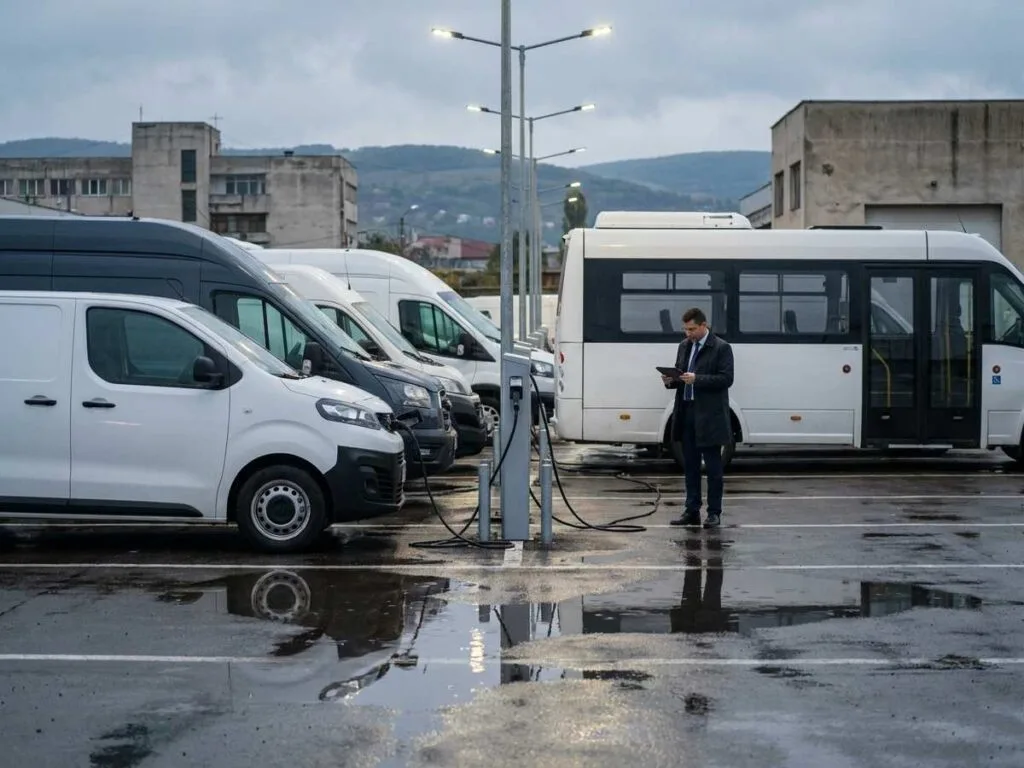
The Ministry of Transport and Infrastructure has considerably widened the “e-DRIVE” state aid scheme. Through Order no. 742 of 3 August 2026, the ministry substantially amends Order no. 2,291/2025, which originally approved financial support only for the purchase of electric cars intended for road passenger transport. Under the same name, the scheme now also covers fleet replacement for any small or medium-sized enterprise, regardless of its field of activity.
In practice, the title of the original order, the article approving the scheme, and the entire technical annex have all been replaced. The result is a scheme with two distinct components, with different rules, ceilings and beneficiaries, but the same objective: reducing road transport emissions by replacing polluting cars with electric ones. In the same week, the ministry also relaunched the “e-Mobility RO” scheme for electric charging stations on motorways, designed to support precisely the electric cars that e-DRIVE finances.
What it changes in practice
Measure 1 is de minimis aid, open to any micro-enterprise, small or medium-sized enterprise registered with Romania’s Trade Registry, regardless of its CAEN code. It can be used to replace cars in categories M1 (passenger cars) and M2 (minibuses) that have been owned by the company for at least one year. The allocated budget, EUR 15 million, is distributed on a scoring basis: micro-enterprises receive the most points, followed by small and then medium-sized enterprises.
Measure 2 is genuine state aid, intended exclusively for road passenger transport operators with CAEN codes 4931 (scheduled transport), 4932 (occasional transport) and 4933 (transport with driver, on demand). They can obtain funding to replace M1, M2 and M3 vehicles, but the money is not granted on request; it goes through a competitive bidding procedure, in which the applicants who request the smallest aid amount per electric vehicle win. The road infrastructure these vehicles will use is itself receiving European funding: the A1 motorway’s Sibiu-Pitești section is receiving an additional EUR 500 million loan from the European Investment Bank.
An electric vehicle does not leave only clean air behind it. Its brakes throw off dust like those of any other car, and Euro 7 gives that dust a limit of its own, 3 milligrams per kilometre against 7 for internal combustion engines, while the test method behind the limit changed on 23 September 2026.
What has changed compared with the previous situation
- Much broader scope: the scheme no longer targets passenger transport exclusively, but also fleet replacement for any small or medium-sized company, regardless of its activity.
- Two distinct measures instead of one: measure 1 (de minimis, for SMEs) and measure 2 (state aid, through bidding, for passenger transport operators) have separate rules, ceilings and procedures.
- The title of the act has changed: from “Order approving the State Aid Scheme supporting investments intended for the purchase of zero-emission vehicles for road passenger transport «e-DRIVE»” to “Order approving the State Aid and De Minimis Scheme supporting investments intended for replacing companies’ fleets, as well as for replacing vehicles for road passenger transport «e-DRIVE»”.
- The technical annex has been completely replaced with a new one, detailing both measures, the eligibility conditions, the ceilings, and the scoring formula.
Advantages and disadvantages
What it improves
- Much broader access to funding: now any SME, not just passenger carriers, can apply for money to electrify its car fleet.
- High aid intensity, up to 100% of eligible costs, which greatly reduces the beneficiary’s own financial effort.
- Passenger transport operators can receive substantial amounts, up to EUR 4 million per beneficiary, under measure 2.
What remains a problem
- The budget is limited at national level (EUR 56.9 million, for an estimated 500 beneficiaries), so demand will likely exceed supply.
- Measure 2 is granted through bidding, not simply on request: whoever offers the smallest aid amount per vehicle wins, which can favour large companies with greater financial negotiating power.
- If the EU regulation underpinning measure 2 (EU Regulation no. 651/2014) is not renewed by the European Commission, no new contracts can be signed under this measure after 31 December 2026.
Practical advice
- For SMEs (measure 1): prepare proof that the car you want to replace has been owned by the company for at least one year (valid registration certificate, motor insurance, roadworthiness certificate) and check the de minimis ceiling, EUR 300,000 over any 3-year period, calculated at the level of the “single undertaking,” meaning including affiliated companies.
- For passenger transport operators (measure 2): if you hold CAEN codes 4931, 4932 or 4933, prepare at least two price quotes in advance, both for the electric option and for its combustion-engine equivalent, since the difference between them is the basis for calculating the aid.
- For all applicants: do not sign the order for the new car before submitting your application to the ministry. The “incentive effect” is mandatory, and starting the purchase before submitting the application disqualifies the entire project.
- Remember the scrapping deadline: you have only 60 days from receiving the new vehicle to prove that the old one was scrapped, or you risk having the aid recovered, with interest.
Frequently asked questions
Who can apply for funding under the e-DRIVE scheme, after the amendment?
What is the difference between measure 1 and measure 2?
How much can a company receive?
What type of cars are eligible?
What happens to the old car?
Until when is the scheme valid?
This article is for informational purposes only and does not constitute legal or financial advice. To submit a funding application, consult the Applicant’s Guide published by the Ministry of Transport and Infrastructure at www.mt.ro.
Original text of the legal act
The text below is reproduced in Romanian, the official published form.
The full text, as published in the Official Gazette of Romania
Official Gazette of Romania no. 655 of 7 August 2026 16 pages PDF, 121 KB the act starts on page 4
Open the official PDFDownload the PDF
The viewer is not shown on small screens. Use the buttons above to open or download the file.
This article is for informational purposes only and does not constitute legal advice. For specific situations, consult a licensed attorney or tax advisor.